


Mechanisms of statin-induced myalgia assessed by physiogenomic associations
- PMID: 21868014
- PMCID: PMC3224998
- DOI: 10.1016/j.atherosclerosis.2011.07.007
Mechanisms of statin-induced myalgia assessed by physiogenomic associations
Abstract
Objective: We investigated genetic variants predictive of muscular side effects in patients treated with statins. We utilized a physiogenomic approach to prototype a multi-gene panel correlated with statin-induced myalgia.
Background: Statin-induced myalgia occurs in ∼10% of lipid clinic outpatients. Its clinical manifestation may depend in part upon gene variation from patient to patient.
Methods: We genotyped 793 patients (377 with myalgia and 416 without) undergoing statin therapy at four U.S. outpatient clinic sites to evaluate 31 candidate genes from the literature for their association with statin-induced common myalgia.
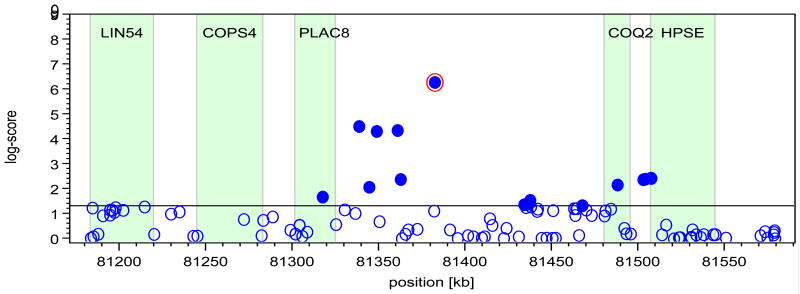
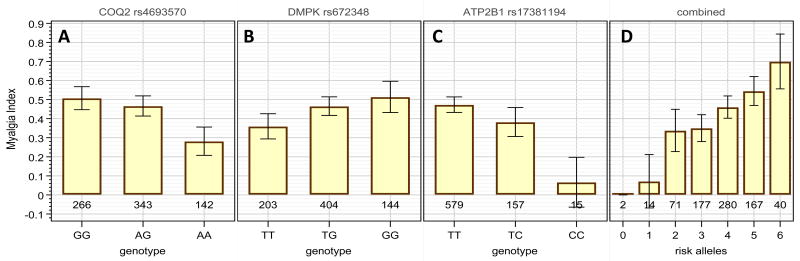
Results: Three previously hypothesized candidate genes were validated: COQ2 (rs4693570) encoding para-hydroxybenzoate-polyprenyltransferase, which participates in the biosynthesis of coenzyme Q10 (p<0.000041); ATP2B1 (rs17381194) which encodes a calcium transporting ATPase involved in calcium homeostasis (p<0.00079); and DMPK (rs672348) which encodes a protein kinase implicated in myotonic dystrophy (p<0.0016).
Conclusions: The candidate genes COQ2, ATP2B1, and DMPK, representing pathways involved in myocellular energy transfer, calcium homeostasis, and myotonic dystonia, respectively, were validated as markers for the common myalgia observed in patients receiving statin therapy. The three genes integrated into a physiogenomic predictive system could be relevant to myalgia diagnosis and prognosis in clinical practice.
Trial registration: ClinicalTrials.gov NCT00767130.
Copyright © 2011 Elsevier Ireland Ltd. All rights reserved.
Conflict of interest statement
Figures
References
-
- Findlay S. The statin drugs. Prescription and price trends October 2005 to December 2006 and potential cost savings to Medicare from increased use of lower cost statins. Consumer Reports. 2007
-
- Statins: The World Market, 2009-2024. London, UK: Visiongain, Ltd.; 3-3-2009.
-
- Waters DD. What the statin trials have taught us. Am J Cardiol. 2006;98:129–34. - PubMed
-
- Thompson PD, Clarkson P, Karas RH. Statin-associated myopathy. JAMA. 2003;289:1681–90. - PubMed
-
- Bruckert E, Hayem G, Dejager S, Yau C, Begaud B. Mild to moderate muscular symptoms with high-dosage statin therapy in hyperlipidemic patients--the PRIMO study. Cardiovasc Drugs Ther. 2005;19:403–14. - PubMed
Publication types
MeSH terms
Substances
Associated data
Grants and funding
LinkOut - more resources
Full Text Sources
Medical
