


Gain and loss of function for glutathione synthesis: impact on advanced atherosclerosis in apolipoprotein E-deficient mice
- PMID: 21868708
- PMCID: PMC3415243
- DOI: 10.1161/ATVBAHA.111.229765
Gain and loss of function for glutathione synthesis: impact on advanced atherosclerosis in apolipoprotein E-deficient mice
Abstract
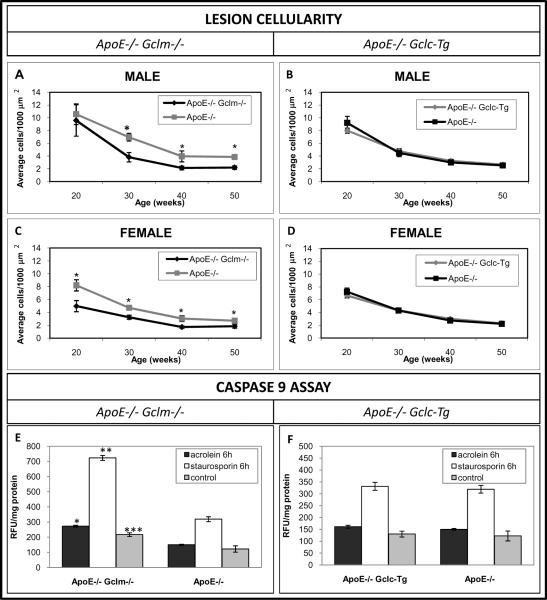
Objective: Glutamate-cysteine ligase (GCL) is the rate-limiting step in glutathione synthesis. The enzyme is a heterodimer composed of a catalytic subunit, GCLC, and a modifier subunit, GCLM. We generated apolipoprotein E (apoE)-/- mice deficient in GCLM (apoE-/-/Gclm-/-) and transgenic mice that overexpress GCLC specifically in macrophages (apoE-/-/Gclc-Tg) to test the hypothesis that significantly altering the availability of glutathione has a measurable impact on both the initiation and progression of atherosclerosis.
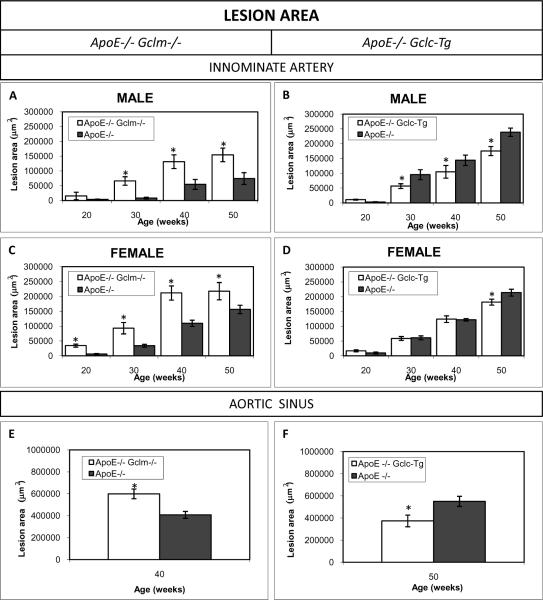
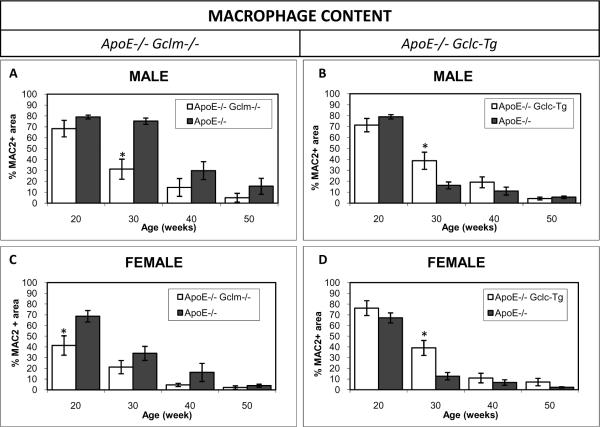
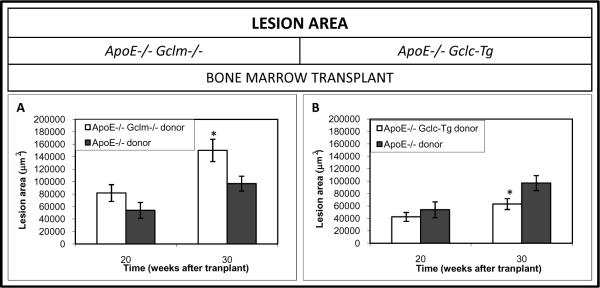
Methods and results: Atherosclerotic plaque size and composition were measured in the innominate artery in chow-fed male and female mice at 20, 30, 40, and 50 weeks of age and in the aortic sinus at 40 and 50 weeks of age. The apoE-/-/Gclm-/- mice more rapidly developed complex lesions, whereas the apoE-/-/Gclc-Tg mice had reduced lesion development compared with the littermate apoE-/- control mice. Transplantation of bone marrow from the apoE-/-/Gclm-/- and apoE-/-/Gclc-Tg mice into apoE-/- mice with established lesions also stimulated or inhibited further lesion development at 30 weeks posttransplant.
Conclusion: Gain and loss of function in the capacity to synthesize glutathione especially in macrophages has reciprocal effects on the initiation and progression of atherosclerosis at multiple sites in apoE-/- mice.
Figures
References
-
- Dalton TP, Chen Y, Schneider SN, Nebert DW, Shertzer HG. Genetically altered mice to evaluate glutathione homeostasis in health and disease. Free Radic Biol Medq. 2004;37:1511–1526. - PubMed
-
- Meister A, Anderson ME. Glutathione. Annu Rev Biochem. 1983;52:711–760. - PubMed
-
- Sierra-Rivera E, Dasouki M, Summar ML, Krishnamani MR, Meredith M, Rao PN, Phillips JA, 3rd, Freeman ML. Assignment of the human gene (glclr) that encodes the regulatory subunit of gamma-glutamylcysteine synthetase to chromosome 1p21. Cytogenet Cell Genet. 1996;72:252–254. - PubMed
-
- Sierra-Rivera E, Summar ML, Dasouki M, Krishnamani MR, Phillips JA, Freeman ML. Assignment of the gene (glclc) that encodes the heavy subunit of gamma-glutamylcysteine synthetase to human chromosome 6. Cytogenet Cell Genet. 1995;70:278–279. - PubMed
-
- Tsuchiya K, Mulcahy RT, Reid LL, Disteche CM, Kavanagh TJ. Mapping of the glutamate-cysteine ligase catalytic subunit gene (glclc) to human chromosome 6p12 and mouse chromosome 9d-e and of the regulatory subunit gene (glclr) to human chromosome 1p21–p22 and mouse chromosome 3h1-3. Genomics. 1995;30:630–632. - PubMed
Publication types
MeSH terms
Substances
Grants and funding
LinkOut - more resources
Full Text Sources
Medical
Molecular Biology Databases
Research Materials
Miscellaneous
