doi: 10.1007/978-1-61779-270-0_12.
PARP1 genomics: chromatin immunoprecipitation approach using anti-PARP1 antibody (ChIP and ChIP-seq)
Affiliations
- PMID: 21870262
- PMCID: PMC3164790
- DOI: 10.1007/978-1-61779-270-0_12
Item in Clipboard
PARP1 genomics: chromatin immunoprecipitation approach using anti-PARP1 antibody (ChIP and ChIP-seq)
Methods Mol Biol.
2011.
Abstract
Poly(ADP-ribose) polymerase1 (PARP1) is a global regulator of different cellular mechanisms, ranging from DNA damage repair to control of gene expression. Since PARP1 protein and pADPr have been shown to persist in chromatin through cell cycle, they may both act as epigenetic markers. However, it is not known how many loci are occupied by PARP1 protein during mitosis genome-wide. To reveal the genome-wide PARP1 binding sites, we used the ChIP-seq approach, an emerging technique to study genome-wide PARP1 protein interaction with chromatin. Here, we describe how to perform ChIP-seq in the context of PARP1 binding sites identification in chromatin, using human embryonic kidney cell lines.
Figures
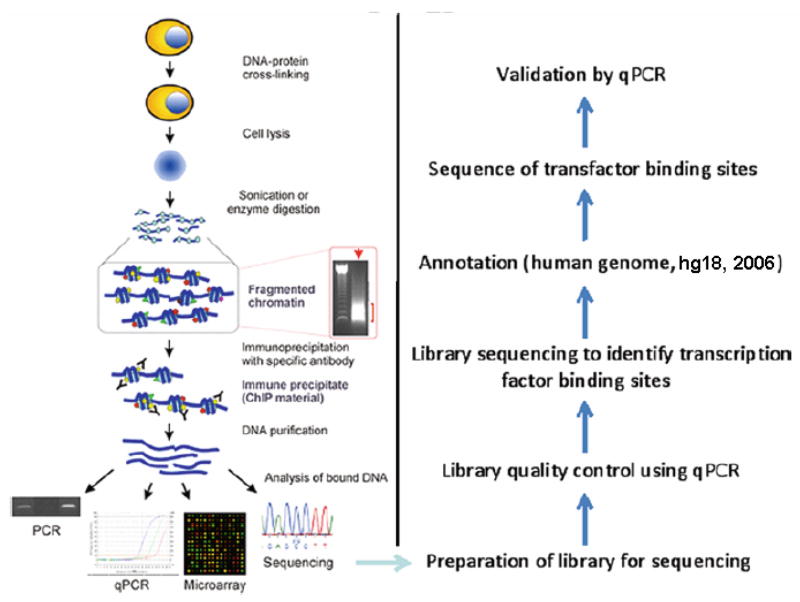
ChIP-seq flow chart. All the steps are same as ChIP up to DNA precipitation; afterward, ChIP-seq steps are followed, adapted from Collas and Dahl (Frontiers in Bioscience) (2008).
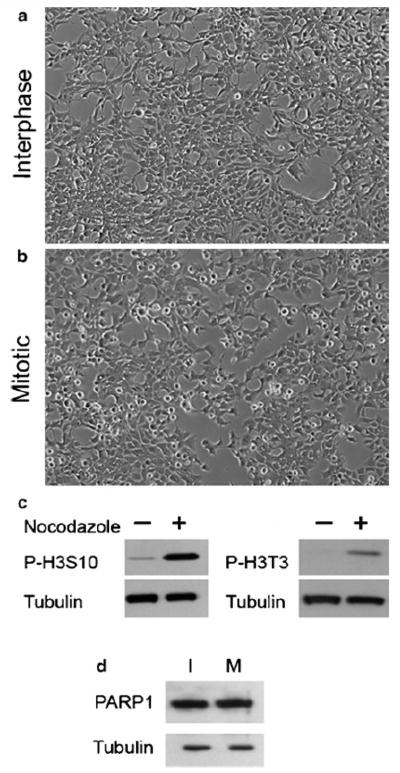
Human embryonic kidney 293 cells (HEK293) untreated (interphase) (a) and synchronized cells in prometaphase treated with nocodazole (b). (c) Histone H3 phosphorylation on serine 10 (H3S10) and on threonine 3 (H3T3) increased in nocodazole-treated HEK293 cells, (d) Specificity of PARP1 antibody checked by Western blot before ChIP. In this figure, PARP1 (113.0 kDa) specificity is shown in interphase (I) and synchronized HEK293 cells (M) with tubulin as a loading control (55 kDa).
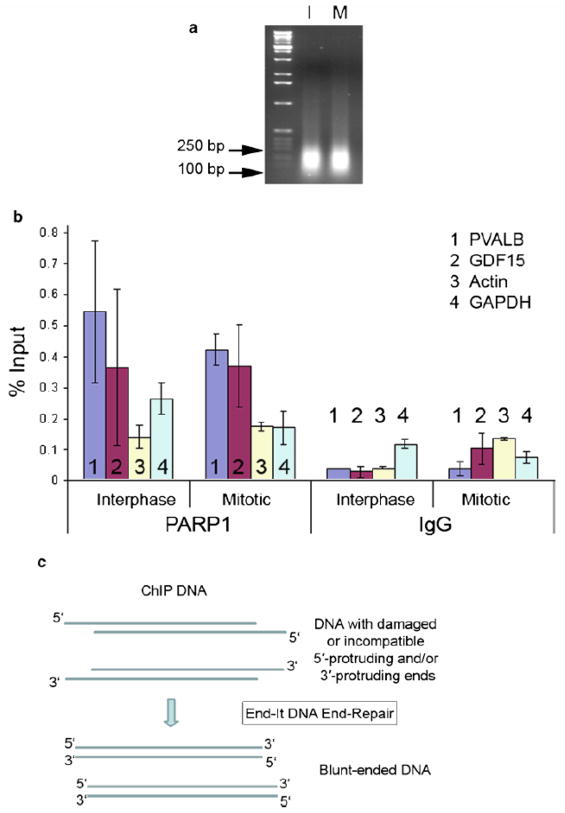
(a) Sonicated fragments of chromatin are in the range of 150–250 bp for ChIP-seq in interphase (I) and synchronized cells (M). (b) qPCR with PVALB, GDF15, actin, and GAPDH to check the quality of ChIP-DNA. (c) DNA with damaged or incompatible 5′-protruding and/or 3′-protruding ends repaired by End-It DNA End-Repair Reaction kit.
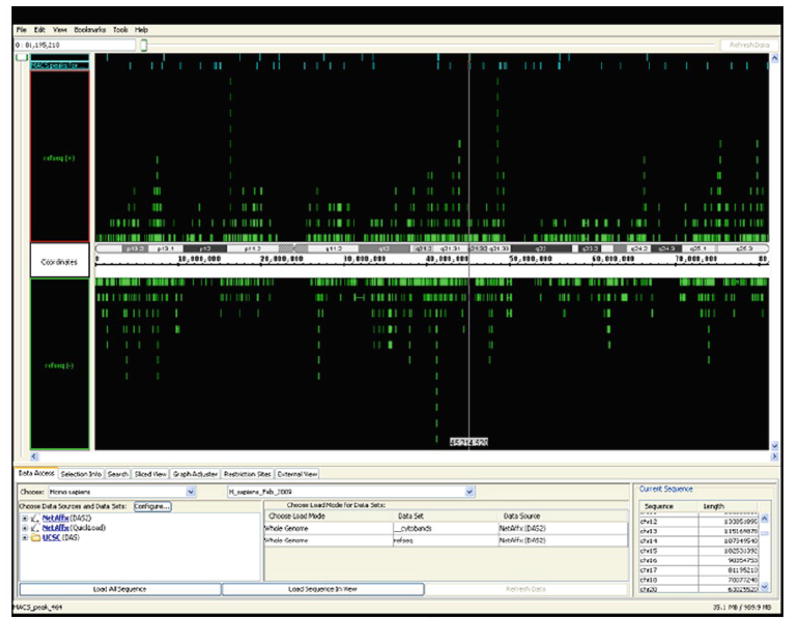
Affymetrix-Integrated Genome Browser. Transcription factor (PARP1) binding sites are located on chromosome of reference genome.
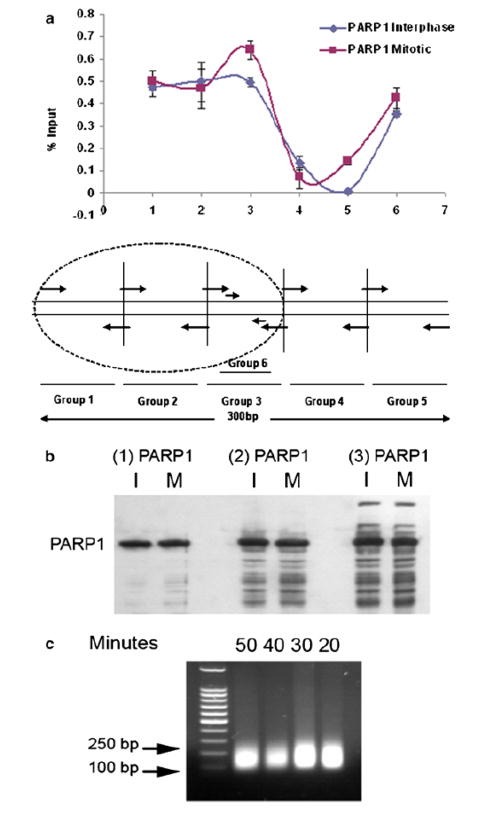
(a) Occupancy of PARP1 on lysine (K)-specific demethylase 2A (KDM2A) locus (300 bp). (b) Western blot showing the specificity of three different PARP1 antibodies. (c) Sonicated chromatin was checked on agarose gel after different time intervals of sonication.
References
-
- Nosseri C, Coppola S, Ghibelli L. Possible involvement of poly(ADP-ribosyl) polymerase in triggering stress-induced apoptosis. Exp Cell Res. 1994;212:367–373. - PubMed
-
- Dantzer F, Amé JC, Schreiber V, Nakamura J, Ménissier-de Murcia J, de Murcia G. Poly(ADP-ribose) polymerase-1 activation during DNA damage and repair. Methods Enzymol. 2006;409:493–510. - PubMed
-
- de Murcia JM, Niedergang C, Trucco C, Ricoul M, Dutrillaux B, Mark M, Oliver FJ, Masson M, Dierich A, LeMeur M, Walztinger C, Chambon P, de Murcia G. Requirement of poly(ADP-ribose) polymerase in recovery from DNA damage in mice and in cells. Proc Natl Acad Sci U S A. 1997;94:7303–7307. - PMC - PubMed
-
- Tulin A, Spradling A. Chromatin loosening by poly(ADP)-ribose polymerase (PARP) at Drosophila puff loci. Science. 2003;299:560–562. - PubMed
Publication types
MeSH terms
Substances
Grants and funding
LinkOut - more resources
Full Text Sources
Miscellaneous