


Links between co-occurring social-communication and hyperactive-inattentive trait trajectories
- PMID: 21871371
- PMCID: PMC3163265
- DOI: 10.1016/j.jaac.2011.05.015
Links between co-occurring social-communication and hyperactive-inattentive trait trajectories
Abstract
Objective: There is overlap between an autistic and hyperactive-inattentive symptomatology when studied cross-sectionally. This study is the first to examine the longitudinal pattern of association between social-communication deficits and hyperactive-inattentive symptoms in the general population, from childhood through adolescence. We explored the interrelationship between trajectories of co-occurring symptoms, and sought evidence for shared prenatal/perinatal risk factors.
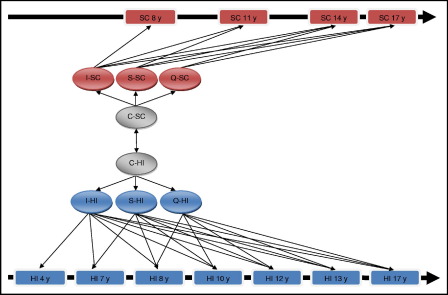
Method: Study participants were 5,383 singletons of white ethnicity from the Avon Longitudinal Study of Parents and Children (ALSPAC). Multiple measurements of hyperactive-inattentive traits (Strengths and Difficulties Questionnaire) and autistic social-communication impairment (Social Communication Disorder Checklist) were obtained between 4 and 17 years. Both traits and their trajectories were modeled in parallel using latent class growth analysis (LCGA). Trajectory membership was subsequently investigated with respect to prenatal/perinatal risk factors.
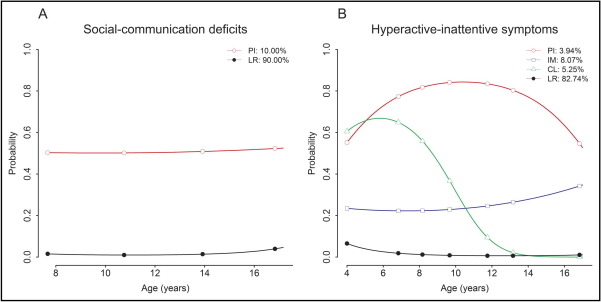
Results: LCGA analysis revealed two distinct social-communication trajectories (persistently impaired versus low-risk) and four hyperactive-inattentive trait trajectories (persistently impaired, intermediate, childhood-limited and low-risk). Autistic symptoms were more stable than those of attention-deficit/hyperactivity disorder (ADHD) behaviors, which showed greater variability. Trajectories for both traits were strongly but not reciprocally interlinked, such that the majority of children with a persistent hyperactive-inattentive symptomatology also showed persistent social-communication deficits but not vice versa. Shared predictors, especially for trajectories of persistent impairment, were maternal smoking during the first trimester, which included familial effects, and a teenage pregnancy.
Conclusions: Our longitudinal study reveals that a complex relationship exists between social-communication and hyperactive-inattentive traits. Patterns of association change over time, with corresponding implications for removing exclusivity criteria for ASD and ADHD, as proposed for DSM-5.
Copyright © 2011 American Academy of Child and Adolescent Psychiatry. Published by Elsevier Inc. All rights reserved.
Figures
Comment in
-
Links between autism spectrum disorder and ADHD symptom trajectories: important findings and unanswered questions.J Am Acad Child Adolesc Psychiatry. 2011 Sep;50(9):857-9. doi: 10.1016/j.jaac.2011.06.012. J Am Acad Child Adolesc Psychiatry. 2011. PMID: 21871367 No abstract available.
References
-
- Ronald A., Simonoff E., Kuntsi J., Asherson P., Plomin R. Evidence for overlapping genetic influences on autistic and ADHD behaviors in a community twin sample. J Child Psychol Psychiatry. 2008;49:535–542. - PubMed
-
- Constantino J.N., Todd R.D. Intergenerational transmission of subthreshold autistic traits in the general population. Biol Psychiatry. 2005;57:655–660. - PubMed
-
- Levy F., Hay D.A., McStephen M., Wood C., Waldman I. Attention-deficit hyperactivity disorder: a category or a continuum?: Genetic analysis of a large-scale twin study. J Am Acad Child Adolesc Psychiatry. 1997;36:737–744. - PubMed
Publication types
MeSH terms
Grants and funding
LinkOut - more resources
Full Text Sources
Medical
