


Abnormal tau, mitochondrial dysfunction, impaired axonal transport of mitochondria, and synaptic deprivation in Alzheimer's disease
- PMID: 21872849
- PMCID: PMC3176990
- DOI: 10.1016/j.brainres.2011.07.052
Abnormal tau, mitochondrial dysfunction, impaired axonal transport of mitochondria, and synaptic deprivation in Alzheimer's disease
Abstract
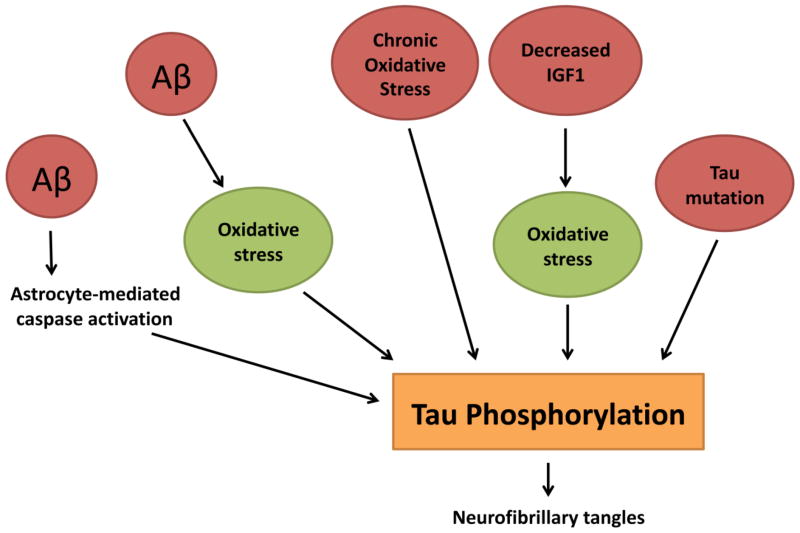
Growing evidence suggests that amyloid beta (Aβ) and tau pathologies are strongly associated with mitochondrial dysfunction and neuronal damage in Alzheimer's disease (AD). Extensive research of AD postmortem brains, mouse and fly models, including triple transgenic AD mice and mutant tau mice, and cell culture studies revealed that tau hyperphosphorylation is caused by multiple factors, including intraneuronal Aβ-oligomers, chronic oxidative stress, reduced insulin-like growth factor 1, and astrocytic mediated-Aβ and caspase activation. Overexpressed and phosphorylated tau appears to impair axonal transport of organelles causing synapse starvation, depletion of ATP, and ultimately neuronal damage. This article evaluates the role of tau in mitochondrial dysfunction and assesses how hyperphosphorylated tau impairs axonal transport of organelles in AD neurons.
Copyright © 2011 Elsevier B.V. All rights reserved.
Figures



References
-
- Alzheimer Association Report. Alzheimer’s Disease Facts and Figures. 2011.
-
- Amadoro G, Corsetti V, Ciotti MT, Florenzano F, Capsoni S, Amato G, Calissano P. Endogenous Aβ causes cell death via early tau hyperphosphorylation. Neurobiol Aging. 2011;32(6):969–990. - PubMed
-
- Atlante A, Amadoro G, Bobba A, de Bari L, Corsetti V, Pappalardo G, Marra E, Calissano P, Passarella S. A peptide containing residues 26–44 of tau protein impairs mitochondrial oxidative phosphorylation acting at the level of the adenine nucleotide translocator. Biochim Biophys Acta. 2008;17771(10):1289–1300. - PubMed
-
- Avila J, Lucas JJ, Perez M, Hernandez F. Role of tau protein in both physiological and pathological conditions. Physiol Rev. 2004;84(2):361–384. - PubMed
-
- Barsoum MJ, Yuan H, Gerencser AA, Liot G, Kushnareva Y, Gräber S, Kovacs I, Lee WD, Waggoner J, Cui J, White AD, Bossy B, Martinou JC, Youle RJ, Lipton SA, Ellisman MH, Perkins GA, Bossy-Wetzel E. Nitric oxide-induced mitochondrial fission is regulated by dynamin-related GTPases in neurons. EMBO J. 2006;25(16):3900–3911. - PMC - PubMed
Publication types
MeSH terms
Substances
Grants and funding
LinkOut - more resources
Full Text Sources
Other Literature Sources
Medical
