


Age-related changes in the plasticity and toughness of human cortical bone at multiple length scales
- PMID: 21873221
- PMCID: PMC3167515
- DOI: 10.1073/pnas.1107966108
Age-related changes in the plasticity and toughness of human cortical bone at multiple length scales
Erratum in
- Proc Natl Acad Sci U S A. 2012 Jul 17;109(29):11890
Abstract
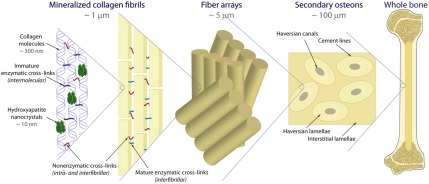
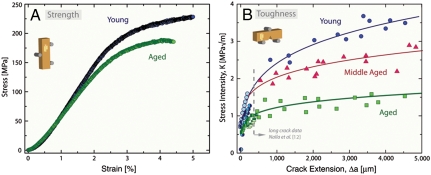
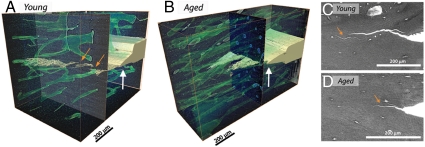
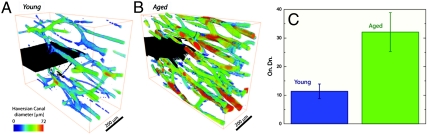
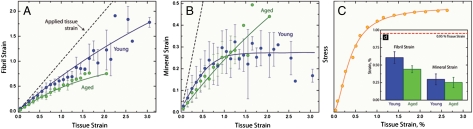
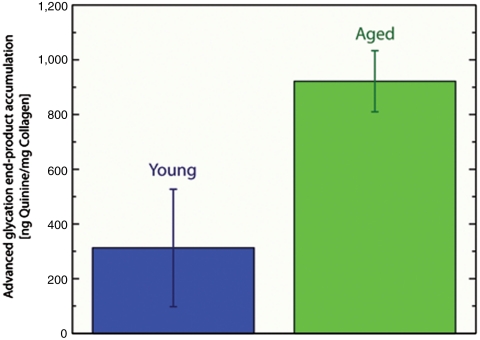
The structure of human cortical bone evolves over multiple length scales from its basic constituents of collagen and hydroxyapatite at the nanoscale to osteonal structures at near-millimeter dimensions, which all provide the basis for its mechanical properties. To resist fracture, bone's toughness is derived intrinsically through plasticity (e.g., fibrillar sliding) at structural scales typically below a micrometer and extrinsically (i.e., during crack growth) through mechanisms (e.g., crack deflection/bridging) generated at larger structural scales. Biological factors such as aging lead to a markedly increased fracture risk, which is often associated with an age-related loss in bone mass (bone quantity). However, we find that age-related structural changes can significantly degrade the fracture resistance (bone quality) over multiple length scales. Using in situ small-angle X-ray scattering and wide-angle X-ray diffraction to characterize submicrometer structural changes and synchrotron X-ray computed tomography and in situ fracture-toughness measurements in the scanning electron microscope to characterize effects at micrometer scales, we show how these age-related structural changes at differing size scales degrade both the intrinsic and extrinsic toughness of bone. Specifically, we attribute the loss in toughness to increased nonenzymatic collagen cross-linking, which suppresses plasticity at nanoscale dimensions, and to an increased osteonal density, which limits the potency of crack-bridging mechanisms at micrometer scales. The link between these processes is that the increased stiffness of the cross-linked collagen requires energy to be absorbed by "plastic" deformation at higher structural levels, which occurs by the process of microcracking.
Conflict of interest statement
The authors declare no conflict of interest.
Figures
References
-
- Buehler MJ. Molecular nanomechanics of nascent bone: Fibrillar toughening by mineralization. Nanotechnology. 2007;18:295102.
-
- Fantner GE, et al. Sacrificial bonds and hidden length dissipate energy as mineralized fibrils separate during bone fracture. Nat Mater. 2005;4:612–616. - PubMed
-
- Nalla RK, Kruzic JJ, Ritchie RO. On the origin of the toughness of mineralized tissue: Microcracking or crack bridging? Bone. 2004;34:790–798. - PubMed
Publication types
MeSH terms
Substances
Grants and funding
LinkOut - more resources
Full Text Sources
Other Literature Sources
Medical
