


Serotonin signaling is associated with lower amyloid-β levels and plaques in transgenic mice and humans
- PMID: 21873225
- PMCID: PMC3169155
- DOI: 10.1073/pnas.1107411108
Serotonin signaling is associated with lower amyloid-β levels and plaques in transgenic mice and humans
Abstract
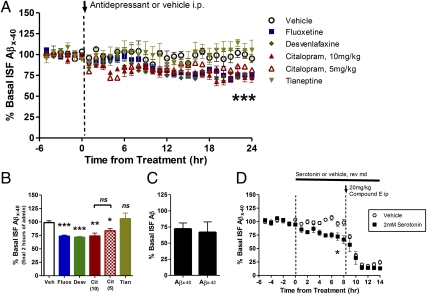
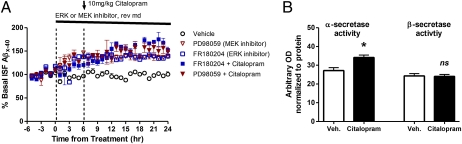
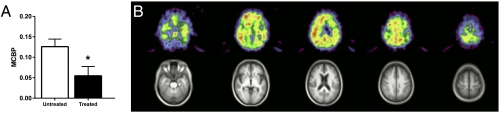
Aggregation of amyloid-β (Aβ) as toxic oligomers and amyloid plaques within the brain appears to be the pathogenic event that initiates Alzheimer's disease (AD) lesions. One therapeutic strategy has been to reduce Aβ levels to limit its accumulation. Activation of certain neurotransmitter receptors can regulate Aβ metabolism. We assessed the ability of serotonin signaling to alter brain Aβ levels and plaques in a mouse model of AD and in humans. In mice, brain interstitial fluid (ISF) Aβ levels were decreased by 25% following administration of several selective serotonin reuptake inhibitor (SSRI) antidepressant drugs. Similarly, direct infusion of serotonin into the hippocampus reduced ISF Aβ levels. Serotonin-dependent reductions in Aβ were reversed if mice were pretreated with inhibitors of the extracellular regulated kinase (ERK) signaling cascade. Chronic treatment with an SSRI, citalopram, caused a 50% reduction in brain plaque load in mice. To test whether serotonin signaling could impact Aβ plaques in humans, we retrospectively compared brain amyloid load in cognitively normal elderly participants who were exposed to antidepressant drugs within the past 5 y to participants who were not. Antidepressant-treated participants had significantly less amyloid load as quantified by positron emission tomography (PET) imaging with Pittsburgh Compound B (PIB). Cumulative time of antidepressant use within the 5-y period preceding the scan correlated with less plaque load. These data suggest that serotonin signaling was associated with less Aβ accumulation in cognitively normal individuals.
Conflict of interest statement
The authors declare no conflict of interest.
Figures

Comment in
-
Potential effects of the APOE epsilon2 allele and of family history of Alzheimer's disease on brain amyloid-β in normal elderly.Proc Natl Acad Sci U S A. 2011 Nov 8;108(45):E1007; author reply E1008. doi: 10.1073/pnas.1114219108. Epub 2011 Oct 31. Proc Natl Acad Sci U S A. 2011. PMID: 22042836 Free PMC article. No abstract available.
References
-
- St George-Hyslop PH, Morris JC. Will anti-amyloid therapies work for Alzheimer's disease? Lancet. 2008;372:180–182. - PubMed
-
- Morris JC, Price AL. Pathologic correlates of nondemented aging, mild cognitive impairment, and early-stage Alzheimer's disease. J Mol Neurosci. 2001;17:101–118. - PubMed
-
- Cirrito JR, et al. Synaptic activity regulates interstitial fluid amyloid-beta levels in vivo. Neuron. 2005;48:913–922. - PubMed
Publication types
MeSH terms
Substances
Grants and funding
LinkOut - more resources
Full Text Sources
Other Literature Sources
Medical
Molecular Biology Databases
Miscellaneous
