Review
. 2011 Dec;63(4):882-900.
doi: 10.1124/pr.110.004176. Epub 2011 Aug 26.

Regulation of G protein-coupled receptor function by Na+/H+ exchange regulatory factors

Affiliations
Review

Regulation of G protein-coupled receptor function by Na+/H+ exchange regulatory factors

Juan A Ardura et al. Pharmacol Rev. 2011 Dec.

Abstract

Many G protein-coupled receptors (GPCR) exert patterns of cell-specific signaling and function. Mounting evidence now supports the view that cytoplasmic adapter proteins contribute critically to this behavior. Adapter proteins recognize highly conserved motifs such as those for Src homology 3 (SH3), phosphotyrosine-binding (PTB), and postsynaptic density 95/discs-large/zona occludens (PDZ) docking sequences in candidate GPCRs. Here we review the behavior of the Na+/H+ exchange regulatory factor (NHERF) family of PDZ adapter proteins on GPCR signalling, trafficking, and function. Structural determinants of NHERF proteins that allow them to recognize targeted GPCRs are considered. NHERF1 and NHERF2 are capable also of modifying the assembled complex of accessory proteins such as β-arrestins, which have been implicated in regulating GPCR signaling. In addition, NHERF1 and NHERF2 modulate GPCR signaling by altering the G protein to which the receptor binds or affect other regulatory proteins that affect GTPase activity, protein kinase A, phospholipase C, or modify downstream signaling events. Small molecules targeting the site of NHERF1-GPCR interaction are being developed and may become important and selective drug candidates.


Figures
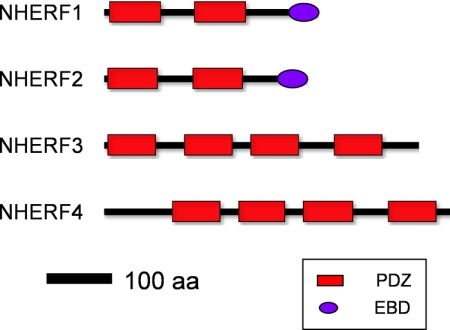
Fig. 1.
Fig. 1.
Schematic representation of human NHERF proteins discussed in this review. PDZ domains are indicated by the red rectangular boxes and EBDs by purple ellipses. The relative scale is shown on the bottom.
Fig. 2.
Fig. 2.
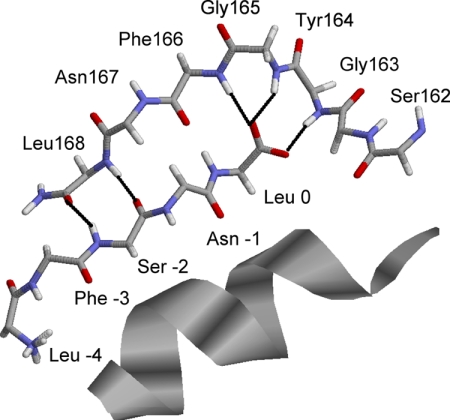
Position of the carboxyl-terminal PTHR (PTHR-CT ligand) in the binding groove of the PDZ2 domain (only the peptide backbone is shown). The α2-helix is displayed as a ribbon. The carboxylate binding loop (Gly-163, Tyr-164, Gly-165, and Phe-166) and β2 strand (Asn-167 and Leu-168) are shown as the polypeptide backbone chain (stick representation). The carbon atoms of the PTHR-CT ligand are yellow, the oxygen atoms are red, and the nitrogen atoms are blue. H-bond interactions are indicated by black dotted lines. The proximity of Ser-162 to this site is evident. Predicted electrostatic interactions between the Glu -3 side chain and Arg-180 (β3 strand) are depicted. (Graphic kindly prepared by Dr. T. Mamonova.)
Fig. 3.
Fig. 3.
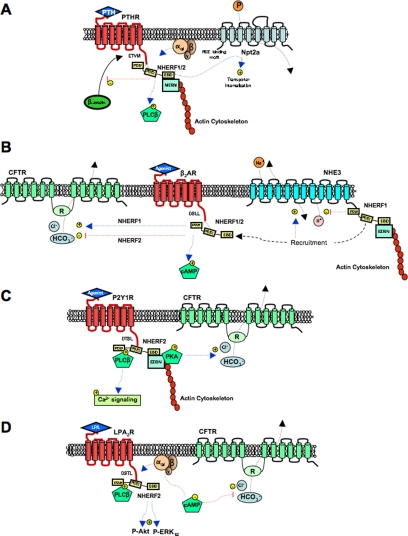
Models of NHERF effects on GPCR signaling. Activation (+) or inhibition (−) of signaling pathways is shown with blue or red lines, respectively. A, E-T-V-M-binding domain at the carboxyl terminus of the PTHR binds to PDZ1 of NHERF1 or PDZ2 of NHERF2. In turn, through the EBD, NHERF1 associates with merlin, ezrin, radixin, or moesin (MERM) with the actin cytoskeleton. NHERF1 interactions with the PTHR increase the binding for Gαq [NHERF1 and -2] or Gαi [NHERF2] proteins (Wang et al., 2010). Upon PTH stimulation, NHERF1 increases PLCβ activity, internalizes the Npt2a Na-Pi cotransporter, and decreases β-arrestin recruitment to the receptor. B, upon agonist stimulation, the D-S-S-L-binding domain at the carboxyl terminus of the β2-AR) binds to PDZ1 of NHERF1 or PDZ1 or PDZ2 of NHERF2 (Lau and Hall, 2001). Interactions of the β2AR with NHERFs increase cAMP accumulation and also increase (NHERF1) or decrease (NHERF2) CFTR of anion extrusion (Naren et al., 2002; Taouil et al., 2003; Singh et al., 2009). Inhibitory effects of NHERF1 on NHE3 transporter activity decrease after NHERF1 releases the transporter when recruited to β2-AR. C, the D-T-S-L-binding domain at the carboxyl terminus of the P2Y1R binds PDZ2 of NHERF2 (Hall et al., 1998a; Fam et al., 2005), tethering the receptor indirectly to PLCβ and increasing calcium (Ca2+) signaling (Fam et al., 2005). NHERF2 associates with ezrin through the EBD and in turn ezrin bind PKA, which increases CFTR Cl efflux (Guerra et al., 2004). D, the DSTL-binding sequence at the carboxyl terminus of the LPA2R binds to PDZ2 of NHERF2, thereby tethering the receptor indirectly to PLCβ and increasing Akt and ERK1/2 phosphorylation (P) and activity upon LPA stimulation (Oh et al., 2004; Yun et al., 2005). NHERF2 interactions with LPA2R also increase the binding for Gαq or Gαi (Li et al., 2005; Lee and Zheng, 2010). Recruitment of Gαi decreases adenylyl cyclase activity, reducing cAMP accumulation, and decreasing Cl transport by the CFTR (Li et al., 2005; Singh et al., 2009).
Fig. 4.
Fig. 4.
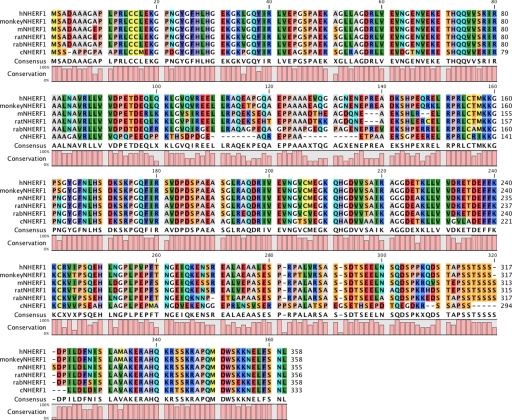
Alignment of NHERF1 by species. The consensus sequence and percentage conservation are shown at the bottom.

References

    1. Abbracchio MP, Burnstock G. (1994) Purinoceptors: are there families of P2X and P2Y purinoceptors? Pharmacol Ther 64:445–475 - PubMed
    1. Agrawal L, Jin Q, Altenburg J, Meyer L, Tubiana R, Theodorou I, Alkhatib G. (2007) CCR5Δ32 protein expression and stability are critical for resistance to human immunodeficiency virus type 1 in vivo. J Virol 81:8041–8049 - PMC - PubMed
    1. Ardura JA, Vilardaga JP, Friedman PA. (2011) Protein-exchange dynamics at GPCR micro-domains: a case study with the parathyroid hormone receptor (Abstract). Biophys J 98 (3 Suppl 1):432a
    1. Beck L, Karaplis AC, Amizuka N, Hewson AS, Ozawa H, Tenenhouse HS. (1998) Targeted inactivation of Npt2 in mice leads to severe renal phosphate wasting, hypercalciuria, and skeletal abnormalities. Proc Natl Acad Sci USA 95:5372–5377 - PMC - PubMed
    1. Benharouga M, Sharma M, So J, Haardt M, Drzymala L, Popov M, Schwapach B, Grinstein S, Du K, Lukacs GL. (2003) The role of the C terminus and Na+/H+ exchanger regulatory factor in the functional expression of cystic fibrosis transmembrane conductance regulator in nonpolarized cells and epithelia. J Biol Chem 278:22079–22089 - PubMed

Publication types

MeSH terms

Substances

LinkOut - more resources