


Directed chromosomal integration and expression of the reporter gene gusA3 in Lactobacillus acidophilus NCFM
- PMID: 21873486
- PMCID: PMC3194874
- DOI: 10.1128/AEM.06028-11
Directed chromosomal integration and expression of the reporter gene gusA3 in Lactobacillus acidophilus NCFM
Abstract
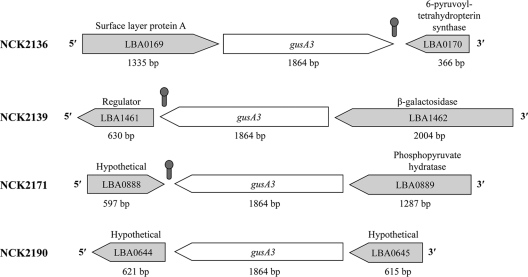
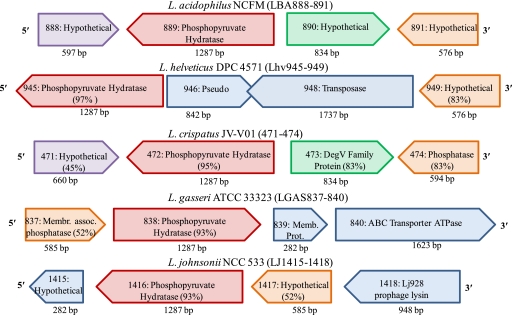
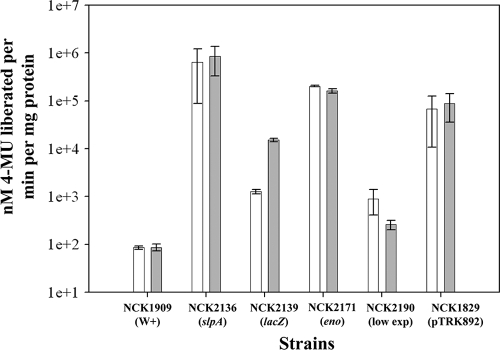
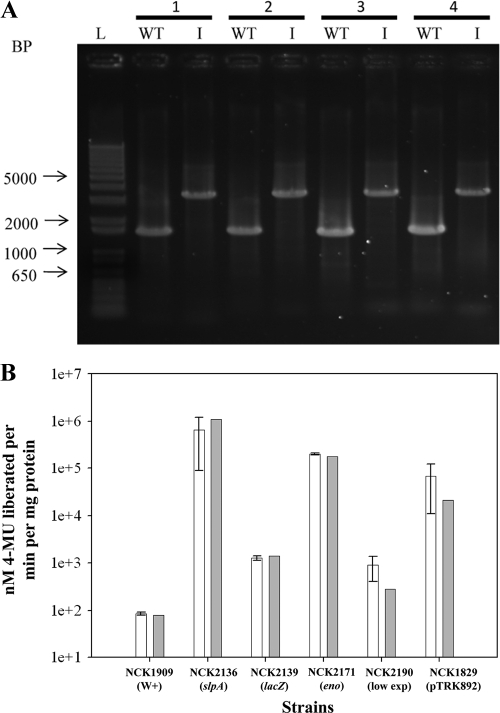
Lactobacillus acidophilus NCFM is a probiotic microbe that survives passage through the human gastrointestinal tract and interacts with the host epithelium and mucosal immune cells. The potential for L. acidophilus to express antigens at mucosal surfaces has been investigated with various antigens and plasmid expression vectors. Plasmid instability and antibiotic selection complicate the possibility of testing these constructs in human clinical trials. Integrating antigen encoding genes into the chromosome for expression is expected to eliminate selection requirements and provide genetic stability. In this work, a reporter gene encoding a β-glucuronidase (GusA3) was integrated into four intergenic chromosomal locations. The integrants were tested for genetic stability and GusA3 activity. Two locations were selected for insertion downstream of constitutively highly expressed genes, one downstream of slpA (LBA0169), encoding a highly expressed surface-layer protein, and one downstream of phosphopyruvate hydratase (LBA0889), a highly expressed gene with homologs in other lactic acid bacteria. An inducible location was selected downstream of lacZ (LBA1462), encoding a β-galactosidase. A fourth location was selected in a low-expression region. The expression of gusA3 was evaluated from each location by measuring GusA3 activity on 4-methyl-umbelliferyl-β-d-glucuronide (MUG). GusA3 activity from both highly expressed loci was more than three logs higher than the gusA3-negative parent, L. acidophilus NCK1909. GusA3 activity from the lacZ locus was one log higher in cells grown in lactose than in glucose. The differences in expression levels between integration locations highlights the importance of rational targeting with gene cassettes intended for chromosomal expression.
Figures
References
-
- Bermúdez-Humarán L. G., Cortes-Perez N. G., L'Haridon R., Langella P. 2008. Production of biological active murine IFN-gamma by recombinant Lactococcus lactis. FEMS Microbiol. Lett. 280:144–149 - PubMed
-
- Bradford M. M. 1976. A rapid and sensitive method for the quantitation of microgram quantities of protein utilizing the principle of protein-dye binding. Anal. Biochem. 72:248–254 - PubMed
Publication types
MeSH terms
Substances
Grants and funding
LinkOut - more resources
Full Text Sources
Other Literature Sources
