Autonomic and adrenocortical reactivity and buccal cell telomere length in kindergarten children
- PMID: 21873585
- PMCID: PMC3212037
- DOI: 10.1097/PSY.0b013e318229acfc
Autonomic and adrenocortical reactivity and buccal cell telomere length in kindergarten children
Abstract
Objective: To examine associations between autonomic nervous system and adrenocortical reactivity to laboratory stressors and buccal cell telomere length (BTL) in children.
Methods: The study sample comprised 78 children, aged 5 to 6 years, from a longitudinal cohort study of kindergarten social hierarchies, biologic responses to adversity, and child health. Buccal cell samples and reactivity measures were collected in the spring of the kindergarten year. BTL was measured by real-time polymerase chain reaction, as the telomere-to-single-copy gene ratio. Parents provided demographic information; parents and teachers reported children's internalizing and externalizing behavior problems. Components of children's autonomic (heart rate, respiratory sinus arrhythmia [RSA], and preejection period [PEP]) and adrenocortical (salivary cortisol) responses were monitored during standardized laboratory challenges. We examined relationships between reactivity, internalizing and externalizing behaviors, and BTL, adjusted for age, race, and sex.
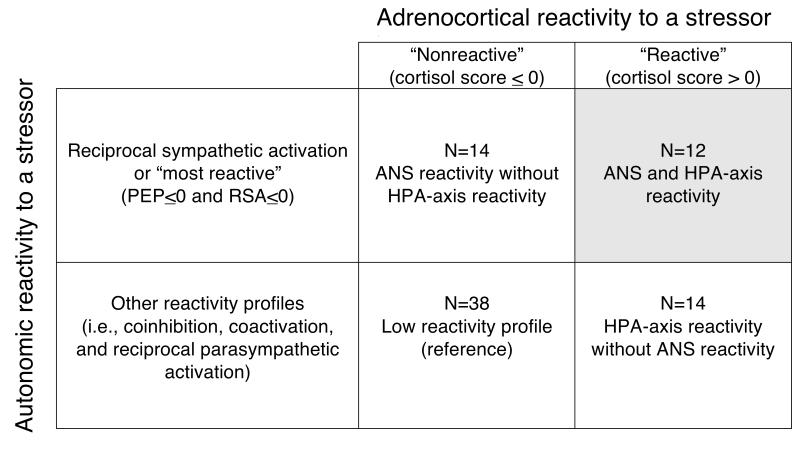
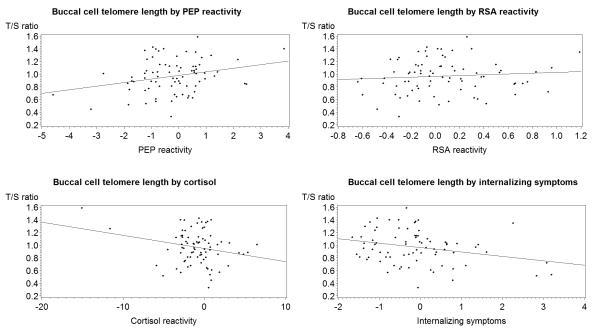
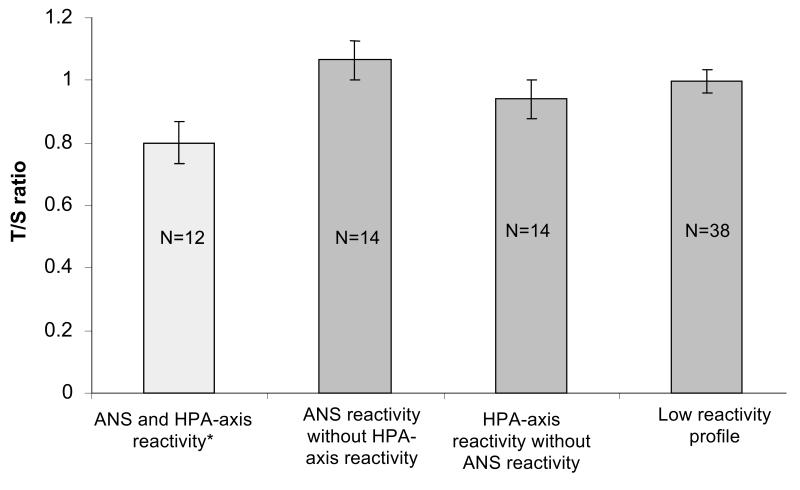
Results: Heart rate and cortisol reactivity were inversely related to BTL, PEP was positively related to BTL, and RSA was unrelated to BTL. Internalizing behaviors were also inversely related to BTL (standardized β = -0.33, p = .004). Split at the median of reactivity parameters, children with high sympathetic activation (decreasing PEP), and parasympathetic withdrawal (decreasing RSA) did not differ with regard to BTL. However, children with both this profile and high cortisol reactivity (n = 12) had significantly shorter BTL (0.80 versus 1.00; χ² = 7.6, p = .006), compared with other children.
Conclusions: The combination of autonomic and adrenocortical reactivity was associated with shorter BTL in children. These data suggest that psychophysiological processes may influence, and that BTL may be a useful marker of, early biologic aging.
Figures
Comment in
-
Telomere length integrates psychological factors in the successful aging story, but what about the biology?Psychosom Med. 2011 Sep;73(7):524-7. doi: 10.1097/PSY.0b013e31822ed876. Epub 2011 Aug 26. Psychosom Med. 2011. PMID: 21873590 No abstract available.
References
-
- Brouilette S, Singh RK, Thompson JR, Goodall AH, Samani NJ. White cell telomere length and risk of premature myocardial infarction. Arterioscler Thromb Vasc Biol. 2003;23:842–6. - PubMed
-
- Cawthon RM, Smith KR, O’Brien E, Sivatchenko A, Kerber RA. Association between telomere length in blood and mortality in people aged 60 years or older. Lancet. 2003;361:393–5. - PubMed
Publication types
MeSH terms
Substances
Grants and funding
LinkOut - more resources
Full Text Sources
Miscellaneous