Review
. 2012 Feb;91(2):142-9.
doi: 10.1177/0022034511421200. Epub 2011 Aug 29.

Cigarette smoking and inflammation: cellular and molecular mechanisms

Affiliations
Review

Cigarette smoking and inflammation: cellular and molecular mechanisms

J Lee et al. J Dent Res. 2012 Feb.

Abstract

Cigarette smoke (CS) causes considerable morbidity and mortality by inducing cancer, chronic lung and vascular diseases, and oral disease. Despite the well-recognized risks associated with smoking, the habit remains unacceptably prevalent. Several toxins present in CS have immunomodulatory effects. CS also contains trace amounts of microbial cell components, including bacterial lipopolysaccharide. These and other CS constituents induce chronic inflammation at mucosal surfaces and modify host responses to exogenous antigens. The effects of CS on immunity are far-reaching and complex; both pro-inflammatory and suppressive effects may be induced. The net effect of CS on immunity depends on many variables, including the dose and type of tobacco, the route and chronicity of exposure, and the presence of other factors at the time of immune cell stimulation, such as Toll receptor ligands or other inflammatory mediators. CS impairs innate defenses against pathogens, modulates antigen presentation, and promotes autoimmunity. CS also impairs immunity in the oral cavity and promotes gingival and periodontal disease and oral cancer. The recognition of specific mechanisms by which CS affects host immunity is an important step toward elucidating mechanisms of tobacco-induced disease and may identify novel therapeutic approaches for the management of diseases that afflict smokers.


Conflict of interest statement

The authors declare no potential conflicts of interest with respect to the authorship and/or publication of this article.

Figures
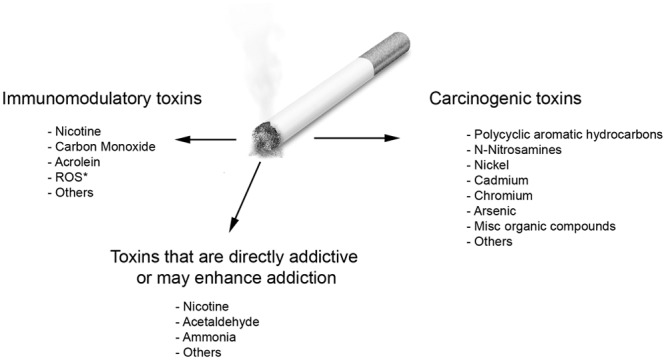
Figure 1.
Figure 1.
Cigarette smoke is a mixture of thousands of chemicals generated from the burning or heating of tobacco. The extraordinarily large collection of compounds present in cigarette smoke may be classified into broad groups, based on known target effects. Many carcinogenic toxins are now known to exist in cigarette smoke. Nicotine is the predominant addictive cigarette smoke constituent, although other chemicals contribute directly or indirectly to the addictive nature of CS (some by modifying nicotine effects). Nicotine, carbon monoxide, ROS, and acrolein are among the more important cigarette smoke toxins with immunomodulatory potential, although many more may exist. *ROS refers to reactive oxidant substances.
Figure 2.
Figure 2.
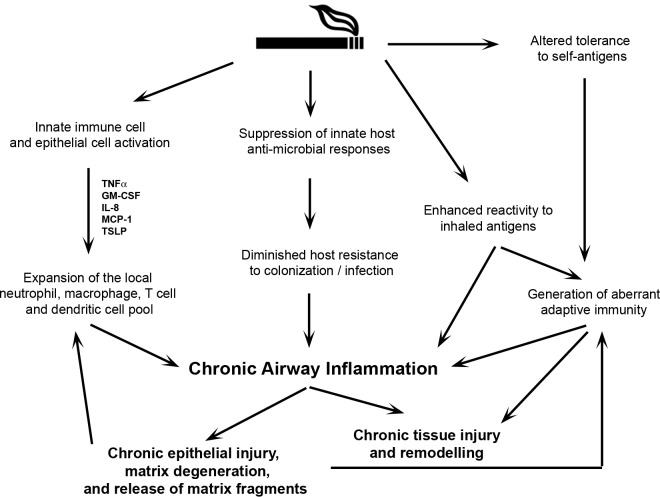
Cigarette smoke modulates inflammation and promotes chronic inflammation in the conducting airways by a variety of mechanisms. Direct activation of epithelial and immune cells in the oral and conducting airways induces the secretion of pro-inflammatory factors (some of which are listed in Fig. 1) that promote the recruitment and survival of other immune cells, including neutrophils, macrophages, T-cells, and dendritic cells. Simultaneously, CS impairs innate host defense mechanisms, subdues innate responses to pathogens, and alters adaptive immune responses to inhaled antigens. The net result of these effects is a state of chronic injury and inflammation of the airways. Repetitive injury coupled with abnormal tolerogenic responses to self-antigens and co-existent pathogen colonization may promote the development of auto-reactive immunity, which further perpetuates tissue injury and inflammation.

References

    1. Bagaitkar J, Williams LR, Renaud DE, Bemakanakere MR, Martin M, Scott DA, et al. (2009). Tobacco-induced alterations to Porphyromonas gingivalis-host interactions. Environ Microbiol 11:1242-1253 - PMC - PubMed
    1. Bartova J, Kratka-Opatrna Z, Prochazkova J, Krejsa O, Duskova J, Mrklas L, et al. (2000). Th1 and Th2 cytokine profile in patients with early onset periodontitis and their healthy siblings. Mediators Inflamm 9:115-120 - PMC - PubMed
    1. Behl Y, Siqueira M, Ortiz J, Li J, Desta T, Faibish D, et al. (2008). Activation of the acquired immune response reduces coupled bone formation in response to a periodontal pathogen. J Immunol 181:8711-8718 - PMC - PubMed
    1. Beklen A, Hukkanen M, Richardson R, Konttinen YT. (2008). Immunohistochemical localization of Toll-like receptors 1-10 in periodontitis. Oral Microbiol Immunol 23:425-431 - PubMed
    1. Bluhm AL, Weinstein J, Sousa JA. (1971). Free radicals in tobacco smoke. Nature 229:500. - PubMed

Publication types

MeSH terms

LinkOut - more resources