


In vitro activity of antiretroviral drugs against Plasmodium falciparum
- PMID: 21876053
- PMCID: PMC3194998
- DOI: 10.1128/AAC.05130-11
In vitro activity of antiretroviral drugs against Plasmodium falciparum
Abstract
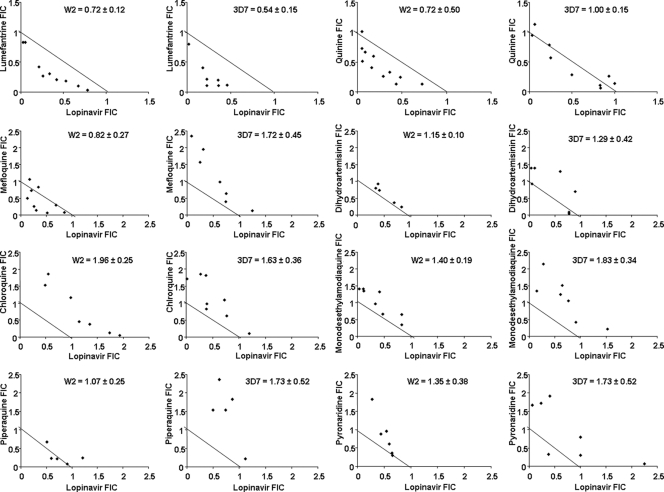
Malaria and HIV infection are both very common in many developing countries. With the increasing availability of therapy for HIV infection, it was of interest to determine whether antiretroviral drugs exert antimalarial effects. We therefore tested the in vitro activity of 19 antiretroviral drugs against the W2 and 3D7 strains of Plasmodium falciparum at concentrations up to 50 μM. None of 5 tested nucleoside reverse transcriptase inhibitors demonstrated activity. Two nonnucleoside reverse transcriptase inhibitors, efavirenz (mean 50% inhibitory concentration [IC(50)] of 22 to 30 μM against the two strains) and etravirine (3.1 to 3.4 μM), were active; nevirapine was not active. Also active were the fusion inhibitor enfuvirtide (6.2 to 7.9 μM) and the entry inhibitor maraviroc (15 to 21 μM). Raltegravir was not active. However, for all active drugs mentioned above, the IC(50)s were considerably greater than the concentrations achieved with standard dosing. The effects most likely to be clinically relevant were with HIV protease inhibitors. Of the tested compounds, activity was seen with lopinavir (2.7 to 2.9 μM), atazanavir (3.3 to 13.0 μM), saquinavir (5.0 to 12.1 μM), nelfinavir (6.5 to 12.1 μM), ritonavir (9.5 to 10.9 μM), tipranavir (15.5 to 22.3 μM), and amprenavir (28.1 to 40.8) but not darunavir. Lopinavir was active at levels well below those achieved with standard dosing of coformulated lopinavir-ritonavir. Lopinavir also demonstrated modest synergy with the antimalarial lumefantrine (mean fractional inhibitory concentration index of 0.66 for W2 and 0.53 for 3D7). Prior data showed that lopinavir-ritonavir also extends the pharmacokinetic exposure of lumefantrine. Thus, when used to treat HIV infection, lopinavir-ritonavir may have clinically relevant antimalarial activity and also enhance the activity of antimalarials.
Figures
References
-
- Arvieux C., Tribut O. 2005. Amprenavir or fosamprenavir plus ritonavir in HIV infection: pharmacology, efficacy and tolerability profile. Drugs 65:633–659 - PubMed
-
- Barrail-Tran A., et al. 2010. Pharmacokinetics of etravirine, raltegravir and darunavir/ritonavir in treatment experienced patients. AIDS 24:2581–2583 - PubMed
Publication types
MeSH terms
Substances
Grants and funding
LinkOut - more resources
Full Text Sources
Medical
