. 2011 Dec 20;108(51):20311-6.
doi: 10.1073/pnas.1100266108. Epub 2011 Aug 29.

A widespread class of reverse transcriptase-related cellular genes

Affiliations

A widespread class of reverse transcriptase-related cellular genes

Eugene A Gladyshev et al. Proc Natl Acad Sci U S A. .

Abstract

Reverse transcriptases (RTs) polymerize DNA on RNA templates. They fall into several structurally related but distinct classes and form an assemblage of RT-like enzymes that, in addition to RTs, also includes certain viral RNA-dependent RNA polymerases (RdRP) synthesizing RNA on RNA templates. It is generally believed that most RT-like enzymes originate from retrotransposons or viruses and have no specific function in the host cell, with telomerases being the only notable exception. Here we report on the discovery and properties of a unique class of RT-related cellular genes collectively named rvt. We present evidence that rvts are not components of retrotransposons or viruses, but single-copy genes with a characteristic domain structure that may contain introns in evolutionarily conserved positions, occur in syntenic regions, and evolve under purifying selection. These genes can be found in all major taxonomic groups including protists, fungi, animals, plants, and even bacteria, although they exhibit patchy phylogenetic distribution in each kingdom. We also show that the RVT protein purified from one of its natural hosts, Neurospora crassa, exists in a multimeric form and has the ability to polymerize NTPs as well as dNTPs in vitro, with a strong preference for NTPs, using Mn(2+) as a cofactor. The existence of a previously unknown class of single-copy RT-related genes calls for reevaluation of the current views on evolution and functional roles of RNA-dependent polymerases in living cells.


Conflict of interest statement

The authors declare no conflict of interest.

Figures
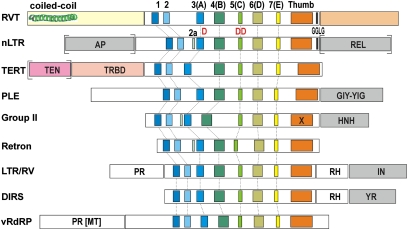
Fig. 1.
Fig. 1.
Domain structure of rvt and representative members of the RT-like sequence cluster (National Center for Biotechnology Information-Conserved Domains Database cl02808 superfamily). Shown are the conserved core RT motifs 1–7 and the adjacent N- and C-terminal domains. Associated endonuclease domains of various types (AP, REL, GIY-YIG, HNH, IN, and YR) are shown in gray. Other domains are abbreviated as follows: TEN, telomerase essential N-terminal; TRBD, telomerase RNA-binding domain; PR, protease; RH, RNase H; MT, methyltransferase; X, maturase. Domains indicated by brackets may or may not be present (e.g., non-LTR elements may contain either AP or REL endonuclease or both). Also shown are the positions of the catalytic D, DD triad and the GGLG motif shared between rvt and early-branching non-LTR retrotransposons. Not shown are RTs of pararetroviruses and copia-like LTR retrotransposons.
Fig. 2.
Fig. 2.
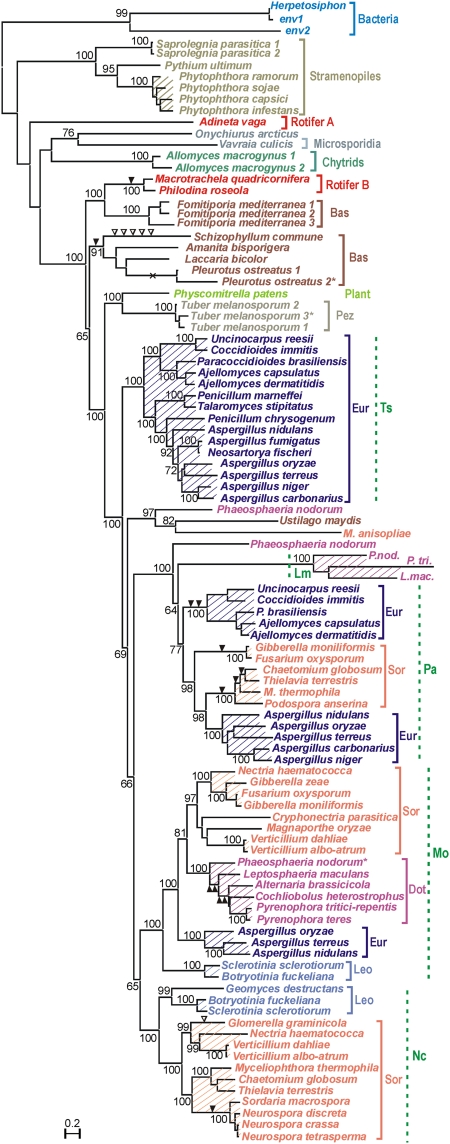
A maximum-likelihood phylogram of 100 representative rvt protein-coding sequences (Dataset S1). Bootstrap support values exceeding 60% are indicated at the nodes. Hatched areas indicate synteny in rvt genomic environments. Shared intron positions are denoted by solid triangles, unique positions by open triangles, and putative intron loss by ×. Asterisks denote copies with several frameshifts or in-frame stop codons. Color-coded taxonomic groups are as follows: Sor, Sordariomycetes; Eur, Eurotiomycetes; Dot, Dothideomycetes; Leo, Leotiomycetes; Pez, Pezizomycetes; Bas, Basidiomycetes. Nc, Mo, Lm, Pa, and Ts denote rvt lineages (see text).
Fig. 3.
Fig. 3.
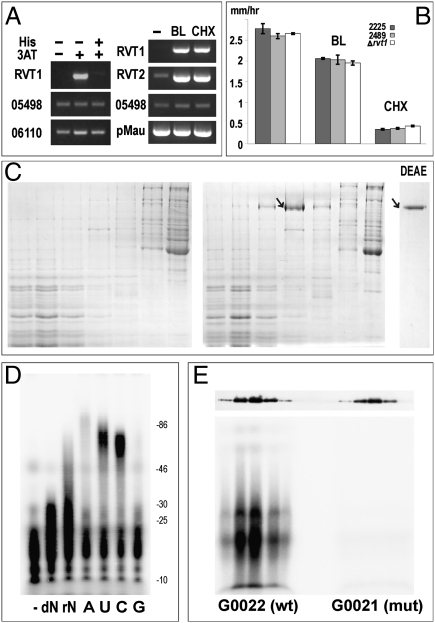
Properties of N. crassa rvt. (A) Semiquantitative RT-PCR showing response of rvt to 3-AT in the cpc-1 mutant [Fungal Genetics Stock Center (FGSC) 4264], with and without histidine addition (Left), and response of rvt in the wild-type Mauriceville strain (FGSC 2225) to blasticidin (BL) and cycloheximide (CHX) (Right). Expression from genes NCU5498, NCU06110, and the Mauriceville plasmid (pMau) was monitored as a control. (B) Effect of blasticidin and cycloheximide on mycelial growth rates for Δrvt and two wild-type strains. (C) Sucrose gradient fractionation and DEAE chromatography purification of NcRVT from blasticidin-induced (Right) and noninduced (Left) Mauriceville strain. The position of the 102-kDa NcRVT protein in stained SDS/PAGE is indicated by an arrow. Odd-numbered fractions 17–29 are shown from left to right in each section of C; numbering begins from the bottom. The rightmost lane depicts the eluate from the DEAE column, which contains pure NcRVT protein. (D) Nucleotidyltransferase activity of NcRVT preincubated with [α-32P]dCTP in the presence of Mn2+. The reaction was chased with dNTP (dN), NTP (rN), ATP (A), UTP (U), CTP (C), or GTP (G). (E) Activity of His-tagged wild-type rvt (G0022) and the D529A mutant (G0021) in five consecutive peak fractions from the sucrose gradient. NcRVT was preincubated with [α-32P]dCTP in the presence of Mn2+, and the reactions were chased with CTP. (Upper) Comparison of the amount of wild-type and mutant protein by Western blotting of the same fractions probed with anti-His antibody.
Fig. 4.
Fig. 4.
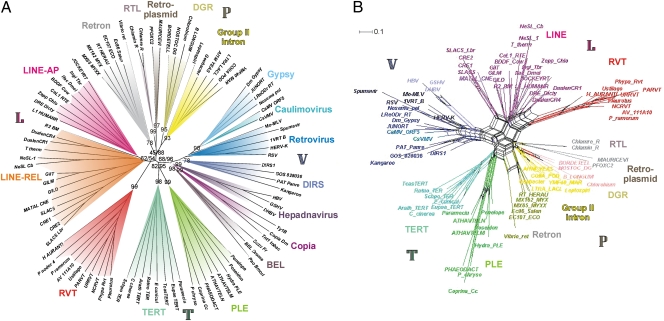
Relation of rvt genes to other RT classes. (A) A phylogram indicating both minimum evolution (ME) and maximum-likelihood (ML) support values for the most basal branches and ME support for each colored clade in cases where it exceeds 70%. (B) A NeighborNet phylogenetic network built using protein ML distances under the WAG model with SplitsTree 4.10 (Materials and Methods).

References

    1. Crick F. Central dogma of molecular biology. Nature. 1970;227:561–563. - PubMed
    1. Baltimore D. RNA-dependent DNA polymerase in virions of RNA tumour viruses. Nature. 1970;226:1209–1211. - PubMed
    1. Temin HM, Mizutani S. RNA-dependent DNA polymerase in virions of Rous sarcoma virus. Nature. 1970;226:1211–1213. - PubMed
    1. Eickbush TH, Malik H. Origins and evolution of retrotransposons. In: Craig NL, Craigie R, Gellert M, Lambowitz AM, editors. Mobile DNA II. Washington, DC: ASM; 2002. pp. 1111–1144.
    1. Ng KK, Arnold JJ, Cameron CE. Structure-function relationships among RNA-dependent RNA polymerases. Curr Top Microbiol Immunol. 2008;320:137–156. - PMC - PubMed

Publication types

Associated data