. 2011 Sep 13;108(37):15468-73.
doi: 10.1073/pnas.1107156108. Epub 2011 Aug 29.

Chemical modulation of memory formation in larval zebrafish

Affiliations

Chemical modulation of memory formation in larval zebrafish

Marc A Wolman et al. Proc Natl Acad Sci U S A. .

Abstract

Whole organism-based small-molecule screens have proven powerful in identifying novel therapeutic chemicals, yet this approach has not been exploited to identify new cognitive enhancers. Here we present an automated high-throughput system for measuring nonassociative learning behaviors in larval zebrafish. Using this system, we report that spaced training blocks of repetitive visual stimuli elicit protein synthesis-dependent long-term habituation in larval zebrafish, lasting up to 24 h. Moreover, repetitive acoustic stimulation induces robust short-term habituation that can be modulated by stimulation frequency and instantaneously dishabituated through cross-modal stimulation. To characterize the neurochemical pathways underlying short-term habituation, we screened 1,760 bioactive compounds with known targets. Although we found extensive functional conservation of short-term learning between larval zebrafish and mammalian models, we also discovered several compounds with previously unknown roles in learning. These compounds included a myristic acid analog known to interact with Src family kinases and an inhibitor of cyclin dependent kinase 2, demonstrating that high-throughput chemical screens combined with high-resolution behavioral assays provide a powerful approach for the discovery of novel cognitive modulators.


Conflict of interest statement

The authors declare no conflict of interest.

Figures
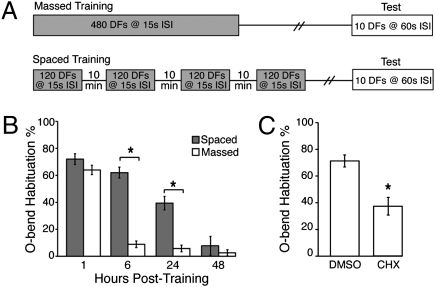
Fig. 1.
Fig. 1.
Six-dpf larval zebrafish demonstrate protein synthesis–dependent long-term habituation to visual stimuli. (A) Massed training regimen of 480 total 1-s dark flashes at a 15-s ISI or a spaced training protocol of four sessions, each consisting of 120 1-s dark flashes at a 15-s ISI, with 10 min between sessions. Larvae were tested 1–48 h later for O-bend behavior to a series of 10 1-s dark flashes delivered at a 60-s ISI. (B) Mean O-bend habituation 1–48 h after training with a massed or spaced training paradigm. O-bend habituation percentage was determined by calculating the ratio of O-bend responsiveness during testing to the O-bend responsiveness to the first 10 training stimuli. (C) Mean O-bend habituation at 4 h after CHX exposure during a spaced training paradigm. n = 6 dishes of 20 larvae for all experimental groups. Error bars denote SEM. *P < 0.001, Student t test.
Fig. 2.
Fig. 2.
Acoustic startle habituation assay and testing apparatus. (A) Larvae were exposed to 60 repetitive acoustic stimuli delivered at varying intensities and ISIs to evaluate startle sensitivity and nonassociative learning. (B and C) Testing apparatus for the acoustic startle experiments. Using stimulus triggering software (SI Experimental Procedures), we simultaneously controlled the precise intensity and ISI of the acoustic stimuli delivered by a vibrational excitor and triggered video recording to capture larval motor behavior 30 ms before and 90 ms after each acoustic stimulus.
Fig. 3.
Fig. 3.
Larval zebrafish SLC habituation to acoustic stimuli fits nonassociative learning parametric criteria. (A) Mean SLC response trend of 180 5-dpf larvae to the acoustic stimulation protocol described in Fig. 2A, showing exponential response decrement during habituation phase and spontaneous recovery after a 3-min rest period between stimulus 50 and stimulus 51. (B) Mean degree of SLC habituation is equivalent in 5- to 14-dpf larvae. N larvae shown within each bar in graph. (C and D) Mean SLC response trend (C) and degree of habituation (D) of 30 5-dpf larvae exposed to acoustic stimuli at a 1-s, 5-s, or 20-s ISI during the habituation phase. Mean SLC responses are binned by sets of 10 successive stimuli. SLC habituation is greater and spontaneous recovery is more robust after a 3-min rest period when larvae are stimulated more frequently. *P < 0.001 vs. 20-s ISI group, Student t test. (E) Mean SLC habituation trend of 48 5-dpf larvae during three sets of 20 acoustic stimuli delivered at a 1-s ISI, separated by 3-min rest periods, indicates potentiation of habituation. The degree of habituation at stimuli 2–7 and 15–17 of set 2 and at stimuli 2–12 and 16–18 of set 3 differed significantly from that at the corresponding stimulus during the initial set of 20 stimuli (P < 0.01, Student t test). (F) Mean SLC responsiveness of 10 5-dpf larvae to acoustic stimuli. Larvae were subjected to 30 acoustic stimuli at a 1-s ISI, then a 3-s window during which either no stimulus or a head touch with a hand-held poker was given, followed by a final acoustic stimulus. Larvae dishabituated to the acoustic stimulus via cross-modal, tactile stimulation. Error bars indicate SEM.
Fig. 4.
Fig. 4.
Pharmacologic modulation of SLC habituation and SLC response sensitivity in 5-dpf larvae. (A) Mean SLC habituation after a 15-min incubation in 1% DMSO vs. varying doses of MK-801 or ketamine. (B) Mean SLC responsiveness to 10 low-level, subthreshold acoustic stimuli after a 15-min incubation in 1% DMSO vs. 100 μM MK-801 or 500 μM ketamine/1% DMSO. (C–F) Mean SLC responsiveness (binned by responses to 10 successive stimuli) to above-threshold acoustic stimulation (C and E) at a 20-s ISI (prehabituation phase) and a 1-s ISI (habituation phase) and to 10 low-level, subthreshold stimuli (D and F) after a 15-min incubation in hydrastine (C and D) or 12-MDA (E and F) at varying concentrations. (G) Chemical structure of the tested myristic acid analogs. (H) Mean SLC habituation after a 15-min incubation in combinations of varying concentrations of NMDA, ketamine, and/or 12-MDA. The number of larvae are shown in the bars in A and B; n = 32 larvae per group for C–F and H. *P < 0.01; **P < 0.001, Student t test vs. the DMSO group or indicated control group. #P < 0.001 vs. additive effect of the 5-μM 12-MDA and 50-μM ketamine groups, Student t test. Error bars indicate SEM.

References

    1. Christoffersen GR. Habituation: Events in the history of its characterization and linkage to synaptic depression. A new proposed kinetic criterion for its identification. Prog Neurobiol. 1997;53:45–66. - PubMed
    1. Braff DL, Grillon C, Geyer MA. Gating and habituation of the startle reflex in schizophrenic patients. Arch Gen Psychiatry. 1992;49:206–215. - PubMed
    1. Jansiewicz EM, Newschaffer CJ, Denckla MB, Mostofsky SH. Impaired habituation in children with attention deficit hyperactivity disorder. Cogn Behav Neurol. 2004;17:1–8. - PubMed
    1. McSweeney FK, Murphy ES, Kowal BP. Regulation of drug taking by sensitization and habituation. Exp Clin Psychopharmacol. 2005;13:163–184. - PubMed
    1. Rothbaum BO, Kozak MJ, Foa EB, Whitaker DJ. Posttraumatic stress disorder in rape victims: Autonomic habituation to auditory stimuli. J Trauma Stress. 2001;14:283–293. - PubMed

Publication types

MeSH terms

Substances
