


Identification of a de novo thymidylate biosynthesis pathway in mammalian mitochondria
- PMID: 21876188
- PMCID: PMC3174652
- DOI: 10.1073/pnas.1103623108
Identification of a de novo thymidylate biosynthesis pathway in mammalian mitochondria
Abstract
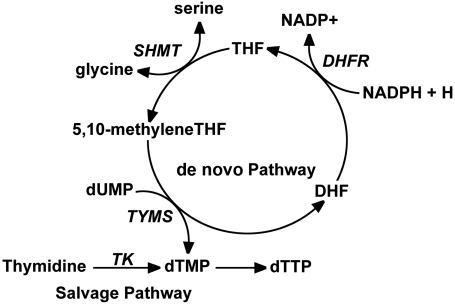
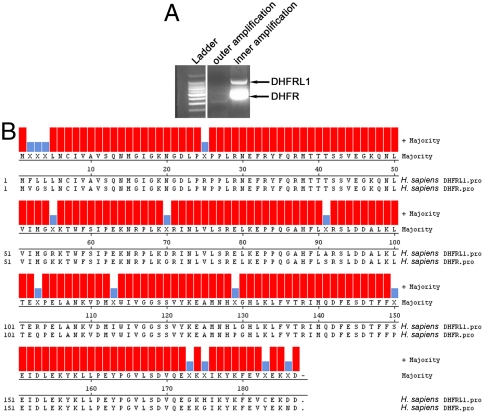
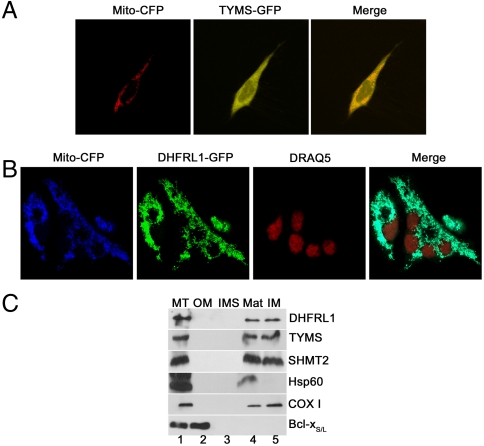
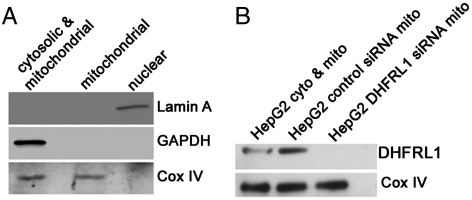
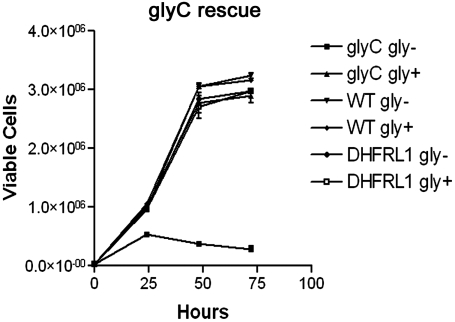
The de novo and salvage dTTP pathways are essential for maintaining cellular dTTP pools to ensure the faithful replication of both mitochondrial and nuclear DNA. Disregulation of dTTP pools results in mitochondrial dysfunction and nuclear genome instability due to an increase in uracil misincorporation. In this study, we identified a de novo dTMP synthesis pathway in mammalian mitochondria. Mitochondria purified from wild-type Chinese hamster ovary (CHO) cells and HepG2 cells converted dUMP to dTMP in the presence of NADPH and serine, through the activities of mitochondrial serine hydroxymethyltransferase (SHMT2), thymidylate synthase (TYMS), and a novel human mitochondrial dihydrofolate reductase (DHFR) previously thought to be a pseudogene known as dihydrofolate reductase-like protein 1 (DHFRL1). Human DHFRL1, SHMT2, and TYMS were localized to mitochondrial matrix and inner membrane, confirming the presence of this pathway in mitochondria. Knockdown of DHFRL1 using siRNA eliminated DHFR activity in mitochondria. DHFRL1 expression in CHO glyC, a previously uncharacterized mutant glycine auxotrophic cell line, rescued the glycine auxotrophy. De novo thymidylate synthesis activity was diminished in mitochondria isolated from glyA CHO cells that lack SHMT2 activity, as well as mitochondria isolated from wild-type CHO cells treated with methotrexate, a DHFR inhibitor. De novo thymidylate synthesis in mitochondria prevents uracil accumulation in mitochondrial DNA (mtDNA), as uracil levels in mtDNA isolated from glyA CHO cells was 40% higher than observed in mtDNA isolated from wild-type CHO cells. These data indicate that unlike other nucleotides, de novo dTMP synthesis occurs within mitochondria and is essential for mtDNA integrity.
Conflict of interest statement
The authors declare no conflict of interest.
Figures
Similar articles
-
SHMT1 and SHMT2 are functionally redundant in nuclear de novo thymidylate biosynthesis.PLoS One. 2009 Jun 9;4(6):e5839. doi: 10.1371/journal.pone.0005839. PLoS One. 2009. PMID: 19513116 Free PMC article.
-
Arsenic trioxide targets MTHFD1 and SUMO-dependent nuclear de novo thymidylate biosynthesis.Proc Natl Acad Sci U S A. 2017 Mar 21;114(12):E2319-E2326. doi: 10.1073/pnas.1619745114. Epub 2017 Mar 6. Proc Natl Acad Sci U S A. 2017. PMID: 28265077 Free PMC article.
-
The former annotated human pseudogene dihydrofolate reductase-like 1 (DHFRL1) is expressed and functional.Proc Natl Acad Sci U S A. 2011 Sep 13;108(37):15157-62. doi: 10.1073/pnas.1103605108. Epub 2011 Aug 26. Proc Natl Acad Sci U S A. 2011. PMID: 21876184 Free PMC article.
-
The thymidylate synthesis cycle and anticancer drugs.Med Res Rev. 1987 Oct-Dec;7(4):441-75. doi: 10.1002/med.2610070405. Med Res Rev. 1987. PMID: 3309507 Review. No abstract available.
-
Flavin-Dependent Thymidylate Synthase as a New Antibiotic Target.Molecules. 2016 May 20;21(5):654. doi: 10.3390/molecules21050654. Molecules. 2016. PMID: 27213314 Free PMC article. Review.
Cited by
-
Transgene expression of Drosophila melanogaster nucleoside kinase reverses mitochondrial thymidine kinase 2 deficiency.J Biol Chem. 2013 Feb 15;288(7):5072-9. doi: 10.1074/jbc.M112.437152. Epub 2013 Jan 3. J Biol Chem. 2013. PMID: 23288848 Free PMC article.
-
A Pyrazolate Osmium(VI) Nitride Exhibits Anticancer Activity through Modulating Protein Homeostasis in HepG2 Cells.Int J Mol Sci. 2022 Oct 24;23(21):12779. doi: 10.3390/ijms232112779. Int J Mol Sci. 2022. PMID: 36361570 Free PMC article.
-
Increasing Dosage of Leucovorin Results in Pharmacokinetic and Gene Expression Differences When Administered as Two-Hour Infusion or Bolus Injection to Patients with Colon Cancer.Cancers (Basel). 2022 Dec 30;15(1):258. doi: 10.3390/cancers15010258. Cancers (Basel). 2022. PMID: 36612253 Free PMC article.
-
Cisplatin-resistant A549 non-small cell lung cancer cells can be identified by increased mitochondrial mass and are sensitive to pemetrexed treatment.Cancer Cell Int. 2019 Nov 29;19:317. doi: 10.1186/s12935-019-1037-1. eCollection 2019. Cancer Cell Int. 2019. PMID: 31798346 Free PMC article.
-
Metabolic modulation of mitochondrial mass during CD4+ T cell activation.Cell Chem Biol. 2023 Sep 21;30(9):1064-1075.e8. doi: 10.1016/j.chembiol.2023.08.008. Cell Chem Biol. 2023. PMID: 37716347 Free PMC article.
References
-
- Samsonoff WA, et al. Intracellular location of thymidylate synthase and its state of phosphorylation. J Biol Chem. 1997;272:13281–13285. - PubMed
-
- Zhou X, et al. Progressive loss of mitochondrial DNA in thymidine kinase 2-deficient mice. Hum Mol Genet. 2008;17:2329–2335. - PubMed
-
- Nishino I, Spinazzola A, Hirano M. Thymidine phosphorylase gene mutations in MNGIE, a human mitochondrial disorder. Science. 1999;283:689–692. - PubMed
-
- Pontarin G, et al. Mitochondrial DNA depletion and thymidine phosphate pool dynamics in a cellular model of mitochondrial neurogastrointestinal encephalomyopathy. J Biol Chem. 2006;281:22720–22728. - PubMed
Publication types
MeSH terms
Substances
Grants and funding
LinkOut - more resources
Full Text Sources
Other Literature Sources
Molecular Biology Databases
Research Materials
