


The toxin and antidote puzzle: new ways to control insect pest populations through manipulating inheritance
- PMID: 21876382
- PMCID: PMC3225740
- DOI: 10.4161/bbug.2.5.15801
The toxin and antidote puzzle: new ways to control insect pest populations through manipulating inheritance
Abstract
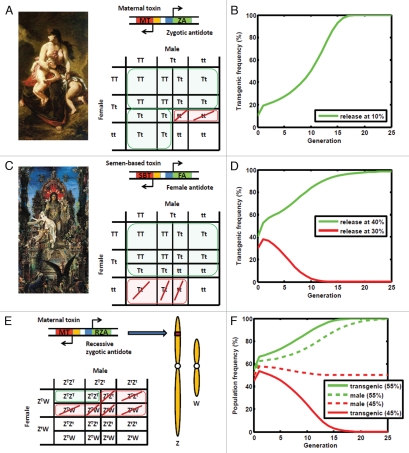
Insects carry out essential ecological functions, such as pollination, but also cause extensive damage to agricultural crops, and transmit human diseases such as malaria and dengue fever. Advances in insect transgenesis are making it increasingly feasible to engineer genes conferring desirable phenotypes, and gene drive systems are required to spread these genes into wild populations. Medea provides one solution, being able to spread into a population from very low initial frequencies through the action of a maternally-expressed toxin linked to a zygotically-expressed antidote. Several other toxin-antidote combinations are imaginable that distort the offspring ratio in favor of a desired transgene, or drive the population towards an all-male crash. We explore two such systems--Semele, which is capable of spreading a desired transgene into an isolated population in a confined manner; and Merea, which is capable of inducing a local population crash when located on the Z chromosome of a Lepidopteron pest.
Figures
References
-
- Beeman RW, Friesen KS, Denell RE. Maternal-effect selfish genes in flour beetles. Science. 1992;256:89–92. - PubMed
-
- Hurst LD. Scat+ is a selfish gene analogous to Medea of Tribolium castaneum. Cell. 1993;75:407–408. - PubMed
-
- Weichenhan D, Kunze B, Traut W, Winking H. Restoration of the Mendelian transmission ratio by a deletion in the mouse chromosome 1 HSR. Genet Res. 1998;71:119–125. - PubMed
Publication types
MeSH terms
Substances
Grants and funding
LinkOut - more resources
Full Text Sources