doi: 10.3410/B3-16.
Epub 2011 Aug 1.
Plant-soil interactions in a changing world
Affiliations
- PMID: 21876727
- PMCID: PMC3155187
- DOI: 10.3410/B3-16
Item in Clipboard
Plant-soil interactions in a changing world
F1000 Biol Rep.
2011.
Abstract
Evidence is mounting to suggest that the transfer of carbon through roots of plants to the soil plays a primary role in regulating ecosystem responses to climate change and its mitigation. Future research is needed to improve understanding of the mechanisms involved in this phenomenon, its consequences for ecosystem carbon cycling, and the potential to exploit plant root traits and soil microbial processes that favor soil carbon sequestration.
Figures
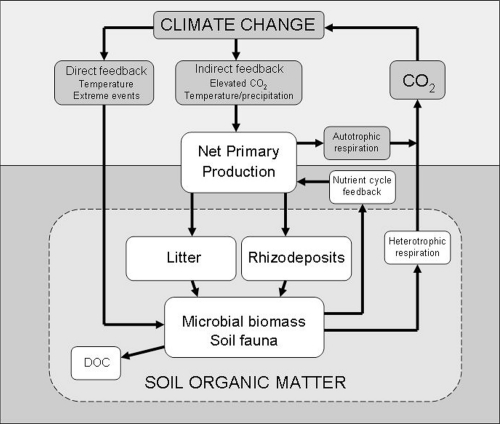
Direct effects include the influence on soil microbes and greenhouse gas production of temperature, changing precipitation, and extreme climatic events. For example, increased temperature can stimulate microbial activity and carbon dioxide production. Indirect effects result from climate-driven changes in plant productivity and vegetation structure, which alter soil physicochemical conditions, the supply of carbon to soil in the form of root exudates and litter, and the structure and activity of microbial communities involved in carbon cycling . Autotrophs, such as plants, can convert carbon dioxide into organic carbon, whereas heterotrophs do the opposite. DOC, dissolved organic carbon. Adapted from Bardgett et al., 2008 [2].
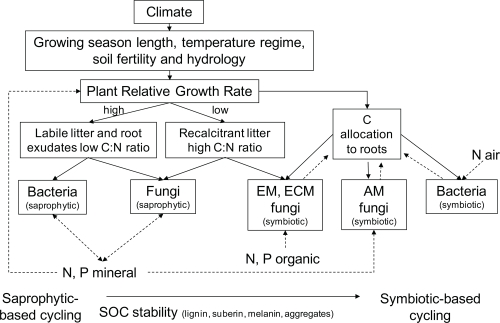
The schematic shows the interdependency of labile and recalcitrant litter inputs to soil, which drive abundances of different functional groups of the soil microbial community and their involvement in carbon sequestration. Labile inputs to soil of low carbon:nitrogen ratio from litter and root exudates favor saprophytic (feeding, absorbing or growing upon decaying matter) bacterial-dominated microbial communities that promote carbon mineralization, and hence carbon loss. In contrast, recalcitrant litter inputs with high carbon:nitrogen ratio and low nutrient availability favor saprophytic fungi and carbon allocation to symbiotic fungi and bacteria, which both promote carbon storage in soil. Solid lines indicate carbon and dotted lines indicate mineral nitrogen and phosphorus flow. Overall, the stability and storage of carbon in soil increases along the spectrum from saprophytic- to symbiotic-based cycling, as indicated on the lower arrow. AM, arbuscular mycorrhizal; ECM, ectomycorrhizal; EM, ericoid mycorrhizal; SOC, soil organic carbon. Adapted from De Deyn et al., 2008 [22].
References
-
- Bardgett RD, Wardle DA. Aboveground-Belowground Linkages: Biotic Interactions, Ecosystem Processes, and Global Change. Oxford, UK: Oxford University Press; 2010.
-
- Dorrepaal ES, Toet S, van Logtestijn RS, Swart E, van de Weg MJ, Callaghan TV, Aerts R. Carbon respiration from subsurface peat accelerated by climate warming in the subarctic. Nature. 2009;460:616–9. doi: 10.1038/nature08216. - DOI
-
Evaluated by Jennifer Dungan 01 Jun 2010