. 2011;6(8):e22974.
doi: 10.1371/journal.pone.0022974. Epub 2011 Aug 18.

The 3-hydroxy-2-butanone pathway is required for Pectobacterium carotovorum pathogenesis

Affiliations

The 3-hydroxy-2-butanone pathway is required for Pectobacterium carotovorum pathogenesis

Maria del Pilar Marquez-Villavicencio et al. PLoS One. 2011.

Abstract

Pectobacterium species are necrotrophic bacterial pathogens that cause soft rot diseases in potatoes and several other crops worldwide. Gene expression data identified Pectobacterium carotovorum subsp. carotovorum budB, which encodes the α-acetolactate synthase enzyme in the 2,3-butanediol pathway, as more highly expressed in potato tubers than potato stems. This pathway is of interest because volatiles produced by the 2,3-butanediol pathway have been shown to act as plant growth promoting molecules, insect attractants, and, in other bacterial species, affect virulence and fitness. Disruption of the 2,3-butanediol pathway reduced virulence of P. c. subsp. carotovorum WPP14 on potato tubers and impaired alkalinization of growth medium and potato tubers under anaerobic conditions. Alkalinization of the milieu via this pathway may aid in plant cell maceration since Pectobacterium pectate lyases are most active at alkaline pH.


Conflict of interest statement

Competing Interests: The authors have declared that no competing interests exist.

Figures

Figure 1
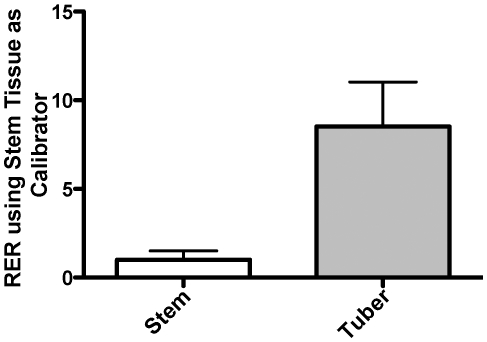
Figure 1. P. c. sp. carotovorum budB transcript is differentially expressed in potato tubers and stems.
Relative expression of the budB transcript in potato stems and tubers was determined with four reference mRNA (ffh, dspE, pelB, and hrcC - Table 2). The mean relative expression ratio (RER) of the budB transcript in tubers was 8.5-fold elevated compared to stem tissue, which was used as the calibrator. The difference was found to be significant at a 95% confidence interval by t-test using Prism software (Mac version 5.0d, GraphPad Software, Inc.) with a P-value = 0.0425. Error bars represent standard error of the mean.
Figure 2
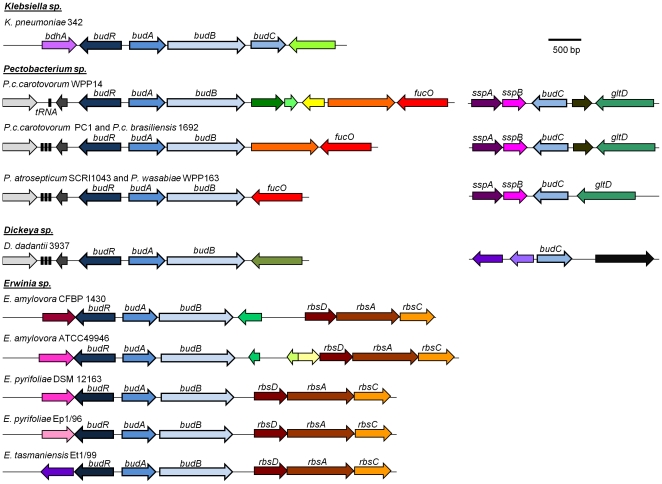
Figure 2. Operon structure of bud genes in Klebsiella, Pectobacterium, Dickeya, and Erwinia species.
Sequences were retrieved from ASAP . Genes are indicated by arrows, with the direction of the arrowhead indicating the direction of the gene. Genes shaded with the same color are homologous and unlabeled genes have no known function. budA is an alpha-acetolactate decarboxylase, budB is an acetolactate synthase, budC is an acetoin reductase and budR is a LysR-family transcriptional regulator. In Klebsiella and Enterobacter (not shown), budABC are in one operon. The locus of the budC gene is found elsewhere in the chromosome in Pectobacterium and Dickeya. The Erwinia species lack budC.
Figure 3
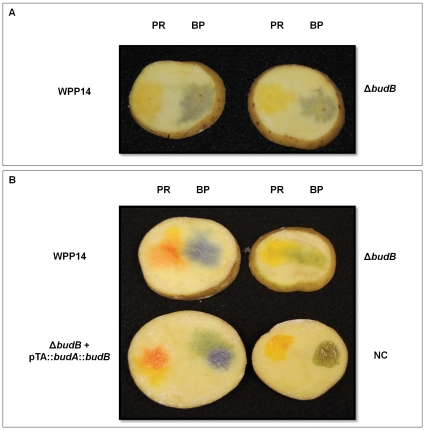
Figure 3. The P. c. subsp. carotovorum budAB operon affects bacterial modification of pH in tubers slices that are incubated anaerobically.
Potato slices were inoculated with 106 CFU and incubated under aerobic (A) and anaerobic conditions (B) for 20 hours at room temperature (∼22°C). PR: pH indicator phenol red (yellow at pH below 6.4 and red violet at pH above 8.2), BP: pH indicator bromocresol purple (yellow at pH below 5.2 and purple at a pH above 6.8).
Figure 4
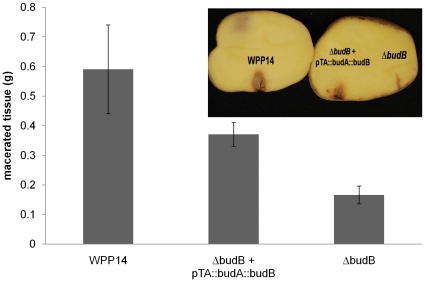
Figure 4. WPP14 ΔbudB is reduced in virulence in potato tubers.
Potato tubers (n = 10) were inoculated with 106 CFU, placed into plastic bags and incubated at 28°C for 3 days. After incubation, macerated tissue was scooped out and weighed. The graph shown is from one experiment. This experiment was repeated twice with similar results. Error bars indicate standard error.
Figure 5
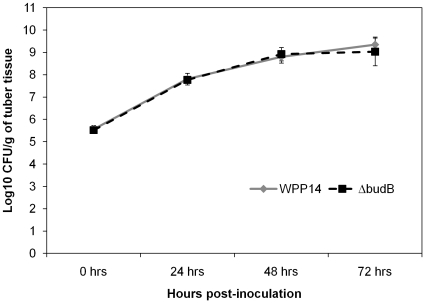
Figure 5. WPP14ΔbudB is not impaired in growth in potato tubers.
Bacterial suspensions containing 105 CFU were stab-inoculated into potato tubers (cv. “Superior”) (n = 5). Tubers were placed into plastic bags and incubated at 28°C. Bacterial population was determined every 24 hrs after inoculation. Error bars indicate standard error. The graph shows data from one of two experiments, neither of which showed significant difference in bacterial growth.

References

    1. Huang M, Oppermann-Sanio FB, Steinbüchel A. Biochemical and molecular characterization of the Bacillus subtilis acetoin catabolic pathway. J Bacteriol. 1999;181:3837–3841. - PMC - PubMed
    1. Lopez JM, Thoms B, Rehbein H. Acetoin degradation in Bacillus subtilis by direct oxidative cleavage. Eur J Biochem. 1975;57:425–430. - PubMed
    1. Levine M. On the significance of the Voges-Proskauer reaction. J Bacteriol. 1916;1:153–164. - PMC - PubMed
    1. Xiao Z, Xu P. Acetoin metabolism in bacteria. Crit Rev Micobiol. 2007;33:127–140. - PubMed
    1. Yoon SS, Mekalanos JJ. 2,3-butanediol synthesis and the emergence of the Vibrio cholerae El Tor biotype. Infect Immun. 2006;74:6574–6556. - PMC - PubMed

Publication types

MeSH terms

LinkOut - more resources