


Tissue composition of mammographically dense and non-dense breast tissue
- PMID: 21877142
- PMCID: PMC3707294
- DOI: 10.1007/s10549-011-1727-4
Tissue composition of mammographically dense and non-dense breast tissue
Abstract
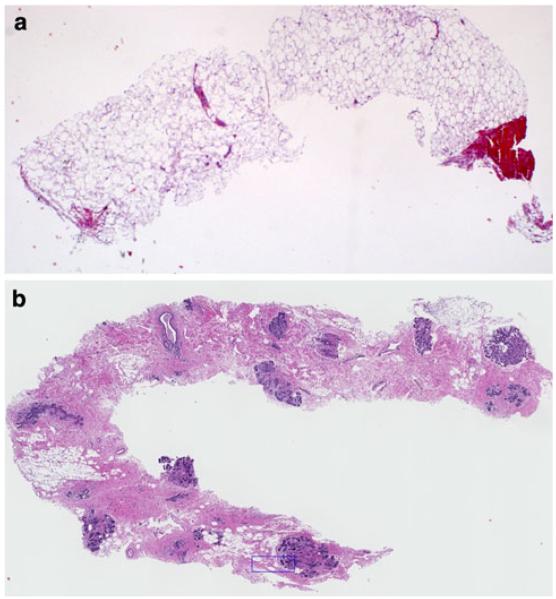
Mammographic density is a strong risk factor for breast cancer but its underlying biology in healthy women is not well-defined. Using a novel collection of core biopsies from mammographically dense versus non-dense regions of the breasts of healthy women, we examined histologic and molecular differences between these two tissue types. Eligible participants were 40 + years, had a screening mammogram and no prior breast cancer or current endocrine therapy. Mammograms were used to identify dense and non-dense regions and ultrasound-guided core biopsies were performed to obtain tissue from these regions. Quantitative assessment of epithelium, stroma, and fat was performed on dense and non-dense cores. Molecular markers including Ki-67, estrogen receptor (ER) and progesterone receptor (PR) were also assessed for participants who had >0% epithelial area in both dense and non-dense tissue. Signed rank test was used to assess within woman differences in epithelium, stroma and fat between dense and non-dense tissue. Differences in molecular markers (Ki-67, ER, and PR) were analyzed using generalized linear models, adjusting for total epithelial area. Fifty-nine women, mean age 51 years (range: 40-82), were eligible for analyses. Dense tissue was comprised of greater mean areas of epithelium and stroma (1.1 and 9.2 mm(2) more, respectively) but less fat (6.0 mm(2) less) than non-dense tissue. There were no statistically significant differences in relative expression of Ki-67 (P = 0.82), ER (P = 0.09), or PR (P = 0.96) between dense and non-dense tissue. Consistent with prior reports, we found that mammographically dense areas of the breast differ histologically from non-dense areas, reflected in greater proportions of epithelium and stroma and lesser proportions of fat in the dense compared to non-dense breast tissue. Studies of both epithelial and stromal components are important in understanding the association between mammographic density and breast cancer risk.
Figures
References
-
- Vachon CM, Brandt KR, Ghosh K, Scott CG, Maloney SD, Carston MJ, Pankratz VS, Sellers TA. Mammographic breast density as a general marker of breast cancer risk. Cancer Epidemiol Biomarkers Prev. 2007;16:43–49. - PubMed
-
- McCormack VA, dos Santos Silva I. Breast density and parenchymal patterns as markers of breast cancer risk: a meta-analysis. Cancer Epidemiol Biomarkers Prev. 2006;6:1159–1169. - PubMed
-
- Boyd NF, Jensen HM, Cooke G, Han HL, Lockwood GA, Miller AB. Mammographic densities and the prevalence and incidence of histological types of benign breast disease. Reference Pathologists of the Canadian National Breast Screening Study. Eur J Cancer Prev. 2000;1:15–24. - PubMed
Publication types
MeSH terms
Substances
Grants and funding
LinkOut - more resources
Full Text Sources
Medical
Research Materials
