


Noninferiority effects on glycemic control and β-cell function improvement in newly diagnosed type 2 diabetes patients: basal insulin monotherapy versus continuous subcutaneous insulin infusion treatment
- PMID: 21877913
- PMCID: PMC3249622
- DOI: 10.1089/dia.2011.0123
Noninferiority effects on glycemic control and β-cell function improvement in newly diagnosed type 2 diabetes patients: basal insulin monotherapy versus continuous subcutaneous insulin infusion treatment
Erratum in
- Diabetes Technol Ther. 2014 Mar;16(3):193
Abstract
Aims: In newly diagnosed type 2 diabetes mellitus (T2DM) patients, short-term insulin therapy might improve β-cell function and glycemic control. This study aimed to compare the effects of basal insulin monotherapy with continuous subcutaneous insulin infusion (CSII) treatment.
Methods: Fifty-nine cases of newly diagnosed T2DM patients with fasting plasma glucose of 9.0-16.7 mmol/L were recruited into this study. They were hospitalized and randomly assigned to a basal insulin monotherapy group (n=27) or a CSII group (n=32). Insulin dosage was titrated according to fasting capillary blood glucose levels, and treatment was stopped after 2 weeks. Intravenous glucose tolerance tests were performed, and blood glucose, insulin, C-peptide, and lipid profiles were measured before therapy and 2 days after therapy withdrawal.
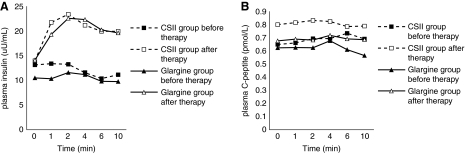
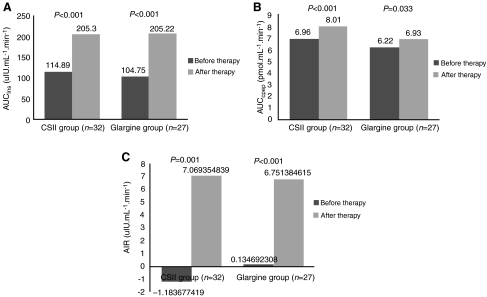
Results: Both treatments reduced fasting and postprandial blood glucose levels (after treatment vs. baseline, both P<0.05). Fasting glycemic control target was achieved in 52 cases (88.14%) with 2 weeks of insulin treatment, and there were no significant differences between the glargine and CSII groups (P=0.059). The time to achieve fasting glycemic target in the CSII group was shorter than that in the glargine group (P<0.01). Plasma lipid profiles such as triglycerides and total cholesterol also decreased significantly after the intervention. Overall β-cell function improved significantly after insulin intervention (P<0.01). Variation did not differ between two groups, nor did the effects on insulin and C-peptide secretion (P>0.05).
Conclusions: The effect of basal insulin monotherapy was similar to that of CSII, and thus basal insulin monotherapy might be a reasonable alternative to CSII for initial insulin therapy in newly diagnosed T2DM patients.
Figures

References
-
- Reaven GM. HOMA-beta in the UKPDS and ADOPT. Is the natural history of type 2 diabetes characterized by a progressive and inexorable loss of insulin secretory function? Maybe? Maybe not? Diabtes Vasc Dis Res. 2009;6:133–138. - PubMed
-
- Wajchenberg BL. Clinical approaches to preserve beta-cell function in diabetes. Adv Exp Med Biol. 2010;654:515–535. - PubMed
-
- Wajchenberg BL. β-Cell failure in diabetes and preservation by clinical treatment. Endocr Rev. 2007;28:187–218. - PubMed
-
- Intensive blood-glucose control with sulphonylureas or insulin compared with conventional treatment and risk of complications in patients with type 2 diabetes (UKPDS33) UK Prospective Diabetes Study (UKPDS) Group. Lancet. 1998;52:837–853. Erratum in Lancet 1999;354:602. - PubMed
Publication types
MeSH terms
Substances
LinkOut - more resources
Full Text Sources
Medical
