


Genotypic and phenotypic diversity of Ralstonia pickettii and Ralstonia insidiosa isolates from clinical and environmental sources including High-purity Water. Diversity in Ralstonia pickettii
- PMID: 21878094
- PMCID: PMC3175462
- DOI: 10.1186/1471-2180-11-194
Genotypic and phenotypic diversity of Ralstonia pickettii and Ralstonia insidiosa isolates from clinical and environmental sources including High-purity Water. Diversity in Ralstonia pickettii
Abstract
Background: Ralstonia pickettii is a nosocomial infectious agent and a significant industrial contaminant. It has been found in many different environments including clinical situations, soil and industrial High Purity Water. This study compares the phenotypic and genotypic diversity of a selection of strains of Ralstonia collected from a variety of sources.
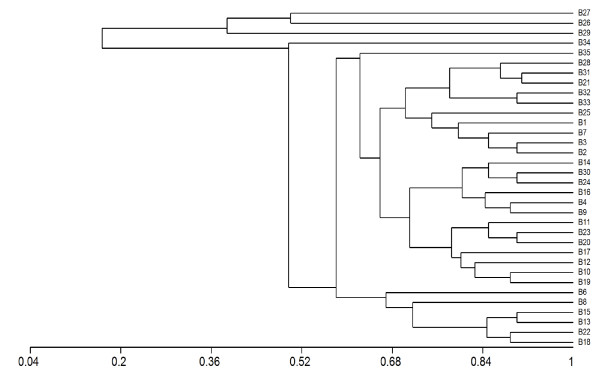
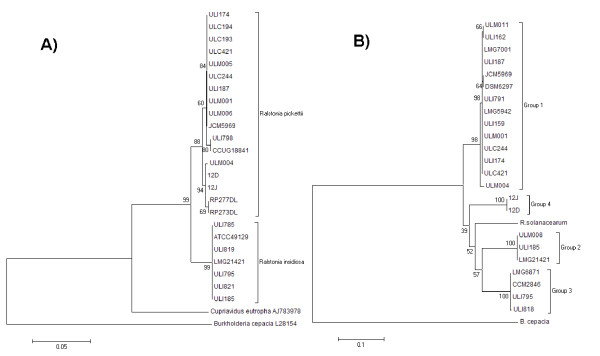
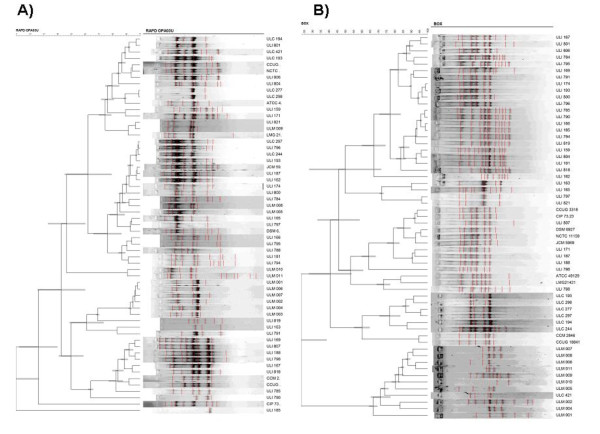
Results: Ralstonia isolates (fifty-nine) from clinical, industrial and environmental origins were compared genotypically using i) Species-specific-PCR, ii) PCR and sequencing of the 16S-23S rRNA Interspatial region (ISR) iii) the fliC gene genes, iv) RAPD and BOX-PCR and v) phenotypically using biochemical testing. The species specific-PCR identified fifteen out of fifty-nine designated R. pickettii isolates as actually being the closely related species R. insidiosa. PCR-ribotyping of the 16S-23S rRNA ISR indicated few major differences between the isolates. Analysis of all isolates demonstrated different banding patterns for both the RAPD and BOX primers however these were found not to vary significantly.
Conclusions: R. pickettii species isolated from wide geographic and environmental sources appear to be reasonably homogenous based on genotypic and phenotypic characteristics. R. insidiosa can at present only be distinguished from R. pickettii using species specific PCR. R. pickettii and R. insidiosa isolates do not differ significantly phenotypically or genotypically based on environmental or geographical origin.
Figures
References
-
- Yabuuchi E, Kosako Y, Yano I, Hotta H, Nishiuchi Y. Transfer of two Burkholderia and an Alcaligenes species to Ralstonia gen. Nov.: Proposal of Ralstonia pickettii (Ralston, Palleroni and Doudoroff 1973) comb. Nov., Ralstonia solanacearum (Smith 1896) comb. Nov. and Ralstonia eutropha (Davis 1969) comb. Nov. Microbiol Immunol. 1995;39(11):897–904. - PubMed
-
- Adley CC, Saieb FM. Biofilm formation in high purity water: Ralstonia pickettii a special case for analysis. Ultrapure Water. 2005;22:14–17.
-
- Adley CC, Ryan MP, Pembroke JT, Saieb FM. In: Biofilms: Persistence and Ubiquity. Mc Bain A, Alison D, Pratten J, Spratt D, Upton M, Verran J, editor. Cardiff: Biofilm Club; 2005. Ralstonia pickettii in high purity water; pp. 261–272.
-
- Gilligan PH, Lum G, Vandamme PAR, Whittier S. In: Manual of Clinical Microbiology. 8. Murray PR, Baron EJ, Pfaller MA, Jorgensen JH, Yolken RH, editor. ASM Press Washington, D.C.; 2003. Burkholderia, Stenotrophomonas, Ralstonia, Brevundimonas, Comamonas, Delftia, Pandoraea and Acidovorax; pp. 729–748.
Publication types
MeSH terms
Associated data
- Actions
- Actions
- Actions
- Actions
- Actions
- Actions
- Actions
- Actions
- Actions
- Actions
- Actions
- Actions
- Actions
- Actions
- Actions
- Actions
- Actions
- Actions
- Actions
- Actions
- Actions
- Actions
- Actions
- Actions
- Actions
- Actions
- Actions
- Actions
- Actions
- Actions
- Actions
- Actions
- Actions
- Actions
- Actions
- Actions
- Actions
LinkOut - more resources
Full Text Sources
Other Literature Sources
Molecular Biology Databases
