


PMS: photosystem I electron donor or fluorescence quencher
- PMID: 21879310
- PMCID: PMC3296009
- DOI: 10.1007/s11120-011-9671-z
PMS: photosystem I electron donor or fluorescence quencher
Abstract
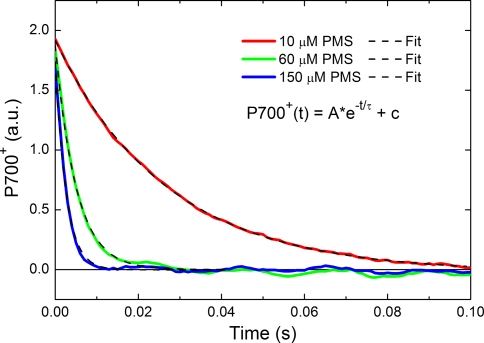
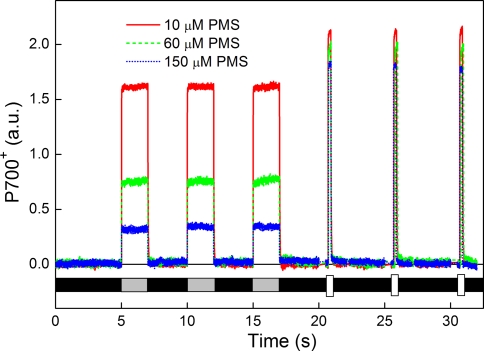
Light energy harvested by the pigments in Photosystem I (PSI) is used for charge separation in the reaction center (RC), after which the positive charge resides on a special chlorophyll dimer called P700. In studies on the PSI trapping kinetics, P700(+) is usually chemically reduced to re-open the RCs. So far, the information available about the reduction rate and possible chlorophyll fluorescence quenching effects of these reducing agents is limited. This information is indispensible to estimate the fraction of open RCs under known experimental conditions. Moreover, it would be important to understand if these reagents have a chlorophyll fluorescence quenching effects to avoid the introduction of exogenous singlet excitation quenching in the measurements. In this study, we investigated the effect of the commonly used reducing agent phenazine methosulfate (PMS) on the RC and fluorescence emission of higher plant PSI-LHCI. We measured the P700(+) reduction rate for different PMS concentrations, and show that we can give a reliable estimation on the fraction of closed RCs based on these rates. The data show that PMS is quenching chlorophyll fluorescence emission. Finally, we determined that the fluorescence quantum yield of PSI with closed RCs is 4% higher than if the RCs are open.
Figures


References
-
- Berthold DA, Babcock GT, Yocum CF. A highly resolved, oxygen-evolving photosystem-II preparation from spinach thylakoid membranes—electron-paramagnetic-res and electron-transport properties. FEBS Lett. 1981;134:231–234. doi: 10.1016/0014-5793(81)80608-4. - DOI
Publication types
MeSH terms
Substances
LinkOut - more resources
Full Text Sources
Other Literature Sources
