


Mitochondrial sirtuins in the regulation of mitochondrial activity and metabolic adaptation
- PMID: 21879450
- PMCID: PMC3245626
- DOI: 10.1007/978-3-642-21631-2_8
Mitochondrial sirtuins in the regulation of mitochondrial activity and metabolic adaptation
Abstract
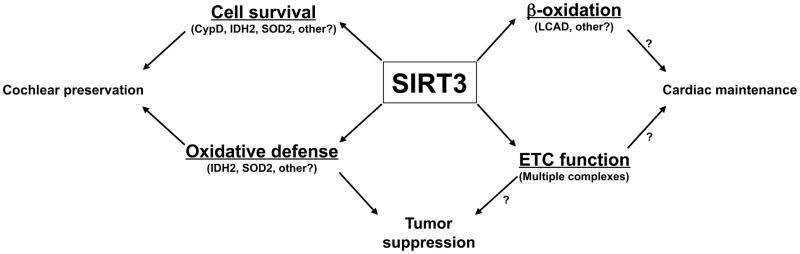
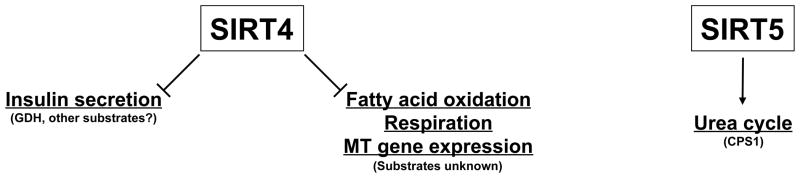
In eukaryotes, mitochondria carry out numerous functions that are central to cellular and organismal health. How mitochondrial activities are regulated in response to differing environmental conditions, such as variations in diet, remains an important unsolved question in biology. Here, we review emerging evidence suggesting that reversible acetylation of mitochondrial proteins on lysine residues represents a key mechanism by which mitochondrial functions are adjusted to meet environmental demands. In mammals, three members of the sirtuin class of NAD(+)-dependent deacetylases - SIRT3, SIRT4, and SIRT5 - localize to mitochondria and regulate targets involved in a diverse array of biochemical pathways. The importance of this activity is highlighted by recent studies of SIRT3 indicating that this protein suppresses the emergence of diverse age-related pathologies: hearing loss, cardiac fibrosis, and malignancy. Together, these findings argue that mitochondrial protein acetylation represents a central means by which mammals regulate mitochondrial functions to maintain cellular and organismal homeostasis.
Figures
References
-
- Ahuja N, Schwer B, Carobbio S, Waltregny D, North BJ, Castronovo V, Maechler P, Verdin E. Regulation of insulin secretion by SIRT4, a mitochondrial ADP-ribosyltransferase. J Biol Chem. 2007;282:33583–92. - PubMed
-
- Allison SJ, Milner J. SIRT3 is pro-apoptotic and participates in distinct basal apoptotic pathways. Cell Cycle. 2007;6:2669–77. - PubMed
Publication types
MeSH terms
Substances
Grants and funding
LinkOut - more resources
Full Text Sources
