


Genome-wide association analysis of clinical vs. nonclinical origin provides insights into Saccharomyces cerevisiae pathogenesis
- PMID: 21880084
- PMCID: PMC3183415
- DOI: 10.1111/j.1365-294X.2011.05225.x
Genome-wide association analysis of clinical vs. nonclinical origin provides insights into Saccharomyces cerevisiae pathogenesis
Abstract
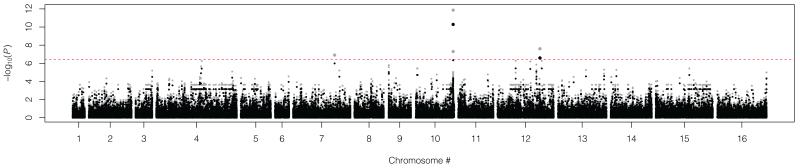
Because domesticated Saccharomyces cerevisiae strains have been used to produce fermented food and beverages for centuries without apparent health implications, S. cerevisiae has always been considered a Generally Recognized As Safe (GRAS) microorganism. However, the number of reported mucosal and systemic S. cerevisiae infections in the human population has increased and fatal infections have occurred even in relatively healthy individuals. In order to gain insight into the pathogenesis of S. cerevisiae and improve our understanding of the emergence of fungal pathogens, we performed a population-based genome-wide environmental association analysis of clinical vs. nonclinical origin in S. cerevisiae. Using tiling array-based, high-density genotypes of 44 clinical and 44 nonclinical S. cerevisiae strains from diverse geographical origins and source substrates, we identified several genetic loci associated with clinical background in S. cerevisiae. Associated polymorphisms within the coding sequences of VRP1, KIC1, SBE22 and PDR5, and the 5' upstream region of YGR146C indicate the importance of pseudohyphal formation, robust cell wall maintenance and cellular detoxification for S. cerevisiae pathogenesis, and constitute good candidates for follow-up verification of virulence and virulence-related factors underlying the pathogenicity of S. cerevisiae.
© 2011 Blackwell Publishing Ltd.
Figures




References
-
- Bassetti S, Frei R, Zimmerli W. Fungemia with Saccharomyces cerevisiae after treatment with Saccharomyces boulardii. American Journal of Medicine. 1998;105:71–72. - PubMed
-
- Bengtsson H, Simpson K, Bullard J, Hansen K. Technical Report #745. Department of Statistics, University of California; Berkeley, USA: 2008. Aroma.affymetrix: a generic framework in R for analyzing small to very large Affymetrix data sets in bounded memory.
-
- Bolstad BM, Irizarry RA, Astrand M, Speed TP. A comparison of normalization methods for high density oligonucleotide array data based on bias and variance. Bioinformatics. 2003;19:185–193. - PubMed
-
- Borth N, Walther A, Reijnst P, Jorde S, Schaub Y, Wendland J. Candida albicans Vrp1 is required for polarized morphogenesis and interacts with Wal1 and Myo5. Microbiology. 2010;156:2962–2969. - PubMed
-
- Clemons KV, McCusker JH, Davis RW, Stevens DA. Comparative pathogenesis of clinical and nonclinical isolates of Saccharomyces cerevisiae. Journal of Infectious Diseases. 1994;169:859–67. - PubMed
Publication types
MeSH terms
Grants and funding
LinkOut - more resources
Full Text Sources
Other Literature Sources
Molecular Biology Databases
Research Materials
