


Analysis of the environmental impact of insulin infusion sets based on loss of resources with waste
- PMID: 21880223
- PMCID: PMC3192587
- DOI: 10.1177/193229681100500403
Analysis of the environmental impact of insulin infusion sets based on loss of resources with waste
Abstract
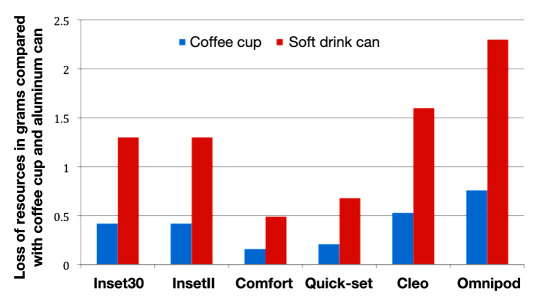
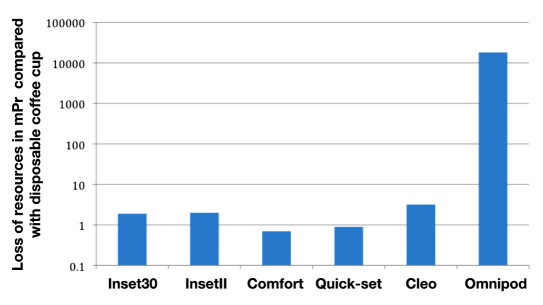
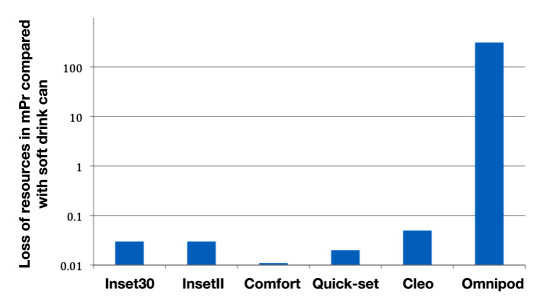
Insulin pump therapy [continuous subcutaneous insulin infusion (CSII)] requires regular change of infusion sets every 2-3 days in order to minimize the risk of skin irritations or other adverse events. This has been discussed to be a potential burden to the environment. The purpose of this analysis was to perform an environmental assessment of insulin pump infusion sets based on loss of resources occurring during incineration of the discarded products and by means of a lifecycle concept used to weight a material in relation to its rareness on earth and its consumption. In addition to five infusion sets (Inset30, InsetII, Comfort, Quick-set, and Cleo), a patch pump (Omnipod) was also included in this analysis. The annual loss in waste of the so called "person reserve" of 3 days of catheter use was compared with daily consumption of a cup of coffee in a disposable paper cup and to a soft drink in an aluminum can. The weight-based loss in resources through waste for the infusion sets (except for Cleo) corresponded to 70-200% of the loss of resources for a coffee cup (Cleo, 320%; Omnipod, 1,821,600%) and to 1-3% of the loss from an aluminum soft drink can (Cleo, 5%; Omnipod, 31,200%). The loss or resources by use of infusion sets used in insulin pump therapy appears to be low and is similar to the burden induced by the uptake of one cup of coffee per day. The loss or resources with regular CSII is considerably lower than the loss or resources induced by patch pumps.
© 2011 Diabetes Technology Society.
Figures
Comment in
-
Analysis: the impact of needle, syringe, and lancet disposal on the community.J Diabetes Sci Technol. 2011 Jul 1;5(4):848-50. doi: 10.1177/193229681100500404. J Diabetes Sci Technol. 2011. PMID: 21880224 Free PMC article.
-
Waste disposal in the 21st century and diabetes technology: a little coffee (cup) or beer (can) with that insulin infusion (set).J Diabetes Sci Technol. 2011 Jul 1;5(4):851-2. doi: 10.1177/193229681100500405. J Diabetes Sci Technol. 2011. PMID: 21880225 Free PMC article.
References
Publication types
MeSH terms
Substances
LinkOut - more resources
Full Text Sources
Medical
