


Mass spectrometry: come of age for structural and dynamical biology
- PMID: 21880480
- PMCID: PMC3193349
- DOI: 10.1016/j.sbi.2011.08.002
Mass spectrometry: come of age for structural and dynamical biology
Abstract
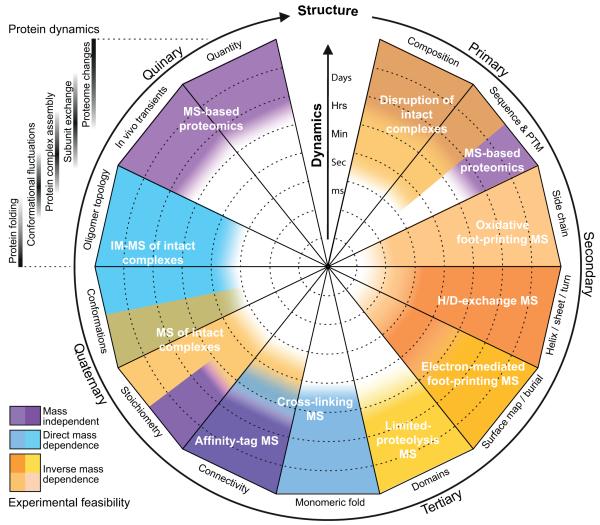
Over the past two decades, mass spectrometry (MS) has emerged as a bone fide approach for structural biology. MS can inform on all levels of protein organization, and enables quantitative assessments of their intrinsic dynamics. The key advantages of MS are that it is a sensitive, high-resolution separation technique with wide applicability, and thereby allows the interrogation of transient protein assemblies in the context of complex mixtures. Here we describe how molecular-level information is derived from MS experiments, and how it can be combined with spatial and dynamical restraints obtained from other structural biology approaches to allow hybrid studies of protein architecture and movements.
Copyright © 2011 Elsevier Ltd. All rights reserved.
Figures

References
-
- Robinson CV, Sali A, Baumeister W. The molecular sociology of the cell. Nature. 2007;450:973–982. - PubMed
-
- Nilsson T, Mann M, Aebersold R, Yates JR, 3rd, Bairoch A, Bergeron JJ. Mass spectrometry in high-throughput proteomics: ready for the big time. Nat Methods. 2010;7:681–685. - PubMed
-
- Heck AJ. Native mass spectrometry: a bridge between interactomics and structural biology. Nat Methods. 2008;5:927–933. - PubMed
-
- Loo JA. Studying noncovalent protein complexes by electrospray ionization mass spectrometry. Mass Spectrom Rev. 1997;16:1–23. - PubMed
Publication types
MeSH terms
Substances
Grants and funding
LinkOut - more resources
Full Text Sources
Miscellaneous
