


Atomic resolution x-ray structure of the substrate recognition domain of higher plant ribulose-bisphosphate carboxylase/oxygenase (Rubisco) activase
- PMID: 21880724
- PMCID: PMC3195603
- DOI: 10.1074/jbc.C111.289595
Atomic resolution x-ray structure of the substrate recognition domain of higher plant ribulose-bisphosphate carboxylase/oxygenase (Rubisco) activase
Abstract
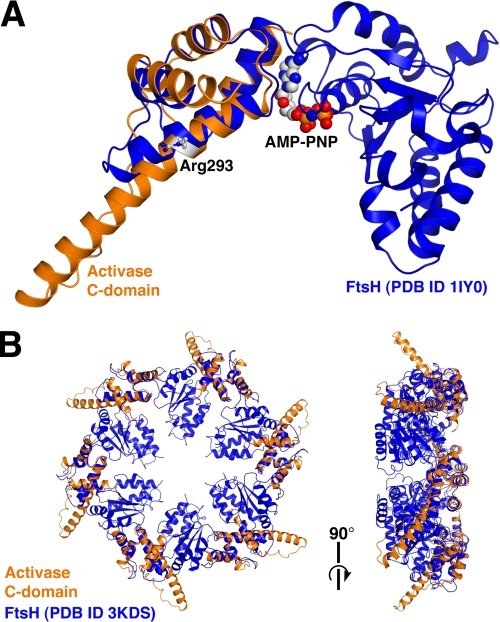
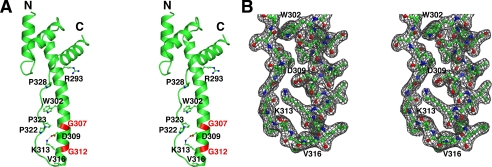
The rapid release of tight-binding inhibitors from dead-end ribulose-bisphosphate carboxylase/oxygenase (Rubisco) complexes requires the activity of Rubisco activase, an AAA+ ATPase that utilizes chemo-mechanical energy to catalyze the reactivation of Rubisco. Activase is thought to play a central role in coordinating the rate of CO(2) fixation with the light reactions of photosynthesis. Here, we present a 1.9 Å crystal structure of the C-domain core of creosote activase. The fold consists of a canonical four-helix bundle, from which a paddle-like extension protrudes that entails a nine-turn helix lined by an irregularly structured peptide strand. The residues Lys-313 and Val-316 involved in the species-specific recognition of Rubisco are located near the tip of the paddle. An ionic bond between Lys-313 and Glu-309 appears to stabilize the glycine-rich end of the helix. Structural superpositions onto the distant homolog FtsH imply that the paddles extend away from the hexameric toroid in a fan-like fashion, such that the hydrophobic sides of each blade bearing Trp-302 are facing inward and the polar sides bearing Lys-313 and Val-316 are facing outward. Therefore, we speculate that upon binding, the activase paddles embrace the Rubisco cylinder by placing their hydrophobic patches near the partner protein. This model suggests that conformational adjustments at the remote end of the paddle may relate to selectivity in recognition, rather than specific ionic contacts involving Lys-313. Additionally, the superpositions predict that the catalytically critical Arg-293 does not interact with the bound nucleotide. Hypothetical ring-ring stacking and peptide threading models for Rubisco reactivation are briefly discussed.
Figures
References
Publication types
MeSH terms
Substances
Associated data
- Actions
LinkOut - more resources
Full Text Sources
