. 2011 Nov;85(21):11235-41.
doi: 10.1128/JVI.05794-11. Epub 2011 Aug 31.

The M segment of the 2009 new pandemic H1N1 influenza virus is critical for its high transmission efficiency in the guinea pig model

Affiliations

The M segment of the 2009 new pandemic H1N1 influenza virus is critical for its high transmission efficiency in the guinea pig model

Yi-ying Chou et al. J Virol. 2011 Nov.

Abstract

A remarkable feature of the 2009 pandemic H1N1 influenza virus is its efficient transmissibility in humans compared to that of precursor strains from the triple-reassortant swine influenza virus lineage, which cause only sporadic infections in humans. The viral components essential for this phenotype have not been fully elucidated. In this study, we aimed to determine the viral factors critical for aerosol transmission of the 2009 pandemic virus. Single or multiple segment reassortments were made between the pandemic A/California/04/09 (H1N1) (Cal/09) virus and another H1N1 strain, A/Puerto Rico/8/34 (H1N1) (PR8). These viruses were then tested in the guinea pig model to understand which segment of Cal/09 virus conferred transmissibility to the poorly transmissible PR8 virus. We confirmed our findings by generating recombinant A/swine/Texas/1998 (H3N2) (sw/Tx/98) virus, a representative triple-reassortant swine virus, containing segments of the Cal/09 virus. The data showed that the M segment of the Cal/09 virus promoted aerosol transmissibility to recombinant viruses with PR8 and sw/Tx/98 virus backgrounds, suggesting that the M segment is a critical factor supporting the transmission of the 2009 pandemic virus.


Figures
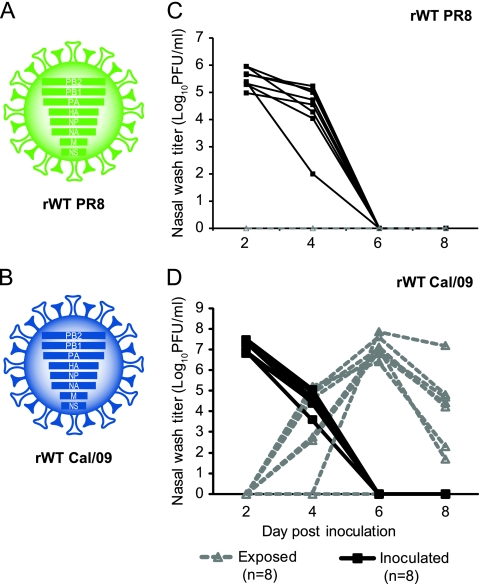
Fig. 1.
Fig. 1.
PR8 virus does not transmit in guinea pigs through the aerosol route. Aerosol transmission experiments were performed with rWTPR8 virus (A) or rWT Cal/09 virus (B). Nasal wash titers are plotted against the time postinoculation, and the titers of the inoculated animals are represented by solid black lines and filled squares, while the titers of the exposed animals are represented by dashed gray lines and open triangles. Cumulative results of two independent experiments for the rWT PR8 virus (C) or rWT Cal/09 virus (D) are shown.
Fig. 2.
Fig. 2.
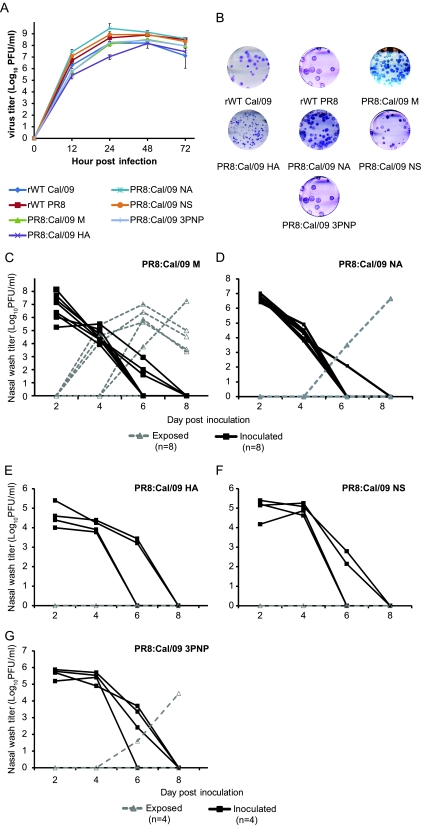
The M segment of Cal/09 virus confers transmissibility in the PR8 background. (A) Multicycle growth kinetics analysis of the rWT viruses and the PR8 reassortant viruses in MDCK cells are shown with an MOI of 0.001. The viral titers are plotted as a function of time postinfection, with each data point representing the average of biological triplicates. The error bars represent the standard deviations of the triplicates. Titers for each virus are represented with different color lines as shown under the figure. (B) Plaque morphologies of each PR8 reassortant viruses are shown. Viral genotypes are indicated under each image. (C to H) Aerosol transmission experiments for each PR8 reassortant virus were performed under the conditions described in Materials and Methods. Virus titers of the nasal lavage fluid are plotted as a function of time postinoculation. The black solid lines and the filled squares represent the viral titers of the inoculated animals; the dashed gray lines and open triangles represent the viral titers of the exposed animals. Cumulative results of two independent experiments are shown for the following reassortant strains: PR8:Cal/09 M viruses (C), PR8:Cal/09 NA viruses (D), PR8:Cal/09 HA viruses (E), PR8:Cal/09 NS viruses (F), and PR8:Cal/09 3PNP viruses (G).
Fig. 3.
Fig. 3.
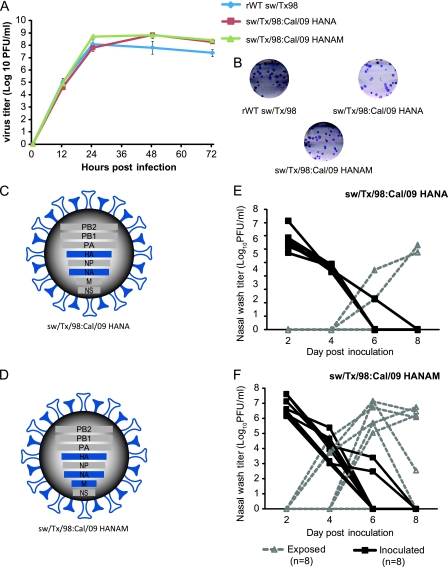
The M segment of the Cal/09 virus promotes aerosol transmission of sw/Tx/98 virus. (A) Multicycle-growth kinetics analysis with MDCK cells was performed for the rWTsw/Tx/98, sw/Tx/98:Cal/09 HANA, and sw/Tx/98:Cal/09 HANAM viruses with an MOI of 0.005. The viral titers are plotted as a function of time postinfection, with each data point representing the average of biological triplicates. The error bars represent the standard deviations of the triplicates. The titers of rWT sw/Tx/98 are represented by blue lines; the titers of the sw/Tx/98:Cal/09 HANA virus are represented by red lines; the sw/Tx/98:Cal/09 HANAM virus is represented by green lines. (B) Plaque phenotypes of the reassortant sw/Tx/98 viruses are shown. The strain shown in each image is labeled individually. (C and D) The genetic constellation of sw/Tx/98 reassortant virus sw/Tx/98:Cal/09 HANA (C) or sw/Tx/98:Cal/09 HANAM (D) is shown. (E and F) Cumulative results of two independent aerosol transmission experiments with the sw/Tx/98:Cal/09 HANA virus (E) or sw/Tx/98:Cal/09 HANAM virus (F) are shown. The nasal wash titers of the inoculated animals are represented as solid black lines and filled squares, while the nasal wash titers of the exposed animals are represented as dashed gray lines and open triangles.

References

    1. Calder L. J., Wasilewski S., Berriman J. A., Rosenthal P. B. 2010. Structural organization of a filamentous influenza A virus. Proc. Natl. Acad. Sci. U. S. A. 107:10685–10690 - PMC - PubMed
    1. CDC 2009. Swine influenza A (H1N1) infection in two children—Southern California, March-April 2009. CDC, Atlanta, GA. http://www.cdc.gov/mmwr/preview/mmwrhtml/mm5815a5.htm - PubMed
    1. Chen L. M., et al. 2011. Receptor specificity of subtype H1 influenza A viruses isolated from swine and humans in the United States. Virology 412:401–410 - PMC - PubMed
    1. Dawood F. S., et al. 2009. Emergence of a novel swine-origin influenza A (H1N1) virus in humans. New Engl. J. Med. 360:2605–2615 - PubMed
    1. Fodor E., et al. 1999. Rescue of influenza A virus from recombinant DNA. J. Virol. 73:9679–9682 - PMC - PubMed

Publication types

MeSH terms

LinkOut - more resources