Comparative Study
. 2011 Nov;301(5):R1408-17.
doi: 10.1152/ajpregu.00211.2011. Epub 2011 Aug 31.

Muscle protein metabolism responds similarly to exogenous amino acids in healthy younger and older adults during NO-induced hyperemia

Affiliations
Comparative Study

Muscle protein metabolism responds similarly to exogenous amino acids in healthy younger and older adults during NO-induced hyperemia

E Lichar Dillon et al. Am J Physiol Regul Integr Comp Physiol. 2011 Nov.

Abstract

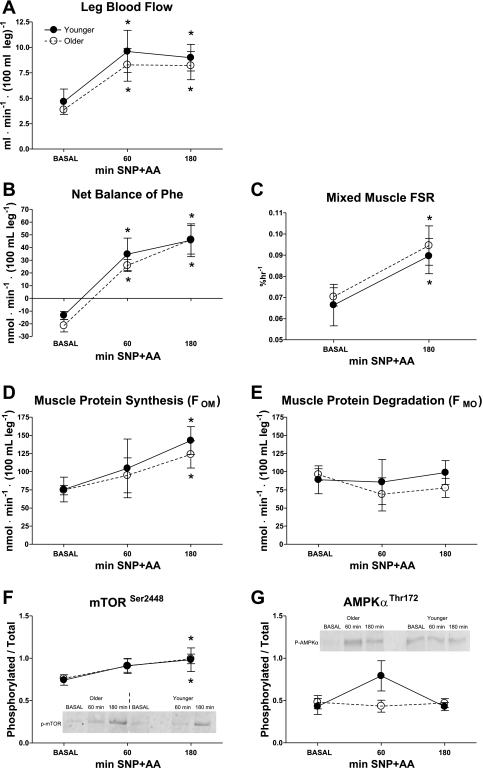
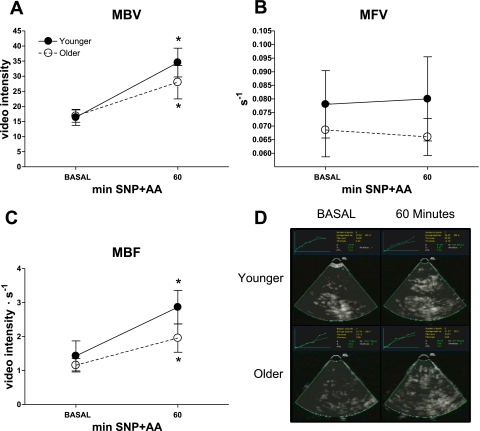
The combination of increasing blood flow and amino acid (AA) availability provides an anabolic stimulus to the skeletal muscle of healthy young adults by optimizing both AA delivery and utilization. However, aging is associated with a blunted response to anabolic stimuli and may involve impairments in endothelial function. We investigated whether age-related differences exist in the muscle protein anabolic response to AAs between younger (30 ± 2 yr) and older (67 ± 2 yr) adults when macrovascular and microvascular leg blood flow were similarly increased with the nitric oxide (NO) donor, sodium nitroprusside (SNP). Regardless of age, SNP+AA induced similar increases above baseline (P ≤ 0.05) in macrovascular flow (4.3 vs. 4.4 ml·min(-1)·100 ml leg(-1) measured using indocyanine green dye dilution), microvascular flow (1.4 vs. 0.8 video intensity/s measured using contrast-enhanced ultrasound), phenylalanine net balance (59 vs. 68 nmol·min(-1)·100 ml·leg(-1)), fractional synthetic rate (0.02 vs. 0.02%/h), and model-derived muscle protein synthesis (62 vs. 49 nmol·min(-1)·100 ml·leg(-1)) in both younger vs. older individuals, respectively. Provision of AAs during NO-induced local skeletal muscle hyperemia stimulates skeletal muscle protein metabolism in older adults to a similar extent as in younger adults. Our results suggest that the aging vasculature is responsive to exogenous NO and that there is no age-related difference per se in AA-induced anabolism under such hyperemic conditions.


Figures
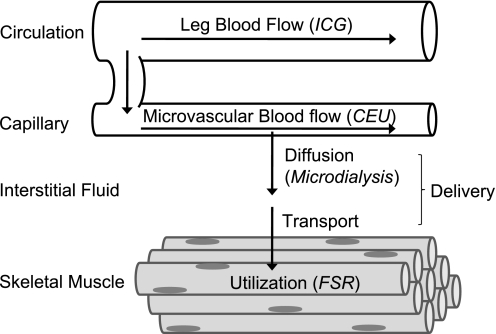
Fig. 1.
Fig. 1.
Simplified schematic illustrating amino acid flux from blood circulation into skeletal muscle tissue. Outflux of amino acids from tissue into circulation is not shown. Techniques used in the various physiological compartments are indicated in parentheses: ICG denotes indocyanine green, CEU denotes contrast-enhanced ultrasound, and FSR denotes fractional synthetic rate.
Fig. 2.
Fig. 2.
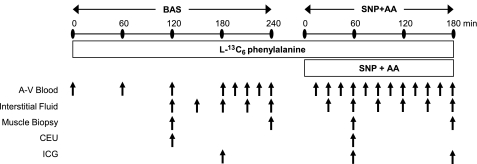
Experimental and stable isotope infusion protocol. After background blood samples were collected, a primed constant infusion of l-[ring-13C6] phenylalanine was maintained throughout the entire experiment. After a basal period of 240 min (BAS), all subjects received a primed constant infusion of sodium nitroprusside and amino acids (SNP+AA) for the following 180 min.
Fig. 3.
Fig. 3.
Leg blood flow (BF; A) was measured by ICG dye dilution in healthy younger and older adults during BASAL and again during SNP+AA at 60 and 180 min. Phenylalanine net balance (NB, B) was measured in healthy younger and older adults during BASAL and again during SNP+AA at 60 min and 180 min. No differences were found between younger and older. Values are expressed as ml·min−1·100 ml leg volume−1. Fractional synthesis rate (FSR; C) of mixed muscle was measured in healthy younger and older subjects during BASAL and during AA + SNP at 180 min. Muscle protein synthesis (FOM, D) and degradation (FMO, E) were calculated in healthy younger and older adults during BASAL and again during SNP+AA at 60 min and 180 min. Ratios of phosphorylated to total protein expression of mTOR (F), and AMPKα (G) in skeletal muscle of younger and older individuals. Student's t-tests were conducted for descriptive purposes only after general linear mixed model revealed a significant effect of time for mTOR (P < 0.05). Student's t-tests were conducted for descriptive purposes only after general linear mixed model revealed a significant effect of time (P < 0.01). *Significant difference from BASAL (Student's t-test, P < 0.05). No differences between younger and older. Lines connecting related data are for descriptive purposes only and do not imply linear changes with time.
Fig. 4.
Fig. 4.
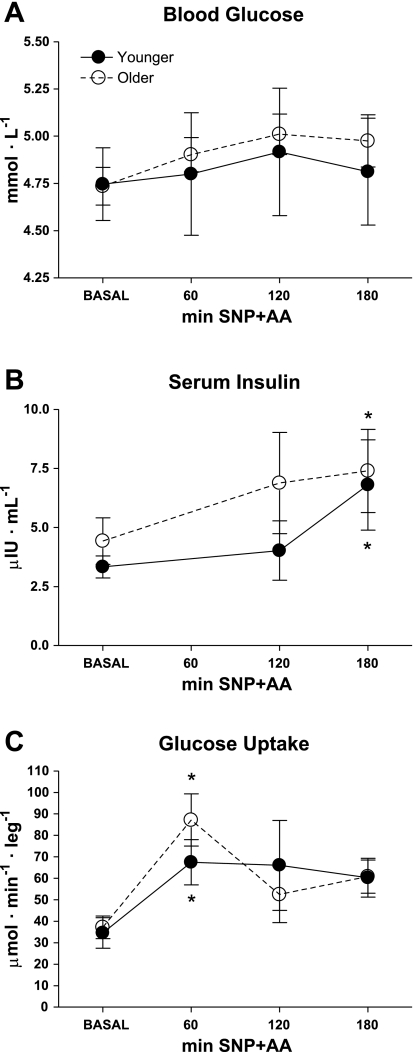
Blood glucose (A) was measured in healthy younger and older adults during BASAL and again during SNP+AA at 60, 120, and 180 min. Serum insulin (B) was measured during BASAL and again during SNP+AA at 120 and 180 min. Glucose uptake (C) was calculated during BASAL and again during SNP+AA at 60 min, 120 min, and 180 min. Student's t-tests were conducted for descriptive purposes only after a general linear mixed model revealed a significant effect of time (P < 0.01). *Significant difference from BASAL. No differences between younger and older. Lines connecting related data are for descriptive purposes only and do not imply linear changes with time.
Fig. 5.
Fig. 5.
Microvascular blood flow was measured by contrast-enhanced ultrasound (CEU). Microvascular blood volume (MBV; A), microvascular flow velocity (MFV; B), microvascular blood flow (MBF; C), and representative images captured during 10-s pulsing intervals (D) in healthy younger and older subjects during BASAL and SNP+AA at 60 min. Student's t-tests were conducted for descriptive purposes only after general linear mixed model revealed a significant effect of time for MBV (P < 0.005) and MBF (P < 0.01). *Significant difference from BASAL. Lines connecting related data are for descriptive purposes only and do not imply linear changes with time.
Fig. 6.
Fig. 6.
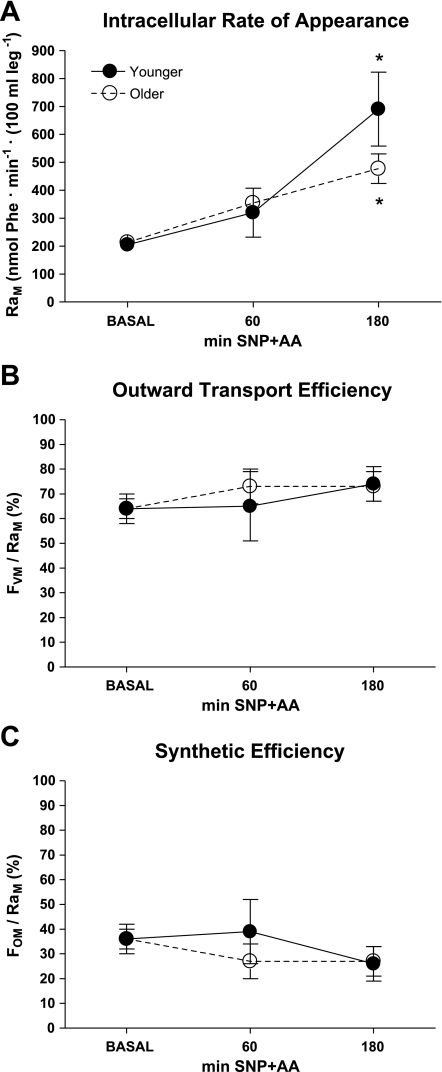
Skeletal muscle phenylalanine trafficking. Intracellular rate of appearance (RaM; A), outward transport efficiency (FVM/RaM; B), and synthetic efficiency (FOM/RaM; C) were calculated. Student's t-tests were conducted for descriptive purposes only after general linear mixed model revealed a significant effect of time for RaM (P < 0.05). *Significant difference from BASAL. There were no significant differences between younger and older individuals at any time. Lines connecting related data are for descriptive purposes only and do not imply linear changes with time.

References

    1. Baron AD, Tarshoby M, Hook G, Lazaridis EN, Cronin J, Johnson A, Steinberg HO. Interaction between insulin sensitivity and muscle perfusion on glucose uptake in human skeletal muscle: evidence for capillary recruitment. Diabetes 49: 768–774, 2000 - PubMed
    1. Baumann PQ, Stirewalt WS, O'Rourke BD, Howard D, Nair KS. Precursor pools of protein synthesis: a stable isotope study in a swine model. Am J Physiol Endocrinol Metab 267: E203–E209, 1994 - PubMed
    1. Bergstrom J, Furst P, Nore LO, Vinnars E. Intracellular free amino acid concentration in human muscle tissue. J Appl Physiol 36: 693–697, 1974 - PubMed
    1. Biolo G, Fleming RY, Maggi SP, Wolfe RR. Transmembrane transport and intracellular kinetics of amino acids in human skeletal muscle. Am J Physiol Endocrinol Metab 268: E75–E84, 1995 - PubMed
    1. Cuthbertson D, Smith K, Babraj J, Leese G, Waddell T, Atherton P, Wackerhage H, Taylor PM, Rennie MJ. Anabolic signaling deficits underlie amino acid resistance of wasting, aging muscle. FASEB J 19: 422–424, 2005 - PubMed

Publication types

MeSH terms