


Epitope-specific human influenza antibody repertoires diversify by B cell intraclonal sequence divergence and interclonal convergence
- PMID: 21880983
- PMCID: PMC3178754
- DOI: 10.4049/jimmunol.1101823
Epitope-specific human influenza antibody repertoires diversify by B cell intraclonal sequence divergence and interclonal convergence
Abstract
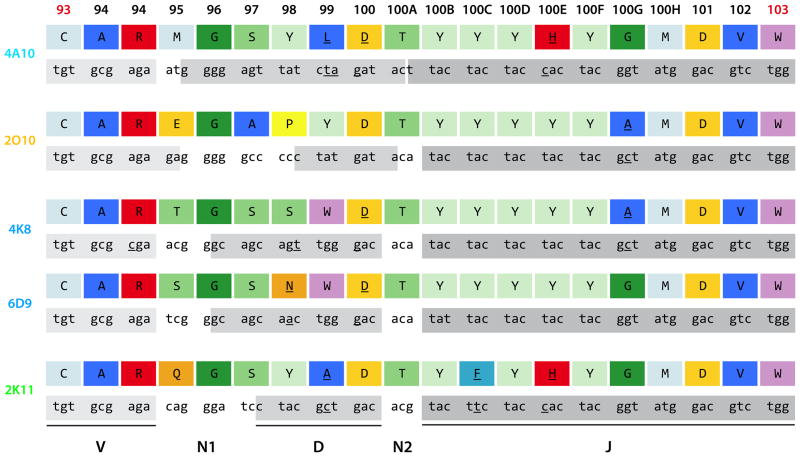
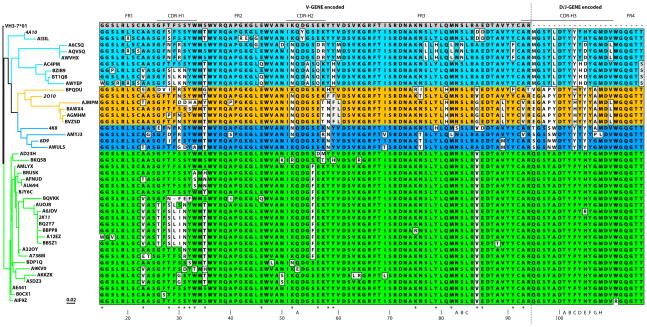
We generated from a single blood sample five independent human mAbs that recognized the Sa antigenic site on the head of influenza hemagglutinin and exhibited inhibitory activity against a broad panel of H1N1 strains. All five Abs used the V(H)3-7 and J(H)6 gene segments, but at least four independent clones were identified by junctional analysis. High-throughput sequence analysis of circulating B cells revealed that each of the independent clones were members of complex phylogenetic lineages that had diversified widely using a pattern of progressive diversification through somatic mutation. Unexpectedly, B cells encoding multiple diverging lineages of these clones, including many containing very few mutations in the Ab genes, persisted in the circulation. Conversely, we noted frequent instances of amino acid sequence convergence in the Ag combining sites exhibited by members of independent clones, suggesting a strong selection for optimal binding sites. We suggest that maintenance in circulation of a wide diversity of somatic variants of dominant clones may facilitate recognition of drift variant virus epitopes that occur in rapidly mutating virus Ags, such as influenza hemagglutinin. In fact, these Ab clones recognize an epitope that acquired three glycosylation sites mediating escape from previously isolated human Abs.
Figures
References
-
- Libster R, Bugna J, Coviello S, Hijano DR, Dunaiewsky M, Reynoso N, Cavalieri ML, Guglielmo MC, Areso MS, Gilligan T, Santucho F, Cabral G, Gregorio GL, Moreno R, Lutz MI, Panigasi AL, Saligari L, Caballero MT, Egues Almeida RM, Gutierrez Meyer ME, Neder MD, Davenport MC, Del Valle MP, Santidrian VS, Mosca G, Garcia Dominguez M, Alvarez L, Landa P, Pota A, Bolonati N, Dalamon R, Sanchez Mercol VI, Espinoza M, Peuchot JC, Karolinski A, Bruno M, Borsa A, Ferrero F, Bonina A, Ramonet M, Albano LC, Luedicke N, Alterman E, Savy V, Baumeister E, Chappell JD, Edwards KM, Melendi GA, Polack FP. Pediatric hospitalizations associated with 2009 pandemic influenza A (H1N1) in Argentina. N Engl J Med. 2010;362:45–55. - PubMed
-
- Centers for Disease Control and Prevention. Serum cross-reactive antibody response to a novel influenza A (H1N1) virus after vaccination with seasonal influenza vaccine. MMWR Morb Mortal Wkly Rep. 2009;58:521–524. - PubMed
-
- Hancock K, Veguilla V, Lu X, Zhong W, Butler EN, Sun H, Liu F, Dong L, DeVos JR, Gargiullo PM, Brammer TL, Cox NJ, Tumpey TM, Katz JM. Cross-reactive antibody responses to the 2009 pandemic H1N1 influenza virus. N Engl J Med. 2009;361:1945–1952. - PubMed
-
- Itoh Y, Shinya K, Kiso M, Watanabe T, Sakoda Y, Hatta M, Muramoto Y, Tamura D, Sakai-Tagawa Y, Noda T, Sakabe S, Imai M, Hatta Y, Watanabe S, Li C, Yamada S, Fujii K, Murakami S, Imai H, Kakugawa S, Ito M, Takano R, Iwatsuki-Horimoto K, Shimojima M, Horimoto T, Goto H, Takahashi K, Makino A, Ishigaki H, Nakayama M, Okamatsu M, Warshauer D, Shult PA, Saito R, Suzuki H, Furuta Y, Yamashita M, Mitamura K, Nakano K, Nakamura M, Brockman-Schneider R, Mitamura H, Yamazaki M, Sugaya N, Suresh M, Ozawa M, Neumann G, Gern J, Kida H, Ogasawara K, Kawaoka Y. In vitro and in vivo characterization of new swine-origin H1N1 influenza viruses. Nature. 2009;460:1021–1025. - PMC - PubMed
Publication types
MeSH terms
Substances
Grants and funding
- UL1RR029887/RR/NCRR NIH HHS/United States
- EY008126/EY/NEI NIH HHS/United States
- P30 DK058404/DK/NIDDK NIH HHS/United States
- P30 EY008126/EY/NEI NIH HHS/United States
- P30 CA068485/CA/NCI NIH HHS/United States
- UL1 RR029887/RR/NCRR NIH HHS/United States
- HHSN272200900047C/AI/NIAID NIH HHS/United States
- CA068485/CA/NCI NIH HHS/United States
- DK058404/DK/NIDDK NIH HHS/United States
- R21 AI085306/AI/NIAID NIH HHS/United States
- R21AI085306/AI/NIAID NIH HHS/United States
- P01 AI058113/AI/NIAID NIH HHS/United States
LinkOut - more resources
Full Text Sources
Other Literature Sources
