. 2012 Mar;6(3):638-49.
doi: 10.1038/ismej.2011.114. Epub 2011 Sep 1.

Black reefs: iron-induced phase shifts on coral reefs

Affiliations

Black reefs: iron-induced phase shifts on coral reefs

Linda Wegley Kelly et al. ISME J. 2012 Mar.

Erratum in

  • ISME J. 2012 Mar;6(3):708

Abstract

The Line Islands are calcium carbonate coral reef platforms located in iron-poor regions of the central Pacific. Natural terrestrial run-off of iron is non-existent and aerial deposition is extremely low. However, a number of ship groundings have occurred on these atolls. The reefs surrounding the shipwreck debris are characterized by high benthic cover of turf algae, macroalgae, cyanobacterial mats and corallimorphs, as well as particulate-laden, cloudy water. These sites also have very low coral and crustose coralline algal cover and are call black reefs because of the dark-colored benthic community and reduced clarity of the overlying water column. Here we use a combination of benthic surveys, chemistry, metagenomics and microcosms to investigate if and how shipwrecks initiate and maintain black reefs. Comparative surveys show that the live coral cover was reduced from 40 to 60% to <10% on black reefs on Millennium, Tabuaeran and Kingman. These three sites are relatively large (>0.75 km(2)). The phase shift occurs rapidly; the Kingman black reef formed within 3 years of the ship grounding. Iron concentrations in algae tissue from the Millennium black reef site were six times higher than in algae collected from reference sites. Metagenomic sequencing of the Millennium Atoll black reef-associated microbial community was enriched in iron-associated virulence genes and known pathogens. Microcosm experiments showed that corals were killed by black reef rubble through microbial activity. Together these results demonstrate that shipwrecks and their associated iron pose significant threats to coral reefs in iron-limited regions.


Figures
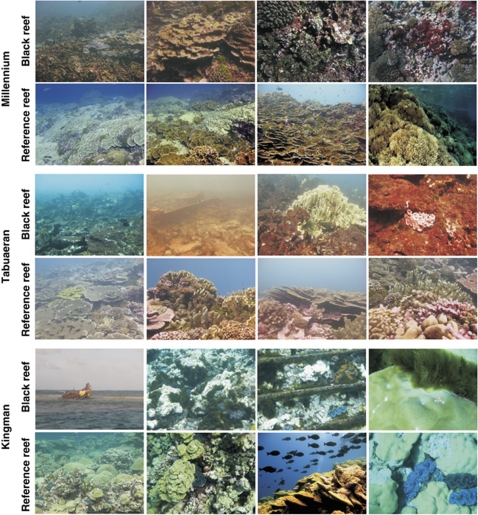
Figure 1
Figure 1
Representative photographs of benthic habitats from black reefs and reference reefs on Millennium (rows 1 and 2), Tabuaeran (rows 3 and 4) and Kingman (rows 5 and 6).
Figure 2
Figure 2
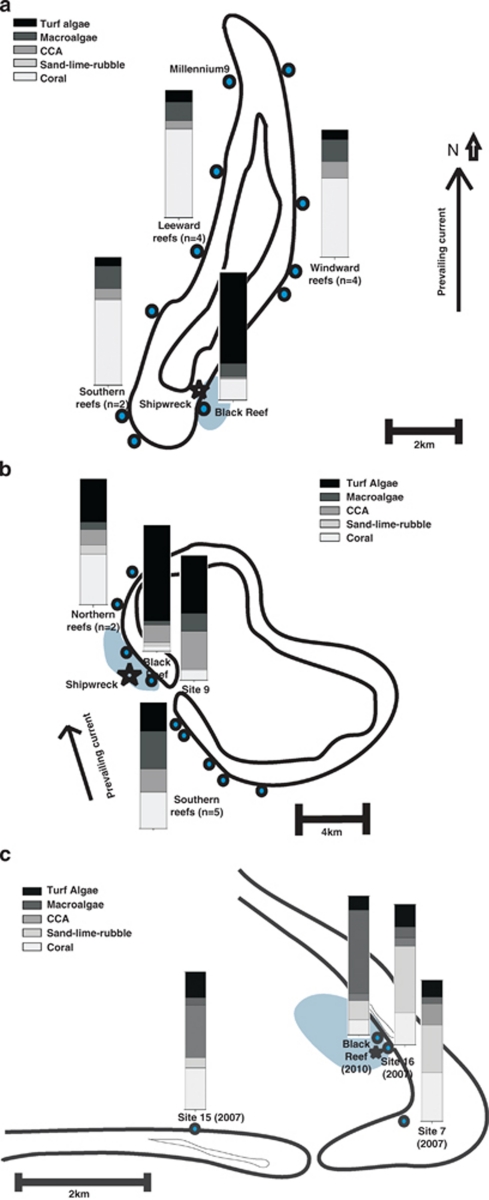
(a) The benthic community composition present on Millennium atoll. The bar graphs represent the percent cover of coral, CCA, macroalgae and turf algae on reefs from Millennium (0.72 m2 quadrats per site, n=20). On the black reef, the average percent cover of various benthic organisms was as follows: corals 16.7%±4.3, CCA 1.5%±0.6, turf algae 71%±4.9 and macroalgae 10.6%±2.0. For 10 control sites around Millennium, the average percent cover of various benthic organisms was as follows: corals 65.9%±7.6, CCA 9.2%±2.9, turf algae 7.9%±2.3 and macroalgae 16.3%±4.5. The photographs depict benthic assemblages characteristic of leeward and windward reefs, and of the black reef. The black arrow indicates the direction of the prevailing current. Water flowed out of the lagoon through the passage where the shipwreck occurred and to the south. (b) The benthic community composition present on Tabuaeran. The photographs depict the benthic assemblages characteristic of the northern leeward reefs, site-2 (black reef), site-9 and of the southern leeward reefs on Tabuaeran. The bar graphs represent the percent cover of coral, CCA, macroalgae and turf algae. The black arrow indicates the direction of the prevailing current. (c) The benthic community composition for back-reef sites on Kingman Reef. Sites 7, 15 and 16 were measured in August 2007 prior to the influence of shipwreck debris. The black reef site was measured in October 2010. The area of reef estimated to be impacted by shipwreck debris is indicated with light blue shading.
Figure 3
Figure 3
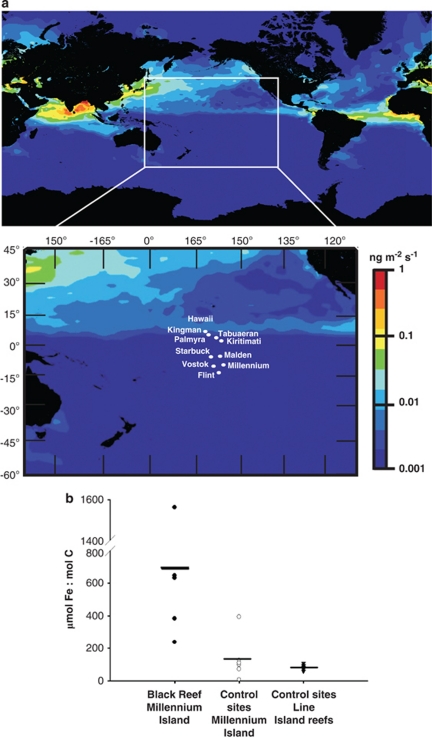
Regional and local iron concentrations. (a) Iron concentrations across the world with an emphasis on the central Pacific (data for oceanic iron concentrations were taken from Behrenfeld et al., 2009). The colored bar estimates iron deposition (ng m−2 s−1). (b) The elemental stoichiometry of iron incorporated into the tissues of benthic organisms from the black reef, control sites on Millennium and from other LI reefs. Iron and carbon concentrations were measured using ICP-OS and EA, respectively. The horizontal line represents the mean of each data set.
Figure 4
Figure 4
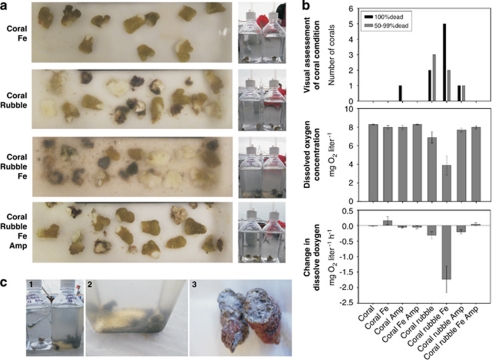
Mesocosm experiments measuring the response of corals and algal-covered rubble to iron enrichment. (a) P. meandrina corals were treated with 1 μ ferric iron (FeCl3) with and without the presence of black reef algae. The same treatments were conducted plus 50 μg ml−1 ampicillin. Coral fragments and mesocosms were photo documented after 5 days (4 of 8 treatments shown, n=10). (b) Coral condition was visually assessed (top panel). The concentration of DO (mg O2 l−1) in the aquarium water was measured at the completion of the experiment (middle panel). The rate of change in DO (mg O2 l−1 h−1) was also measured (bottom panel). Fe, ferric iron; Amp, ampicillin. (c) Photographs of iron-enriched mesocosms depicting water turbidity (1) and the formation of black particulate material characteristic of the black reef (2). Cross-section of algal-covered rubble collected from the Millennium black reef (3).
Figure 5
Figure 5
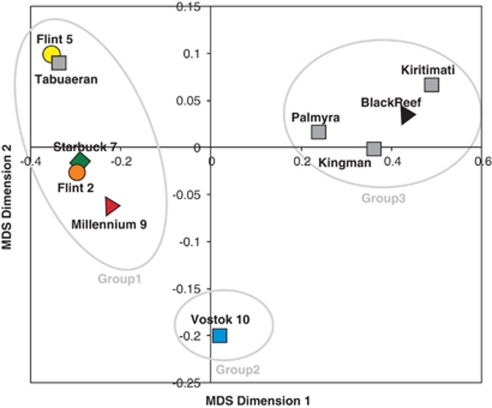
Metabolic profile for the microbial community inhabiting the black reef compared with nine other coral reefs. The scatter-plot depicts the first two dimensions of the nMDS analysis. The 10 microbial metagenomes used for this analysis include six southern and four northern LI coral reefs (Dinsdale et al., 2008b). Metagenomic libraries collected from northern LI reefs are depicted with gray squares. Metagenomic libraries collected from the same atoll are depicted with the same symbol (for example, circles for Flint and triangles for Millennium). The three grouping shown were determined by a similarity profile test (P⩽0.05).

References

    1. Abram NJ, Gagan MK, McCulloch MT, Chappell J, Hantoro WS. Coral reef death during the 1997 Indian Ocean dipole linked to Indonesian wildfires. Science. 2003;301:952–955. - PubMed
    1. Abram NJ, Gagan MK, McCulloch MT, Chappell J, Hantoro WS. The sudden death of a coral reef—Response. Science. 2004;303:1293–1294.
    1. Altschul SF, Gish W, Miller W, Myers EW, Lipman DJ. Basic local alignment search tool. J Mol Biol. 1990;215:403–410. - PubMed
    1. Amin SA, Green DH, Hart MC, Kupper FC, Sunda WG, Carrano CJ. Photolysis of iron–siderophore chelates promotes bacterial–algal mutualism. Proc Natl Acad Sci USA. 2009;106:17071–17076. - PMC - PubMed
    1. Anderson RM.1998Analytical theory of epidemicsIn: Krause RM (ed).Emerging Infections Academic Press: New York, NY; 23–50.

Publication types