


Association of bile acid receptor TGR5 variation and transit in health and lower functional gastrointestinal disorders
- PMID: 21883702
- PMCID: PMC3190664
- DOI: 10.1111/j.1365-2982.2011.01772.x
Association of bile acid receptor TGR5 variation and transit in health and lower functional gastrointestinal disorders
Abstract
Background: The membrane bound bile acid (BA) receptor, TGR5, is located on myenteric, cholinergic and nitrergic neurons in colon and proximal small intestine. Our aim was to assess the association of genetic variation in TGR5 and small bowel transit (SBT) and colonic transit.
Methods: In 230 healthy controls and 414 patients with lower functional GI disorders [FGID: irritable bowel syndrome (IBS)-alternators (Alt) 84, IBS-constipation (IBS-C) 157, IBS-diarrhea (IBS-D) 173], we tested the association between TGR5 SNP rs11554825 (minor allele frequency 41%) with symptom phenotype (total cohort) and intermediate phenotype (SBT or colonic transit by radioscintigraphy) which was available in 213 people in this cohort. The association with symptom phenotype was assessed using logistic regression, while the association with colonic filling at 6 h (CF6), and colonic transit [geometric center (GC) at 24 h] was assessed using ancova, in each instance assuming a dominant genetic model.
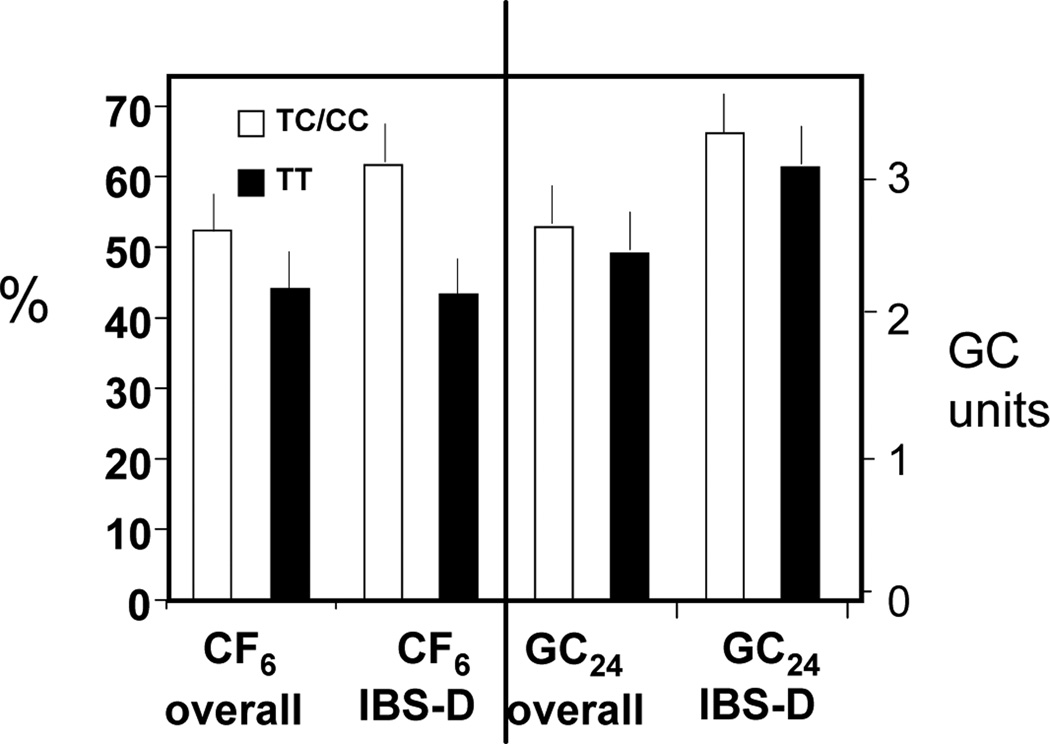
Key results: There was no significant association with symptom phenotype. We observed a potential association of SNP rs11554825 with overall transit: CF6 (P = 0.061) and GC24 (P = 0.083). The association of the SNP with CF6 in the IBS-D subgroup (P = 0.017) indicated the TC/CC subgroup had an average 50% faster SBT compared with the TT subgroup. In IBS-D patients, GC24 was not significantly associated with rs11554825 (TC/CC vs TT).
Conclusions & inferences: Variation in TGR5 may contribute to altered SBT and colonic transit in lower FGID. Further studies are required to characterize the potential role of BA receptor, TGR5, in the mechanism and treatment of bowel dysfunction in lower FGID.
© 2011 Blackwell Publishing Ltd.
Conflict of interest statement
Figures
References
-
- Claudel T, Staels B, Kuipers F. The Farnesoid X receptor: a molecular link between bile acid and lipid and glucose metabolism. Arterioscler Thromb Vasc Biol. 2005;25:2020–2030. - PubMed
-
- Wang H, Chen J, Hollister K, Sowers LC, Forman BM. Endogenous bile acids are ligands for the nuclear receptor FXR/BAR. Mol Cell. 1999;3:543–553. - PubMed
-
- Maruyama T, Miyamoto Y, Nakamura T, et al. Identification of membrane-type receptor for bile acids (M-BAR) Biochem Biophys Res Commun. 2002;298:714–719. - PubMed
-
- Kawamata Y, Fujii R, Hosoya M, et al. A G protein-coupled receptor responsive to bile acids. J Biol Chem. 2003;278:9435–9440. - PubMed
-
- Kuipers F, Stroeve JH, Caron S, Staels B. Bile acids, farnesoid X receptor, atherosclerosis and metabolic control. Curr Opin Lipidol. 2007;18:289–297. - PubMed
Publication types
MeSH terms
Substances
Grants and funding
LinkOut - more resources
Full Text Sources
Other Literature Sources
Miscellaneous
