


Rapid evolution caused by pollinator loss in Mimulus guttatus
- PMID: 21884055
- PMCID: PMC5958604
- DOI: 10.1111/j.1558-5646.2011.01326.x
Rapid evolution caused by pollinator loss in Mimulus guttatus
Abstract
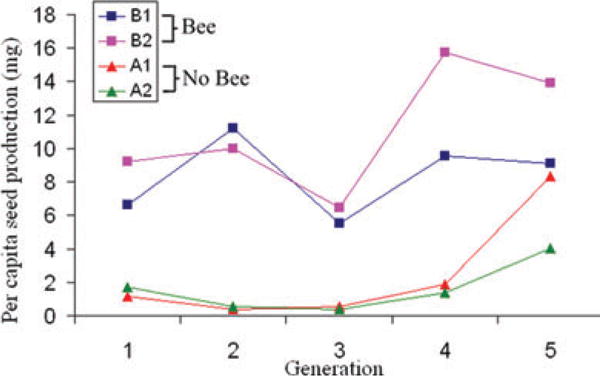
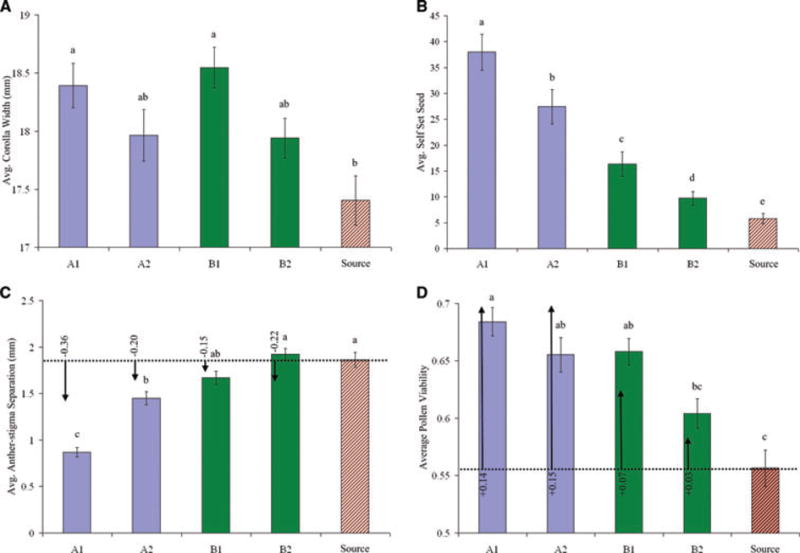
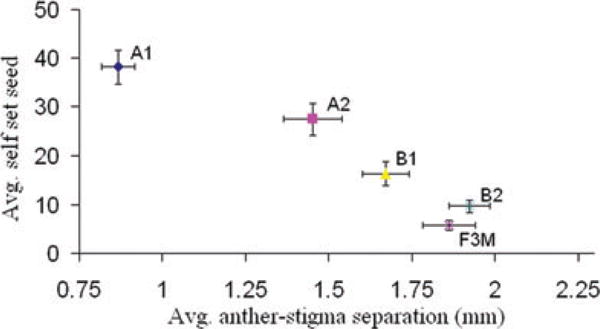
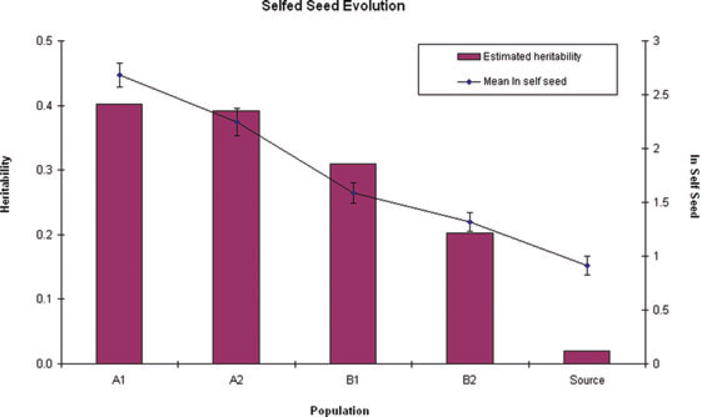
Anthropogenic perturbations including habitat loss and emerging disease are changing pollinator communities and generating novel selection pressures on plant populations. Disruption of plant-pollinator relationships is predicted to cause plant mating system evolution, although this process has not been directly observed. This study demonstrates the immediate evolutionary effects of pollinator loss within experimental populations of a predominately outcrossing wildflower. Initially equivalent populations evolved for five generations within two pollination treatments: abundant bumblebee pollinators versus no pollinators. The populations without pollinators suffered greatly reduced fitness in early generations but rebounded as they evolved an improved ability to self-fertilize. All populations diverged in floral, developmental, and life-history traits, but only a subset of characters showed clear association with pollination treatment. Pronounced treatment effects were noted for anther-stigma separation and autogamous seed set. Dramatic allele frequency changes at two chromosomal polymorphisms occurred in the no pollinator populations, explaining a large fraction of divergence in pollen viability. The pattern of phenotypic and genetic changes in this experiment favors a sequential model for the evolution of the multitrait "selfing syndrome" observed throughout angiosperms.
© 2011 The Author(s).
Figures
References
-
- Agrawal AF, Brodie ED, Rieseberg LH. Possible consequences of genes of major effect: transient changes in the G-matrix. Genetica. 2001;112–113:33–43. - PubMed
-
- Arathi HS, Kelly JK. Corolla morphology facilitates both autogamy and bumblebee pollination in Mimulus guttatus. Int J Plant Sci. 2004;165:139–145.
-
- Armbruster P, Reed DH. Inbreeding depression in benign and stressful environments. Heredity. 2005;95:235–242. - PubMed
-
- Awadalla P, Ritland K. Microsatellite variation and evolution in the Mimulus guttatus species complex with contrasting mating systems. Mol Biol Evol. 1997;14:1023–1034. - PubMed
-
- Baker HG. Support for Baker’s Law-as a rule. Evolution. 1967;21:853–856. - PubMed
Publication types
MeSH terms
Grants and funding
LinkOut - more resources
Full Text Sources
Other Literature Sources