


The CHADS2 score predicts ischemic stroke in the absence of atrial fibrillation among subjects with coronary heart disease: data from the Heart and Soul Study
- PMID: 21884876
- PMCID: PMC3199107
- DOI: 10.1016/j.ahj.2011.05.023
The CHADS2 score predicts ischemic stroke in the absence of atrial fibrillation among subjects with coronary heart disease: data from the Heart and Soul Study
Abstract
Background: We sought to evaluate the prognostic performance of the CHADS(2) score for prediction of ischemic stroke/transient ischemic attack (TIA) in subjects with coronary heart disease (CHD) without atrial fibrillation (AF).
Methods: In 916 nonanticoagulated outpatients with stable CHD and no AF by baseline electrocardiogram, we calculated CHADS(2) scores (congestive heart failure, hypertension, age ≥75 years, diabetes [1 point each], and prior stroke or TIA [2 points]). The primary outcome was time to ischemic stroke or TIA over a mean follow-up of 6.4 ± 2.3 years.
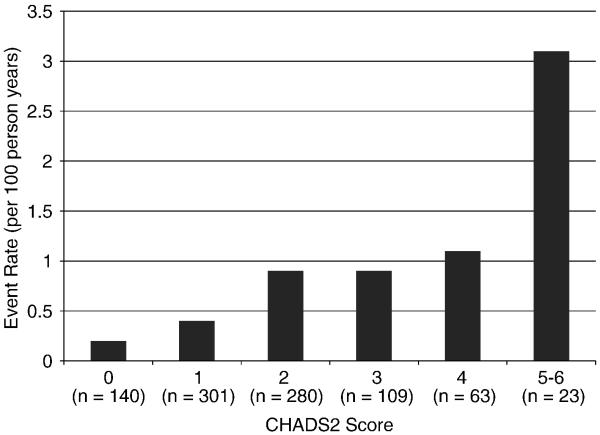
Results: Over 5,821 person-years of follow-up, 40 subjects had an ischemic stroke/TIA (rate 0.69/100 person-years, 95% CI 0.50-0.94). Compared with subjects with low (0-1) CHADS(2) scores, those with intermediate (2-3) and high (4-6) CHADS(2) scores had an increased rate of stroke/TIA, even after adjustment for age, tobacco, antiplatelet therapy, statins, and angiotensin inhibitors (CHADS(2) score 2-3: HR 2.4, 95% CI 1.1-5.3, P = .03; CHADS(2) score 4-6: HR 4.0, 95% CI 1.5-10.6, P = .006). Model discrimination (c-statistic = 0.65) was comparable with CHADS(2) model fit in published AF-only cohorts.
Conclusions: The CHADS(2) score predicts ischemic stroke/TIA in subjects with stable CHD and no baseline AF. The event rate in non-AF subjects with high CHADS(2) scores (5-6) was comparable with published rates in AF patients with moderate CHADS(2) scores (1-2), a population known to derive benefit from stroke prevention therapies. These findings should inform efforts to determine whether stroke prevention therapies or screening for silent AF may benefit subjects with stable CHD and high CHADS(2) scores.
Copyright © 2011 Mosby, Inc. All rights reserved.
Figures

References
-
- Gage BF. Validation of clinical classification schemes for predicting stroke: Results from the National Registry of Atrial Fibrillation. Jama. 2001;285:2864–2870. - PubMed
-
- Camm AJ, Kirchhof P, Lip GYH, et al. Guidelines for the management of atrial fibrillation. European Heart Journal. 2010;31:2369–2429. - PubMed
-
- Singer D, Albers G, Dalen J, et al. American College of Chest Physicians. Antithrombotic therapy in atrial fibrillation: American College of Chest Physicians evidence-based clinical practice guidelines. Chest. 2008;133:546S–592S. - PubMed
-
- Fuster V, Ryden L, Cannom D, et al. ACC/AHA/ESC 2006 guidelines for the management of patients with atrial fibrillation: A report of the American College of Cardiology/American Heart Association task force on practice guidelines and the European Society of Cardiology committee for practice guidelines (writing committee to revise the 2001 guidelines for the management of patients with atrial fibrillation): Developed in collaboration with the European Heart Rhythm association and the Heart Rhythm Society. Circulation. 2006;114:e257. - PubMed
-
- Lloyd-Jones D, Adams R, Carnethon M, et al. Heart disease and stroke statistics--2009 update: A report from the American Heart Association statistics committee and stroke statistics subcommittee. Circulation. 2009;119:e21–181. - PubMed
Publication types
MeSH terms
Grants and funding
LinkOut - more resources
Full Text Sources
Medical
