


Diffusion tensor imaging tractography of the optic radiation for epilepsy surgical planning: a comparison of two methods
- PMID: 21885257
- PMCID: PMC3223565
- DOI: 10.1016/j.eplepsyres.2011.07.019
Diffusion tensor imaging tractography of the optic radiation for epilepsy surgical planning: a comparison of two methods
Abstract
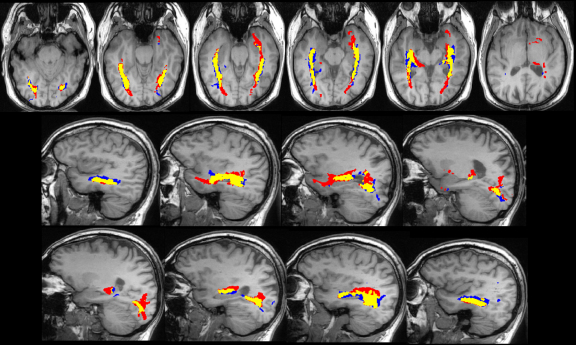
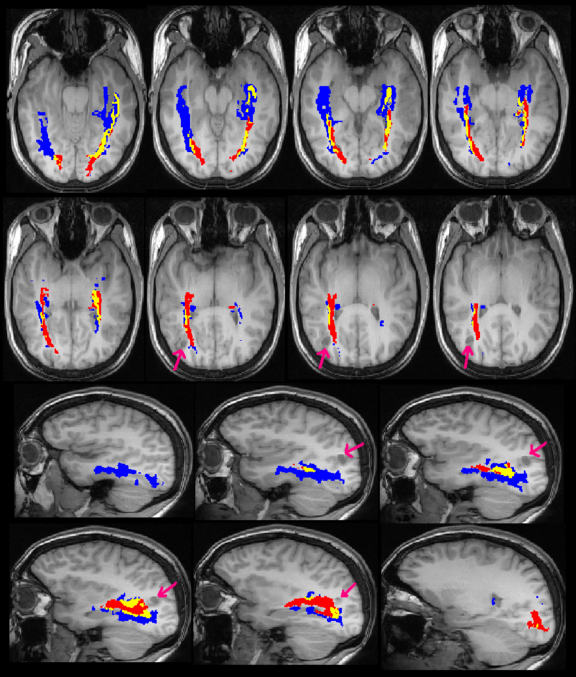
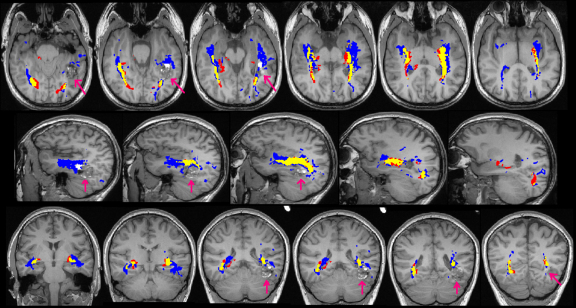
The optic radiation is a key white matter structure at risk during epilepsy surgery involving the temporal, parietal or occipital lobes. It shows considerable anatomical variability, cannot be delineated on clinical MRI sequences and damage may cause a disabling visual field deficit. Diffusion tensor imaging tractography allows non-invasive mapping of this pathway. Numerous methods have been published but direct comparison is difficult as patient, acquisition and analysis parameters differ. Two methods for delineating the optic radiation were applied to 6 healthy controls and 4 patients with epileptogenic lesions near the optic radiation. By comparing methods with the same datasets, many of the parameters could be controlled. The first method was previously developed to accurately identify Meyer's loop for planning anterior temporal lobe resection. The second aimed to address limitations of this method by using a more automated technique to reduce operator time and to depict the entire optic radiation. Whilst the core of the tract was common to both methods, there was significant variability between the methods. Method 1 gave a more consistent depiction of Meyer's loop with fewer spurious tracts. Method 2 gave a better depiction of the entire optic radiation, particularly in more posterior portions, but did not identify Meyer's loop in one patient. These results show that whilst tractography is a promising technique, there is significant variability depending on the method chosen even when the majority of parameters are fixed. Different methods may need to be chosen for surgical planning depending on the individual clinical situation.
Crown Copyright © 2011. Published by Elsevier B.V. All rights reserved.
Figures
References
-
- Alexander D.C., Barker G.J., Arridge S.R. Detection and modeling of non-Gaussian apparent diffusion coefficient profiles in human brain data. Magn. Reson. Med. 2002;48:331–340. - PubMed
-
- Barton J.J., Hefter R., Chang B., Schomer D., Drislane F. The field defects of anterior temporal lobectomy: a quantitative reassessment of Meyer's loop. Brain. 2005;128:2123–2133. - PubMed
-
- Basser P.J. Inferring microstructural features and the physiological state of tissues from diffusion-weighted images. NMR Biomed. 1995;8:333–344. - PubMed
-
- Behrens T.E., Johansen-Berg H., Woolrich M.W., Smith S.M., Wheeler-Kingshott C.A., Boulby P.A., Barker G.J., Sillery E.L., Sheehan K., Ciccarelli O., Thompson A.J., Brady J.M., Matthews P.M. Non-invasive mapping of connections between human thalamus and cortex using diffusion imaging. Nat. Neurosci. 2003;6:750–757. - PubMed
-
- Catani M., Jones D.K., Donato R., Ffytche D.H. Occipito-temporal connections in the human brain. Brain. 2003;126:2093–2107. - PubMed
