


Review
doi: 10.1126/science.1207084.
Synthetic biology: integrated gene circuits
Affiliations
- PMID: 21885772
- PMCID: PMC4117316
- DOI: 10.1126/science.1207084
Item in Clipboard
Review
Synthetic biology: integrated gene circuits
Science.
.
Abstract
A major goal of synthetic biology is to develop a deeper understanding of biological design principles from the bottom up, by building circuits and studying their behavior in cells. Investigators initially sought to design circuits "from scratch" that functioned as independently as possible from the underlying cellular system. More recently, researchers have begun to develop a new generation of synthetic circuits that integrate more closely with endogenous cellular processes. These approaches are providing fundamental insights into the regulatory architecture, dynamics, and evolution of genetic circuits and enabling new levels of control across diverse biological systems.
Figures
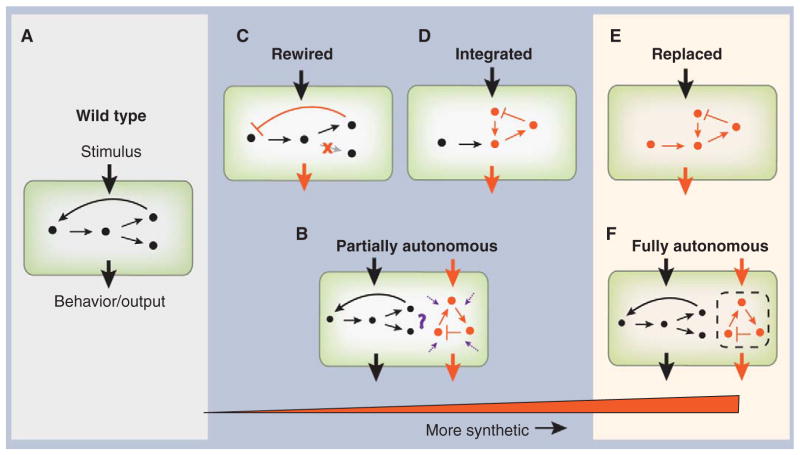
A continuum of synthetic biology. Wild-type cells (A) can be subject to two basic types of synthetic manipulation. (B) Autonomous synthetic circuits, consisting of ectopic components, may be introduced into the cell. Such circuits process inputs and implement functions (orange arrows) separate from the endogenous circuitry (black). However, unknown interactions with the host cell may affect their function (purple arrows). (C) An alternative is to rewire (orange lines) the endogenous circuits themselves to have new connectivity. (D) Extending this line of synthetic manipulation, synthetic circuits could be integrated into appropriately rewired endogenous circuitry to act as sensors and to implement additional functionality. Ultimate goals of this program are to be able to design and construct (E) synthetic circuits that can functionally replace endogenous circuits or (F) fully autonomous circuits that operate independently of the cellular mileu.
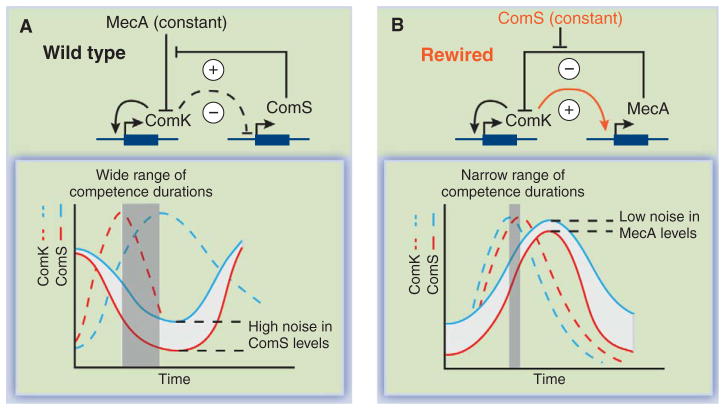
Rewiring an endogenous gene circuit. (A) (Top) Part of the natural competence circuit from B. subtilis. The MecA protease adaptor (assumed to be constant) degrades ComK; ComS inhibits this degradation and thus is an indirect activator. ComK indirectly represses ComS. (Bottom) Exit from competence depends on returning to low ComS levels. Noise in ComS (white region between red and blue curves, representing the extremes of the distribution of ComS profiles in a population) is significant at such low levels. The resulting distribution in ComK curves (red dashed and blue dashed)—and thus competence durations (vertical gray bar)—is wide. (B) (Top) The rewired competence circuit: Here the activation and repression loops have been switched. Competence exit occurs when MecA levels reach a high threshold. (Bottom) The resulting distribution of competence curves is narrow because variability in MecA is relatively low at high MecA concentrations.
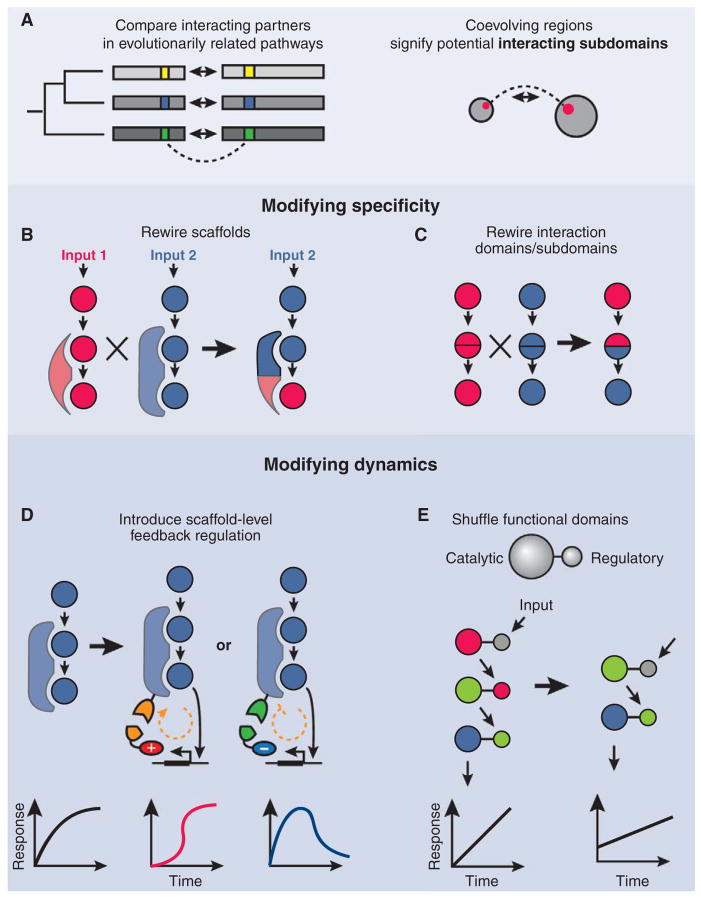
Diversifying signaling pathways through rewiring. (A) Sequence correlations among proteins from a large family (left, SCA, also see text) can be used to identify interacting subdomains (right). Interaction specificity can be altered by rewiring scaffolds (B) or by shuffling specificity-determining domains or subdomains (C). The dynamic behavior of a pathway can be modified by (D) introducing new autoregulatory connections or by (E) altering regulation directly at the protein level by generating new combinations of catalytic and regulatory protein domains.
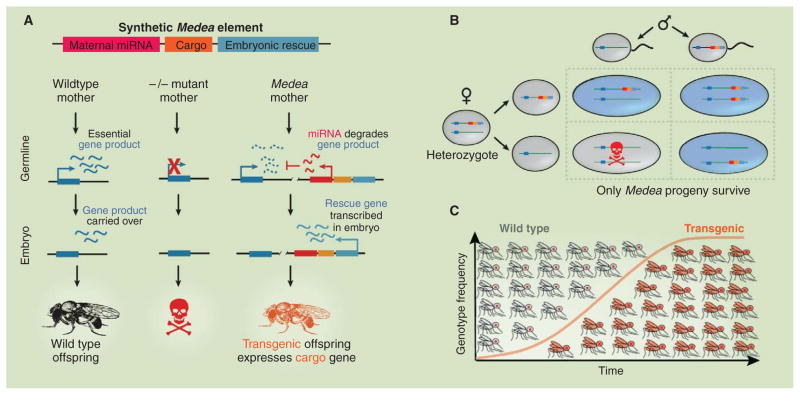
An integrated synthetic circuit controls development and population dynamics. (A) In Drosophila, the synthetic Medea element (top) maternally expresses an miRNA (red) that silences a maternally expressed gene whose product is essential for embryogenesis (left column). Eggs from female flies mutant for this gene do not hatch (middle column). The Medea element also contains a rescue gene that is expressed only in the early embryo. The Medea element may also accommodate a cargo gene that is expressed in Medea progeny (right column). (B) Progeny of female Medea-positive flies will only survive if they receive the Medea element from either parent. (C) This super-Mendelian inheritance pattern can efficiently drive Medea into populations.
References
Publication types
MeSH terms
Grants and funding
LinkOut - more resources
Full Text Sources
Other Literature Sources
