


Evaluation of artificial neural network algorithms for predicting METs and activity type from accelerometer data: validation on an independent sample
- PMID: 21885802
- PMCID: PMC3233887
- DOI: 10.1152/japplphysiol.00309.2011
Evaluation of artificial neural network algorithms for predicting METs and activity type from accelerometer data: validation on an independent sample
Abstract
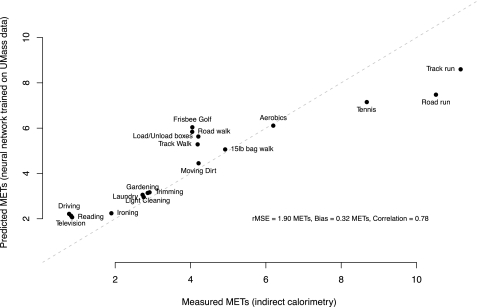
Previous work from our laboratory provided a "proof of concept" for use of artificial neural networks (nnets) to estimate metabolic equivalents (METs) and identify activity type from accelerometer data (Staudenmayer J, Pober D, Crouter S, Bassett D, Freedson P, J Appl Physiol 107: 1330-1307, 2009). The purpose of this study was to develop new nnets based on a larger, more diverse, training data set and apply these nnet prediction models to an independent sample to evaluate the robustness and flexibility of this machine-learning modeling technique. The nnet training data set (University of Massachusetts) included 277 participants who each completed 11 activities. The independent validation sample (n = 65) (University of Tennessee) completed one of three activity routines. Criterion measures were 1) measured METs assessed using open-circuit indirect calorimetry; and 2) observed activity to identify activity type. The nnet input variables included five accelerometer count distribution features and the lag-1 autocorrelation. The bias and root mean square errors for the nnet MET trained on University of Massachusetts and applied to University of Tennessee were +0.32 and 1.90 METs, respectively. Seventy-seven percent of the activities were correctly classified as sedentary/light, moderate, or vigorous intensity. For activity type, household and locomotion activities were correctly classified by the nnet activity type 98.1 and 89.5% of the time, respectively, and sport was correctly classified 23.7% of the time. Use of this machine-learning technique operates reasonably well when applied to an independent sample. We propose the creation of an open-access activity dictionary, including accelerometer data from a broad array of activities, leading to further improvements in prediction accuracy for METs, activity intensity, and activity type.
Figures
Comment in
-
"Divide and conquer": assessing energy expenditure following physical activity type classification.J Appl Physiol (1985). 2012 Mar;112(5):932; author reply 933. doi: 10.1152/japplphysiol.01403.2011. J Appl Physiol (1985). 2012. PMID: 22383498 No abstract available.
References
-
- ActiGraph Actisoft Analysis Software 3.2 User's Manual. Fort Walton Beach, FL: MTI Health Services, 2005, p. 17
-
- Ainsworth BE, Haskell WL, Whitt MC, Irwin ML, Swartz AM, Strath SJ, O'Brien WL, Bassett DR, Schmitz KH, Emplaincourt PO, Jacobs DR, Leon AS. Compendium of physical activities: an update of activity codes and MET intensities. Med Sci Sports Exerc 32, Suppl: S498–S516, 2000 - PubMed
-
- Bassett DR, Jr, Ainsworth BE, Swartz AM, Strath SJ, O'Brien WL, King GA. Validity of four motion sensors in measuring moderate intensity physical activity. Med Sci Sports Exerc 32, Suppl: S471–S480, 2000 - PubMed
Publication types
MeSH terms
Grants and funding
LinkOut - more resources
Full Text Sources
Other Literature Sources
Medical
Miscellaneous
