


Fatty liver, abdominal visceral fat, and cardiometabolic risk factors: the Jackson Heart Study
- PMID: 21885852
- PMCID: PMC3228266
- DOI: 10.1161/ATVBAHA.111.234062
Fatty liver, abdominal visceral fat, and cardiometabolic risk factors: the Jackson Heart Study
Abstract
Objective: The goal of this study was to examine whether fatty liver and abdominal visceral adipose tissue (VAT) are jointly associated with cardiometabolic abnormalities.
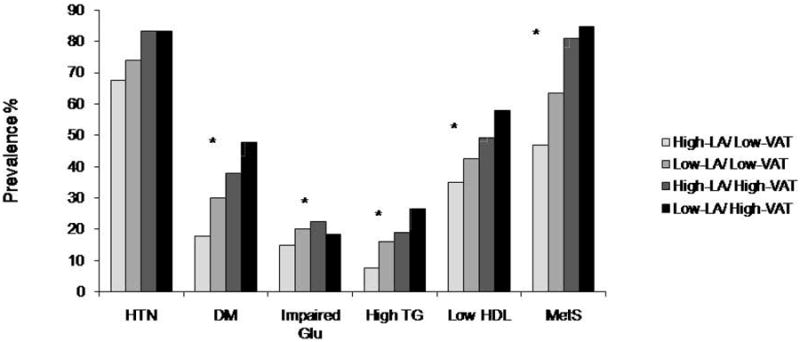
Methods and results: Black participants were from the Jackson Heart Study (n=2882, 65% women) who underwent computed tomography. Fatty liver was measured by liver attenuation in Hounsfield units (LA), and VAT was quantified volumetrically. Cross-sectional associations between LA, VAT, and cardiometabolic risk factors were assessed using linear and logistic regression, and their joint associations were further examined in 4 subgroups: high-LA/low-VAT (n=1704), low-LA/low-VAT (n=422), high-LA/high-VAT (n=436), and low-LA/high-VAT (n=320). Both LA and VAT were associated with most cardiometabolic traits (all P<0.0001), which persisted after additional adjustment for each other (LA, P<0.01-0.0001; VAT, P<0.0001). In bootstrap analyses, the regression coefficient of VAT was significantly greater than LA for triglycerides, high-density lipoprotein cholesterol, impaired glucose, and metabolic syndrome (P=0.009-0.0001). The interaction between LA and VAT was significant for high-density lipoprotein cholesterol (P=0.002), impaired glucose (P=0.003), and metabolic syndrome (P=0.04). Among 4 subgroups, participants with higher VAT and lower LA had higher prevalence of cardiometabolic traits than those with each condition alone.
Conclusion: Both fatty liver and VAT are independent correlates of cardiometabolic risk, but the associations are stronger for VAT than for fatty liver.
Conflict of interest statement
Figures
References
-
- Fox CS, Massaro JM, Hoffmann U, Pou KM, Maurovich-Horvat P, Liu CY, Vasan RS, Murabito JM, Meigs JB, Cupples LA, D’Agostino RB, Sr, O’Donnell CJ. Abdominal visceral and subcutaneous adipose tissue compartments: association with metabolic risk factors in the Framingham Heart Study. Circulation. 2007;116:39–48. - PubMed
-
- Thamer C, Machann J, Stefan N, Haap M, Schafer S, Brenner S, Kantartzis K, Claussen C, Schick F, Haring H, Fritsche A. High visceral fat mass and high liver fat are associated with resistance to lifestyle intervention. Obesity (Silver Spring) 2007;15:531–8. - PubMed
-
- Goran MI, Bergman RN, Gower BA. Influence of total vs. visceral fat on insulin action and secretion in African American and white children. Obes Res. 2001;9:423–31. - PubMed
Publication types
MeSH terms
Substances
Grants and funding
LinkOut - more resources
Full Text Sources
Medical
