


Histological assessment of tangentially excised burn eschars
- PMID: 21886431
- PMCID: PMC2940971
Histological assessment of tangentially excised burn eschars
Abstract
Background: The burn eschar serves as a medium for bacterial growth and a source of local and systemic infection. To prevent or minimize these complications, it is important to debride the eschar as early as possible.
Objective: To identify the presence of viable skin within the excisions by examining tangentially excised burn eschars.
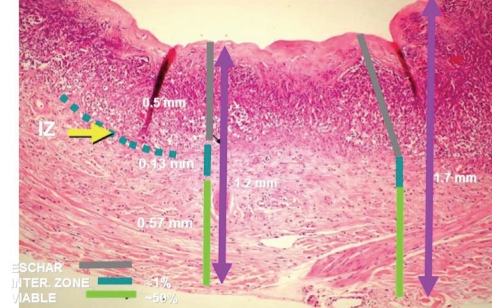
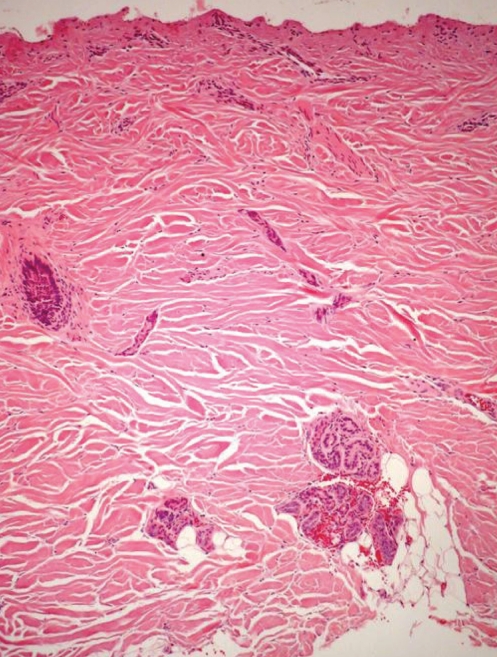
Methods: A total of 146 samples of burned human tissue were removed during 54 routine sharp tangential excision procedures (using dermatomes). The samples were histologically examined to identify the relative thickness of the dead, intermediate and viable layers.
Results: The mean (± SD) thickness of the excised samples was 1.7±1.1 mm. The sacrificed viable tissue (mean thickness 0.7±0.8 mm) occupied 41.2% of the entire thickness of the excision. In 32 biopsies (21.8%; 95% CI 16.0 to 29.3), the excision did not reach viable skin. Only eight biopsies (5.4%; 95% CI 2.8 to 10.1) contained all of the necrotic tissue without removing viable tissue.
Conclusions: The thickness of a single tangentially excised layer of eschar is not much greater than the actual thickness of the entire skin and often contains viable tissue. Because surgical debridement is insufficiently selective, more selective means of debriding burn eschars should be explored.
HISTORIQUE :: L’escarre de brûlure est un médium de croissance bactérienne et une source d’infection locale et systémique. Pour prévenir ou réduire au minimum ces complications, il est important de débrider l’escarre le plus rapidement possible.
OBJECTIF :: Déterminer la présence de peau viable dans les excisions par l’examen des escarres de brûlures séparées par excision tangentielle.
MÉTHODOLOGIE :: Au total, on a procédé à la séparation de 146 échantillons de tissus humains brûlés dans le cadre de 54 interventions systématiques d’excision tangentielle tranchante (au moyen de dermatomes). Les échantillons ont fait l’objet d’un examen histologique afin de déterminer l’épaisseur relative des couches morte, intermédiaire et viable.
RÉSULTATS :: L’épaisseur moyenne (± ÉT) des échantillons excisés était de 1,7±1,1 mm. Le tissu viable sacrifié (épaisseur moyenne de 0,7±0,8 mm) occupait 41,2 % de toute l’épaisseur de l’excision. Dans 32 biopsies (21,8 %; 95 % IC 16,0 à 29,3), l’excision n’atteignait pas la peau viable. Seulement huit biopsies (5,4 %; 95 % IC 2,8 à 10,1) contenaient la totalité des tissus nécrotiques, sans tissus viables.
CONCLUSIONS :: L’épaisseur d’une seule couche d’escarre séparée par excision tangentielle n’est pas tellement plus importante que toute l’épaisseur de la peau et contient souvent des tissus viables. Puisque le débridement chirurgical n’est pas assez sélectif, il faudrait explorer des modes plus sélectifs de débridement des escarres de brûlure.
Keywords: Burns; Dermatome; Eschar; Tangential excision.
Figures
References
-
- Singh V, Devgan L, Bhat S, Milner SM. The pathogenesis of burn wound conversion. Ann Plast Surg. 2007;59:109–15. - PubMed
-
- Janzekovic Z. A new concept in the early excision and immediate grafting of burns. J Trauma. 1970;10:1103–8. - PubMed
-
- Jackson DM, Stone PA. Tangential excision and grafting of burns. Br J Plast Surg. 1972;25:416. - PubMed
-
- Lavrance JC, Carney SA. Tangential excision of burns; studies on the metabolic activity of the recipient areas for skin grafts. Br J Plast Surg. 1973;26:93. - PubMed
-
- Monafo WW. Tangential excision. Clin Plast Surg. 1974;1:591–601. - PubMed
LinkOut - more resources
Full Text Sources
Other Literature Sources