


Extrinsic Threshold PEEP Reduces Post-exercise Dyspnea in COPD Patients: A Placebo-controlled, Double-blind Cross-over Study
- PMID: 21886475
- PMCID: PMC3163412
Extrinsic Threshold PEEP Reduces Post-exercise Dyspnea in COPD Patients: A Placebo-controlled, Double-blind Cross-over Study
Abstract
Purpose: Most patients with chronic obstructive pulmonary disease (COPD) complain of dyspnea during and following exercise, and the development of intrinsic positive end-expiratory pressure (PEEP) is thought to contribute to lung hyperinflation and dyspnea. Many people with COPD use pursed lip breathing (PLB) in an attempt to produce extrinsic PEEP to reduce lung hyperinflation and dyspnea during and following exertion. We hypothesized that the use of a threshold, extrinsic PEEP device would reduce post-exercise dyspnea in people with COPD.
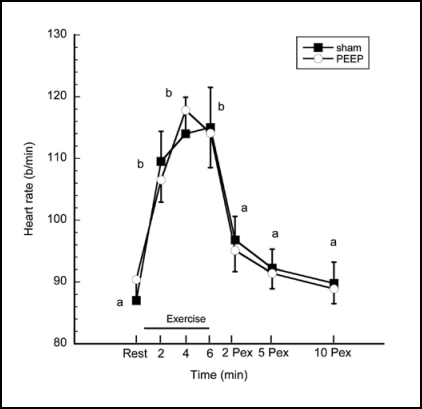
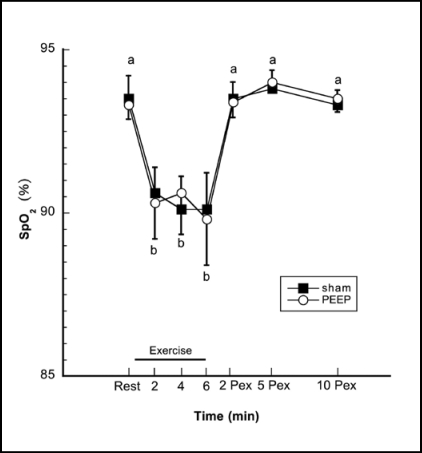
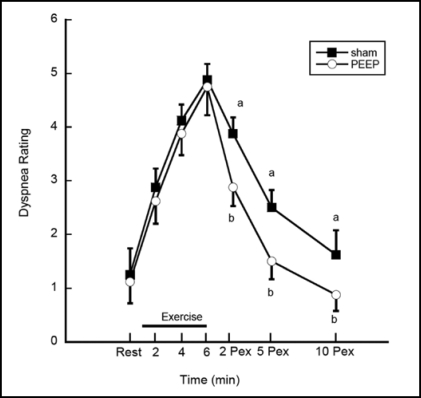
Methods: A double blind, crossover study was conducted on post-exercise dyspnea in 8 patients with COPD whose exercise tolerance was limited by dyspnea. Subjects performed two identical 6-minute treadmill bouts that led to a Borg dyspnea rating of at least 5/10. Dyspnea, heart rate, and oxygen-hemoglobin saturation (SpO(2)) were recorded at rest, every 2 minutes during exercise and at 2, 5, and 10 minutes post-exercise. Immediately following the exercise bouts, the subjects used either a threshold PEEP device for 6 breaths at 10 cm H(2)O or a Sham device.
Results: Heart rate and SpO(2) were not different between treatments any time point before, during, or after exercise. Dyspnea ratings were not different between devices at rest or during exercise, but were lower in the post-exercise period following use of PEEP (p < 0.05). When asked which device, if any, the subjects would prefer to use to relieve post-exercise dyspnea, 7 of 8 chose the PEEP device and one had no preference.
Conclusions: We found that the use of a PEEP device can help reduce postexercise dyspnea in patients with COPD.
Keywords: COPD; PEEP; dyspnea; exertion; pursed lip breathing.
Figures
References
-
- Rochester CL. Exercise training in chronic obstructive pulmonary disease. J Rehabil Res Dev. 2003;40:59–80. - PubMed
-
- Grazzini M, Stendardi L, Gigliotti F, et al. Pathophysiology of exercise dyspnea in healthy subjects and in patients with chronic obstructive pulmonary disease (COPD) Respir Med. 2005;99:1403–1412. - PubMed
-
- Hoo GW. Nonpharmacologic adjuncts to training during pulmonary rehabilitation: the role of supplemental oxygen and noninvasive ventilation. J Rehabil Res Dev. 2003;40:81–97. - PubMed
-
- O'Donnell DE, Lam M, Webb KA. Measurement of symptoms, lung hyperinflation, and endurance during exercise in chronic obstructive pulmonary disease. Am J Respir Crit Care Med. 1998;158:1557–1565. - PubMed
-
- O'Donnell DE, Lam M, Webb KA. Spirometric correlates of improvement in exercise performance after anticholinergic therapy in chronic obstructive pulmonary disease. Am J Respir Crit Care Med. 1999;160:542–549. - PubMed
LinkOut - more resources
Full Text Sources