. 2011 Aug 15:2:48.
doi: 10.3389/fphys.2011.00048. eCollection 2011.

Role of MicroRNAs in Insect Host-Microorganism Interactions

Affiliations

Role of MicroRNAs in Insect Host-Microorganism Interactions

Sassan Asgari. Front Physiol. .

Abstract

MicroRNAs (miRNAs) have appeared as important regulators of various biological processes including development, cancer, immunity, and host-microorganism interactions. Accumulating evidence demonstrates the differential expression of host miRNAs upon infection by various microorganisms and the involvement of microorganism-encoded miRNAs in host manipulation. Some of these alterations could be part of a host response to an infection to limit replication and dissemination of the microorganism or, conversely, due to manipulation of the host miRNA pathway by the microorganism to facilitate its replication. Insights into the role of miRNAs in host defense responses and host manipulation by microorganisms will enable a better understanding of host-microorganism interactions.

Keywords: host; interaction; microRNA; microorganism; pathogen; virus.


Figures

Figure 1
Figure 1
Canonical biogenesis of miRNA. miRNA genes are expressed by RNA polymerase II in the nucleus forming the primary miRNA (pri-miRNA) which contains one or several stem–loop structures. The stem–loop is cleaved by Drosha in conjunction with Pasha (= DGCR8 in vertebrates). The resulting precursor miRNA (pre-miRNA) is transported into the cytoplasm by Exportin-5 (Exp 5) where it is further processed by Dicer 1 in association with the loquacious protein (= TAR RNA binding protein in mammals, TRBP) to produce a ∼22 nt miRNA:miRNA* duplex. The passenger strand, miRNA*, is usually degraded and the guide strand, miRNA, becomes incorporated into the RNA-induced silencing complex (RISC) containing the argonaute (Ago) protein. The miRNA–RISC complex interacts with the target sequences leading to repression of translation, mRNA degradation, or upregulation of transcript levels.
Figure 2
Figure 2
Schematic diagram of Heliothis virescens ascovirus (HvAV-3e) genome. HvAV-3e DNA polymerase (ORF1), and DNA dependent RNA polymerase II (ORF64; DdRP) and RNA polymerase β subunit (ORF82) genes are targeted by HvAV-3e-encoded miRNA (HvAV-miR-1) and the host Hz-miR-24 miRNA, respectively. However, during early to late hours of infection, HvAV-3e reduces the expression of Hz-miR-24, a period critical for the expression of ORF64 and ORF82.
Figure 3
Figure 3
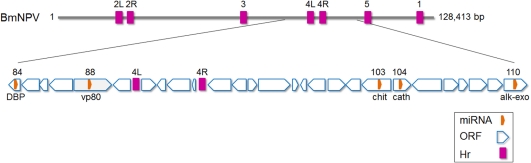
Schematic diagram of Bombyx mori nucleopolyhedrovirus (BmNPV) genome with the location of miRNAs shown. DBP, DNA-binding protein; chit, Chitinase; cath, cathepsin; alk-exo, alkaline exonuclease. Based on (Gomi et al., ; Singh et al., 2010). Hr, homologous region. The numbers above Hr regions refer to homologous regions 1–5 in the virus genome (L, left and R, right).

References

    1. Alexandarov I. D., Alexandrova M. V., Goryacheva I. I., Rochina N. V. (2007). Removing endosymbiotic Wolbachia specifically decreases lifespan of females and competitiveness in a laboratory strain of Drosophila melanogaster. Russ. J. Genet. 43, 1147–1152 10.1134/S1022795407100080 - DOI - PubMed
    1. Amsterdam A., Nissen R. M., Sun Z., Swindell E. C., Farrington S., Hopkins N. (2004). Identification of 315 genes essential for early zebrafish development. Proc. Natl. Acad. Sci. U.S.A. 101, 12792–12797 10.1073/pnas.0403929101 - DOI - PMC - PubMed
    1. Aravin A. A., Lagos-Quintana M., Yalcin A., Zavolan M., Marks D. S., Gaasterland T., Meyer J., Tuschl T. (2003). The small RNA profile during Drosophila melanogater development. Insect Biochem. Mol. Biol. 37, 3–9 - PubMed
    1. Bartel D. P. (2009). MicroRNAs: target recognition and regulatory functions. Cell 23, 215–233 10.1016/j.cell.2009.01.002 - DOI - PMC - PubMed
    1. Barth S., Pfuhl T., Mamiani A., Ehses C., Roemer K., Kremmer E., Jäker C., Höck J., Meister G., Grässer F. A. (2008). Epstein-Barr virus-encoded microRNA miR-BART2 down-regulates the viral DNA polymerase BALF5. Nucleic Acids Res. 36, 666–675 10.1093/nar/gkm1080 - DOI - PMC - PubMed

LinkOut - more resources