The morphological and molecular diagnosis of lung cancer
- PMID: 21886665
- PMCID: PMC3163783
- DOI: 10.3238/arztebl.2011.0525
The morphological and molecular diagnosis of lung cancer
Abstract
Background: In Germany, lung cancer causes more deaths than any other malignant disease. Its main etiology is smoking, but other risk factors need to be considered as well. The morphological, molecular and biological phenotype is complex and should no longer be just categorized as either small-cell or non-small cell lung cancer.
Methods: This review article is based on the authors' longstanding involvement in the scientific investigation and diagnostic evaluation of lung cancer, including contributions to the current WHO classification and collaboration in the new interdisciplinary classification of adenocarcinoma. The relevant literature was selectively reviewed.
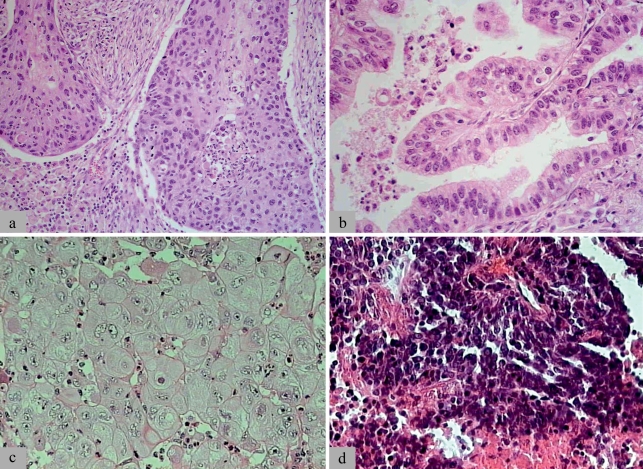
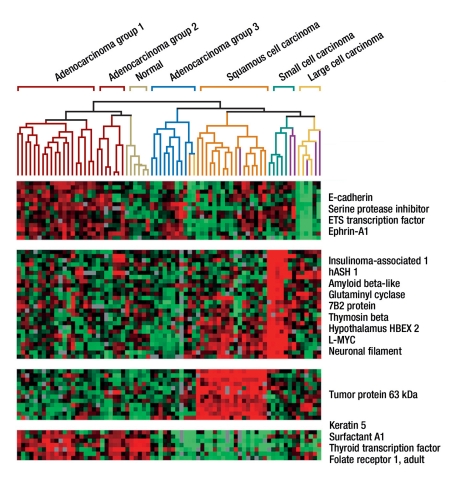
Results: Lung cancer is morphologically classified into four main subtypes-small-cell carcinoma, squamous-cell carcinoma, adenocarcinoma, and large-cell carcinoma. Genetic and molecular analyses have revealed distinct differences within subtypes; in particular, adenocarcinomas can be further subdivided. Complex techniques of genomic analysis are now available, but clinicopathological data are still the most important determinants of prognosis and are clearly better for this purpose than molecular classification alone. Nonetheless, the assessment of specific molecular markers is becoming increasingly important.
Conclusion: The morphological and molecular classification of lung cancer is undergoing a re-evaluation which will lead to more accurate assessment of individual prognoses and to improved prediction of the response to specific treatment regimens.
Figures
Comment in
-
Correspondence (letter to the editor): Laboratory tests to ascertain tumor resistance to drugs are available.Dtsch Arztebl Int. 2012 Mar;109(10):188; author reply 188-9. doi: 10.3238/arztebl.2012.0188a. Epub 2012 Mar 9. Dtsch Arztebl Int. 2012. PMID: 22470408 Free PMC article. No abstract available.
References
-
- Robert Koch-Institut und die Gesellschaft der epidemiologischen Krebsregister in Deutschland (GEKID) e. V. (eds) Krebs in Deutschland 2005/2006. www.gekid.de. 7th revised edition. Berlin: 2010. Häufigkeiten und Trends.
-
- Goeckenjan G, Sitter H, Thomas M. Prävention, Diagnose, Therapie und Nachsorge des Lungenkarzinoms Interdisziplinäre S3-Leitlinie der Deutschen Gesellschaft für Pneumologie und Beatmungsmedizin und der Deutschen Krebsgesellschaft. Pneumologie. 2010;64(Suppl 2):e1–e164.
-
- Travis WD, Brambilla E, Müller-Hermeling K. In: World Health Organization Classification of tumours. Pathology and genetics of tumours of the lung, pleura, thymus and heart. Harris CC, editor. Lyon: IARCPress; 2004.
-
- Klein F, Amin Kotb WFM, Petersen I. Incidence of human papilloma virus in lung cancer. Lung Cancer. 2009;65:13–18. - PubMed
-
- Petersen I, Amin Kotb WFM, Friedrich KH, Schlüns K, Böcking A, Dietel M. Core classification of lung cancer: Correlating nuclear size and mitoses with ploidy and clinicopathological parameters. Lung Cancer. 2009;65:312–318. - PubMed
Publication types
MeSH terms
Substances
LinkOut - more resources
Full Text Sources
Medical