


Cylindroma transforming into basal cell carcinoma in a patient with Brooke-Spiegler syndrome
- PMID: 21886698
- PMCID: PMC3157764
- DOI: 10.3315/jdcr.2007.1.1002
Cylindroma transforming into basal cell carcinoma in a patient with Brooke-Spiegler syndrome
Abstract
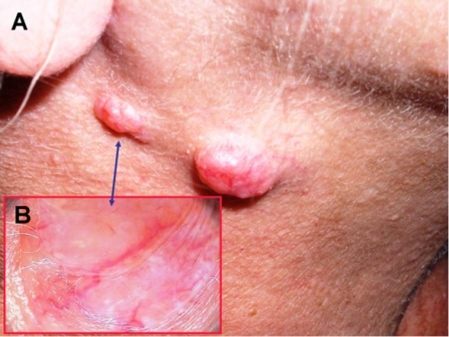
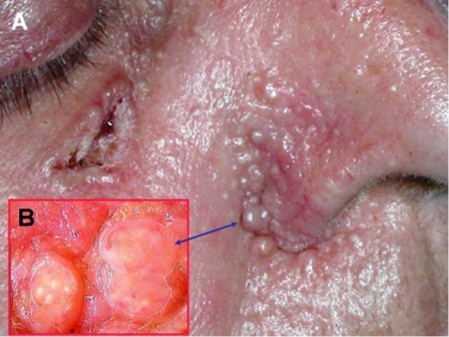
Background: Brooke-Spiegler syndrome is a rare condition with a predisposition to develop cutaneous adnexal neoplasms, especially cylindromas, trichoepitheliomas and spiradenomas. Malignant transformation of cylindromas is rare. In such cases usually cylindrocarcinomas develop within these lesions. We present an unusual case of basal cell carcinoma developing within a preexisting cylindroma.
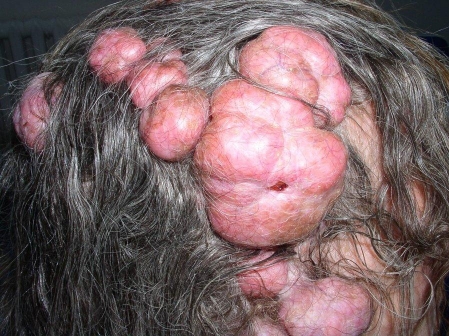
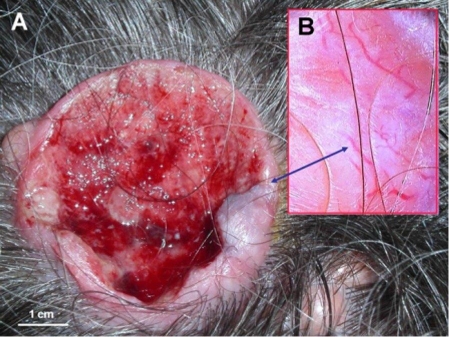
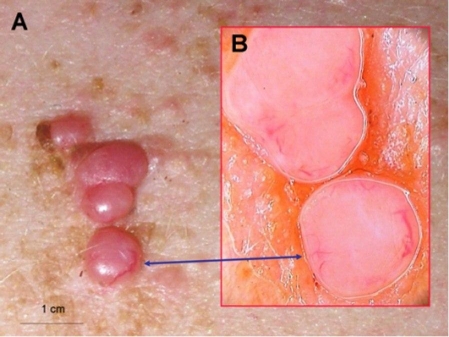
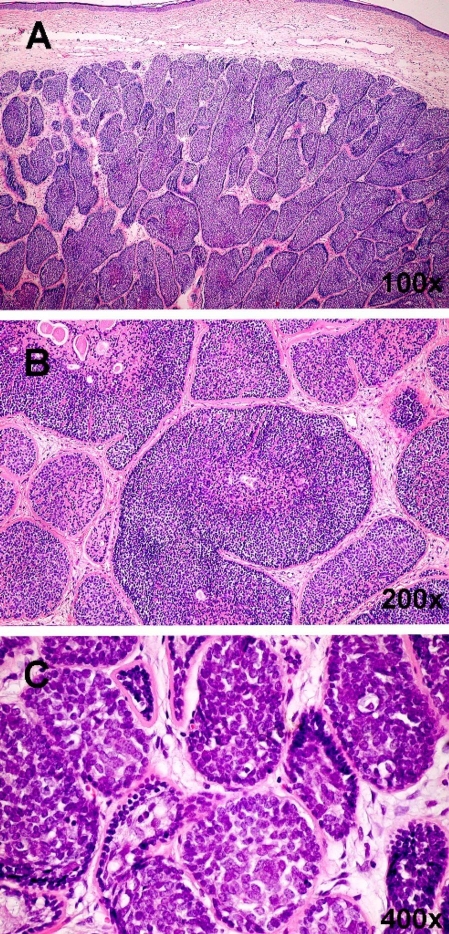
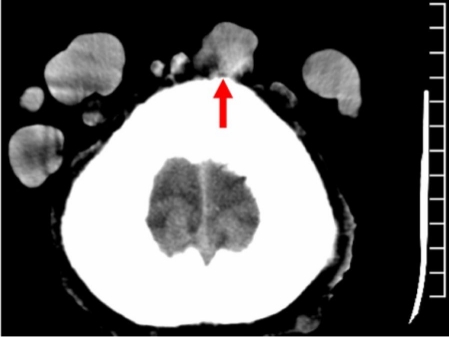
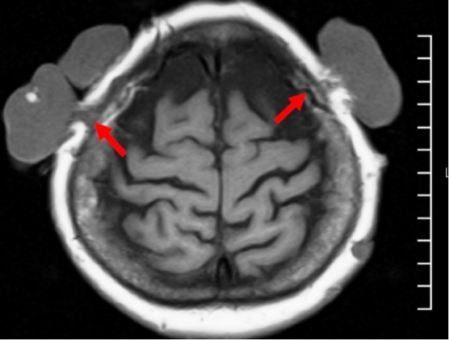
Main observations: 58-year-old woman with a 30-year history of multiple dermal cylindromas extensively involving her scalp was referred for dermatological treatment. The patient reported that one of the long-lasting lesions, 5.5 cm in size, ulcerated within the foregoing few weeks. Histopathology confirmed cylindromas and basal cell carcinoma within the ulcerating tumor. Surgical excision of largest cylindroma tumors led to cosmetic and functional improvement. Magnetic resonance and computed tomography showed tumor infiltration into the skull lamina externa. Metastases were excluded by chest radiography and abdominal ultrasound examination.
Conclusion: Patients with Brooke-Spiegler syndrome should be followed-up for malignant transformation of skin tumors to prevent deep penetration and possible metastases.
Keywords: basal cell carcinoma; computed tomography; cylindroma; magnetic resonance imaging; syringoma; trichoepithelioma; turban tumor.
Figures

References
-
- Uede K, Yamamoto Y, Furukawa F. Brooke-Spiegler syndrome associated with cylindroma, trichoepithelioma, spiradenoma, and syringoma. J Dermatol. 2004;31:32–38. - PubMed
-
- Michal M, Lamovec J, Mukensnabl P, Pizinger K. Spiradenocylindromas of the skin: tumors with morphological features of spiradenoma and cylindroma in the same lesion: report of 12 cases. Pathol Int. 1999;49:419–425. - PubMed
-
- Kazakov DV, Soukup R, Mukensnabl P, Boudova L, Michal M. Brooke-Spiegler syndrome: report of a case with combined lesions containing cylindromatous, spiradenomatous, trichoblastomatous, and sebaceous differentiation. Am J Dermatopathol. 2005;27:27–33. - PubMed
-
- Garat H, Loche F, Gorguet B, Rumeau H, Lamant L, Bazex J. Brooke-Spiegler syndrome. Ann Dermatol Venereol. 1999;126:513–517. - PubMed
-
- De Francesco V, Frattasio A, Pillon B, Stinco G, Scott CA, Trotter D, Patrone P. Carcinosarcoma arising in a patient with multiple cylindromas. Am J Dermatopathol. 2005;27:21–26. - PubMed
Publication types
LinkOut - more resources
Full Text Sources