


Discounting in Pigeons When the Choice is between Two Delayed Rewards: Implications for Species Comparisons
- PMID: 21887130
- PMCID: PMC3156978
- DOI: 10.3389/fnins.2011.00096
Discounting in Pigeons When the Choice is between Two Delayed Rewards: Implications for Species Comparisons
Abstract
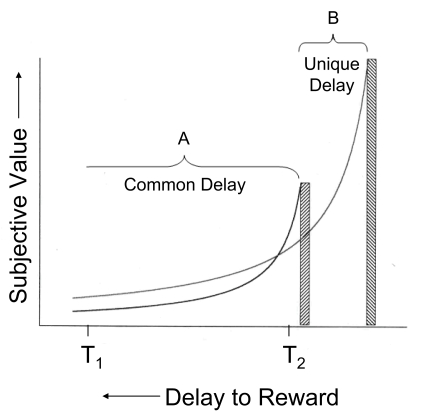
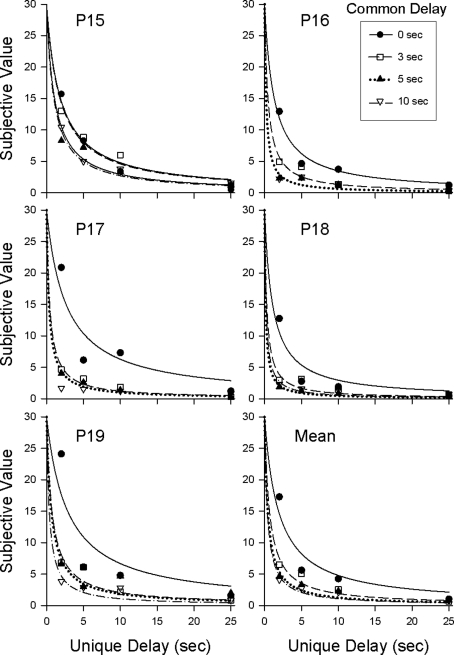
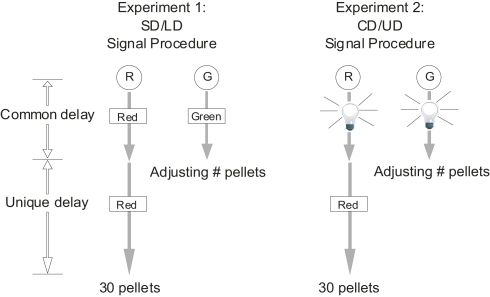
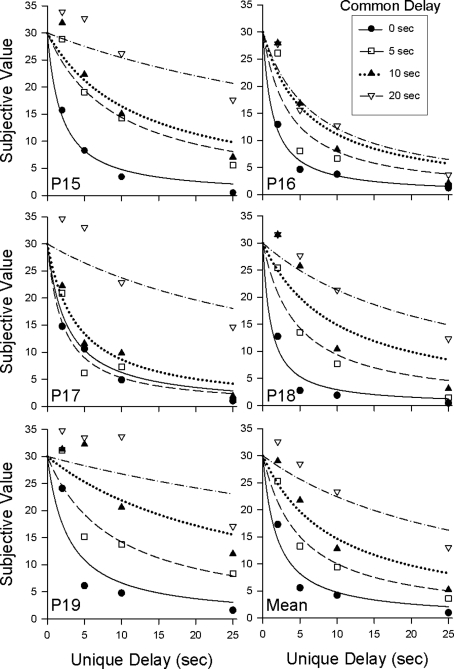
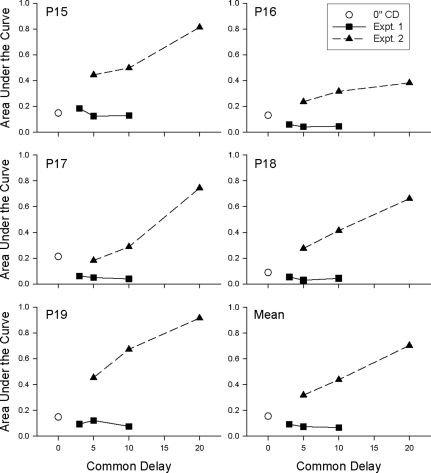
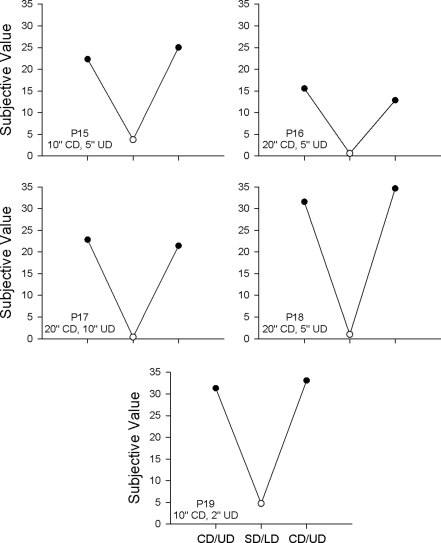
Studies of delay discounting typically have involved choices between smaller, immediate outcomes and larger, delayed outcomes. In a study of delay discounting in humans, Green et al. (2005) added a period of time prior to both outcomes, creating a delay common to both. They found that the subjective value of the more delayed reward was well described by a hyperboloid discounting function and that the degree to which that outcome was discounted decreased as the common delay increased. In two experiments, we examined the effect of adding a common delay on the discounting of food rewards in pigeons. In Experiment 1, an adjusting-amount procedure was used to establish discounting functions when the common delay was 0, 3, 5, and 10 s, and different stimuli signaled time to the smaller, sooner and larger, later rewards. In contrast to humans, the pigeons showed increases in the degree of discounting when a common delay was added. In Experiment 2, the delay common to both rewards and the delay unique to the larger, later reward were each specifically signaled. With this procedure, the degree of discounting decreased as the common delay increased, a result consistent with that obtained with humans (Green et al., 2005). These findings reveal fundamental similarities between pigeons' and humans' choice behavior, and provide strong interspecies support for the hypothesis that choice between delayed outcomes is based on comparison of their hyperbolically discounted present subjective values.
Keywords: delay discounting; discounting function; humans; hyperbolic; pigeons.
Figures
References
-
- Ainslie G., Herrnstein R. J. (1981). Preference reversal and delayed reinforcement. Anim. Learn. Behav. 9, 476–482 10.3758/BF03209777 - DOI
-
- Dinsmoor J. A. (1983). Observing and conditioned reinforcement. Behav. Brain Sci. 6, 693–704 10.1017/S0140525X00017969 - DOI
-
- Fantino E. (1977). “Conditioned reinforcement,” in Handbook of Operant Behavior, eds Honig W. K., Staddon J. E. R. (Englewood Cliffs, NJ: Prentice-Hall; ), 313–339
-
- Green L., Fisher E. B., Jr., Perlow S., Sherman L. (1981). Preference reversal and self-control: choice as a function of reward amount and delay. Behav. Anal. Lett. 1, 43–51
Grants and funding
LinkOut - more resources
Full Text Sources
