Review
. 2011 Aug;1(2):125-33.
doi: 10.1016/j.coviro.2011.06.008.

Viral life cycles captured in three-dimensions with electron microscopy tomography

Affiliations
Review

Viral life cycles captured in three-dimensions with electron microscopy tomography

Chi-yu Fu et al. Curr Opin Virol. 2011 Aug.

Abstract

Viruses hijack host cell functions and optimize them for viral replication causing a severe threat to human health. However, viruses are also tools to understand cell biology and they may be effective reagents in nano-medicine. Studies from the molecular to cellular levels are aimed at understanding the details of viral life cycles and the underlying virus-host interactions. Recent developments in electron microscopy tomography allow viral and cellular events to be observed in fine structural detail in three-dimension. By combining high-resolution structures of individual proteins and macro-complexes obtained by crystallography and electron cryo-microscopy and image reconstruction with reconstructions performed on sub-tomographic volumes, electron tomography has advanced the structural and mechanistic understanding of virus infections both in vitro and in host cells.

Keywords: Electron tomography; Virus.


Figures
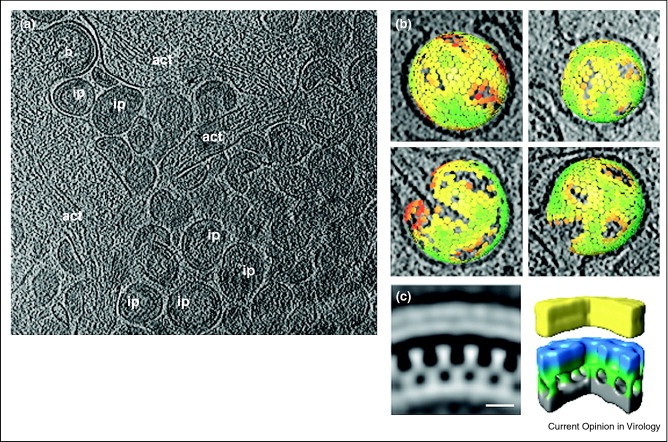
Figure 1
Figure 1
Cryoelectron tomography of HIV-1 budding sites and the gag protein lattice of the budding particles determined by sub tomographic averaging. (a) A computationally isolated tomographic slice of cells transduced with adenoviral vectors expressing HIV-1 Gag. act, actin; b, budding sites; ip, immature particles. (b) Gag lattice maps of immature (top) and intermediate (bottom) HIV-1. The center and orientation of each aligned sub tomogram are marked with a hexagon and are colored according to the cross correlation on a scale from low (red) to high (green). (c) The average of the aligned sub tomograms extracted from an individual budding site was displayed in the central radial sections from the structure (left) and in isosurface rendering of the structure (right). The surfaces have been colored radially to illustrate different domains in Gag: yellow — membrane + MA; blue/green — CA; gray — NC + RNA.
Figure 2
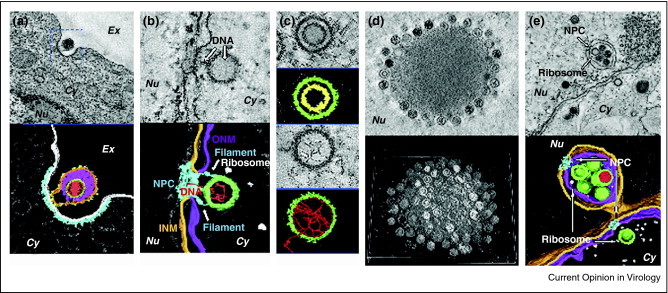
Figure 2
Dual-axis electron tomography of NIH 3T3 cells infected with murine gammaherpesvirus. (a) A tomogram (top) and the 3D rendering (bottom) of a virus attaching to the cell surface for prior to endocytosis. Color codes in 3D rendering: red, viral DNA; green, capsid; magenta, tegument; orange, envelope; yellow, protrusions on the membrane; light gray, plasma membrane; cyan, membrane coating. (b) A tomogram (top) and the 3D rendering (bottom) of a capsid docking at a nuclear pore and injecting viral DNA. Color codes in 3D rendering: red, viral DNA; green, capsid; light gray, ribosomes; orange, INM; magenta, ONM; cyan, NPC. (c) Tomograms (top) and the 3D rendering (bottom) of an assembly intermediate and a capsid packaging viral DNA. Color codes in 3D rendering: red, viral DNA; green, capsid; yellow, scaffolding protein. (d) A tomogram (top) and shaded surface views of entire sections of Virus-Induced Nuclear Inclusion Bodies. (e) A tomogram (top) and the 3D rendering (bottom) of capsids egressing from the nucleus. Color codes in 3D rendering: red, viral DNA; green, capsid; orange, INM or primary envelope; magenta, ONM or primary envelop in fusion; cyan, NPC; light gray, ribosome.
Figure 3
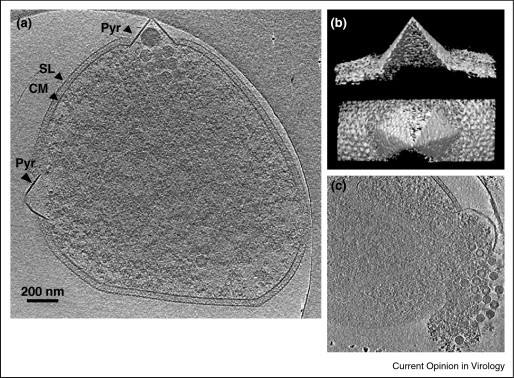
Figure 3
Whole cell cryoelectron tomography of Sulfolubs infected with STIV. (a) A computationally isolated tomographic slice of Sulfolubs infected with STIV. SL, s-layer; PS, periplasmic space; CM, cytoplasmic membrane; Pyr, pyramid-like protrusion; STIV, STIV particles. (b) Surface representations of a pyramid in 3D viewed from the side and the top of the structure. (c) A computationally isolated tomographic slice of Sulfolubs bursting out particles from a pyramid structure.
Figure 4
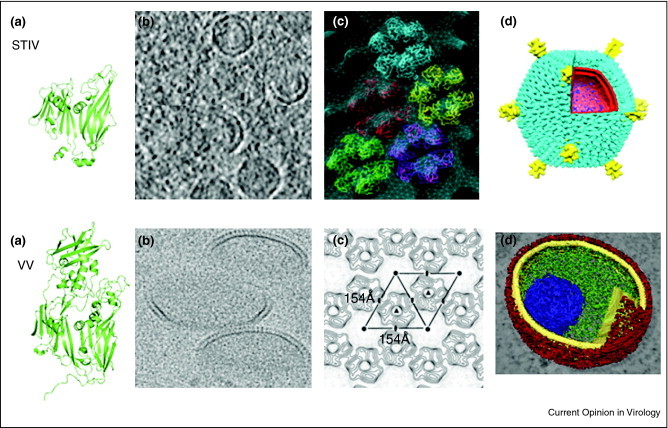
Figure 4
Hybrid approaches reveal conserved structures and assembly pathway of STIV and Vaccinia virus. The tertiary structures of the STIV MCP and Vaccinia virus D13 protein share similar folds (a) that recruit membranes to generate open membrane crescents (b) with hexagonal protein lattice packing (c). The similar inner-membrane-containing particles are visualized (d). Approximate scales for each panel are (a) STIV MCP ∼37 kDa; VV D13 ∼62 kDa. (b) STIV particle diameter ∼74 nm; VV center diameter ∼200 nm. (c) STIV hexamer center-to-center dimension ∼74 Å; VV dimension ∼154 Å. (d) STIV particle diameter ∼75 nm; VV immature particle diameter ∼270 nm (long axis).

References

    1. Lucic V., Forster F., Baumeister W. Structural studies by electron tomography: from cells to molecules. Annu Rev Biochem. 2005;74:833–865. - PubMed
    1. Jensen G.J., Briegel A. How electron cryotomography is opening a new window onto prokaryotic ultrastructure. Curr Opin Struct Biol. 2007;17:260–267. - PubMed
    1. Sosinsky G.E., Crum J., Jones Y.Z., Lanman J., Smarr B., Terada M., Martone M.E., Deerinck T.J., Johnson J.E., Ellisman M.H. The combination of chemical fixation procedures with high pressure freezing and freeze substitution preserves highly labile tissue ultrastructure for electron tomography applications. J Struct Biol. 2008;161:359–371. - PMC - PubMed
    1. Al-Amoudi A., Norlen L.P., Dubochet J. Cryo-electron microscopy of vitreous sections of native biological cells and tissues. J Struct Biol. 2004;148:131–135. - PubMed
    1. Huiskonen J.T., Hepojoki J., Laurinmaki P., Vaheri A., Lankinen H., Butcher S.J., Grunewald K. Electron cryotomography of Tula hantavirus suggests a unique assembly paradigm for enveloped viruses. J Virol. 2010;84:4889–4897. - PMC - PubMed

LinkOut - more resources