


Unidirectional relationship between heroin self-administration and impulsive decision-making in rats
- PMID: 21887498
- PMCID: PMC3249213
- DOI: 10.1007/s00213-011-2444-8
Unidirectional relationship between heroin self-administration and impulsive decision-making in rats
Abstract
Rationale: There is growing clinical evidence for a strong relationship between drug addiction and impulsivity. However, it is not fully clear whether impulsivity is a pre-existing trait or a consequence of drug abuse. Recent observations in the animal models show that pre-existing levels of impulsivity predict cocaine and nicotine seeking. Whether such relationships also exist with respect to non-stimulant drugs is largely unknown.
Objective: We studied the relationship between impulsive choice and vulnerability to heroin taking and seeking.
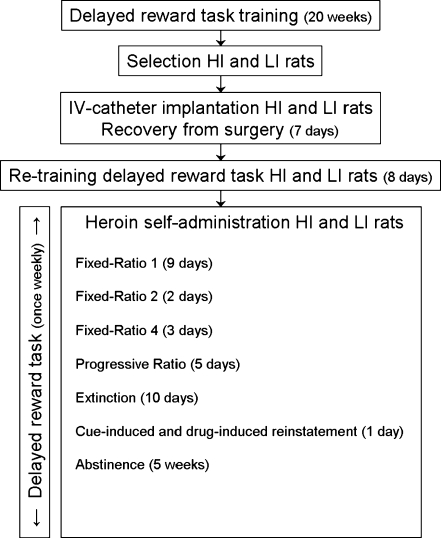
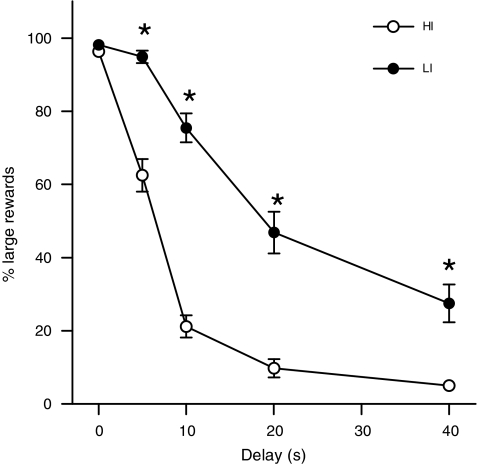
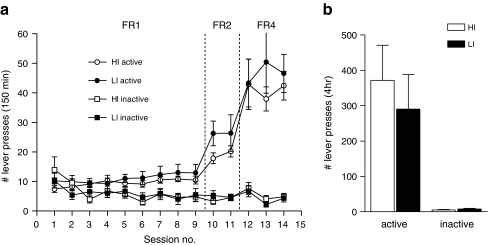
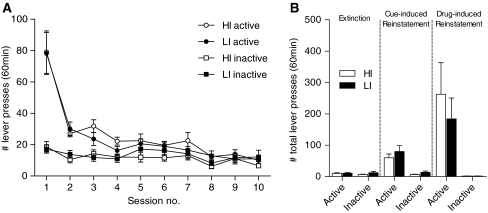
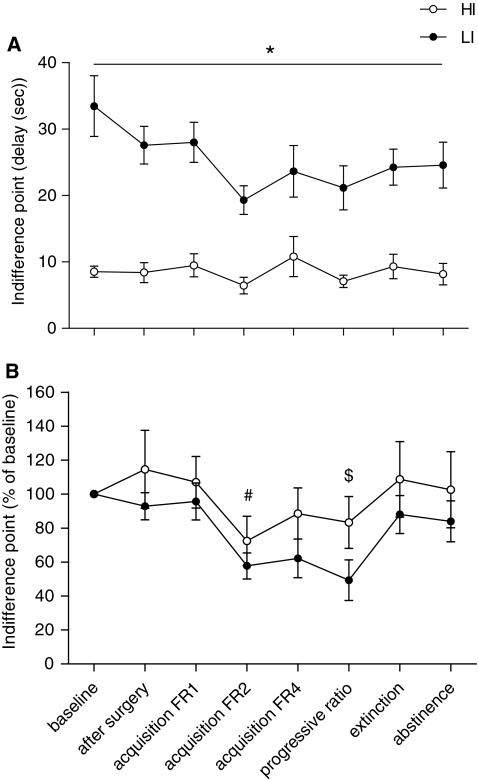
Materials and methods: Rats were selected in the delayed reward task based on individual differences in impulsive choice. Subsequently, heroin intravenous self-administration behaviour was analysed, including acquisition of heroin intake, motivation, extinction and drug- and cue-induced reinstatement. Throughout the entire experiment, changes in impulsive choice were monitored weekly.
Results and discussion: High impulsivity did not predict measures of heroin taking. Moreover, high impulsive rats did not differ from low impulsive rats in extinction rates or heroin- and cue-induced reinstatement. However, both groups became more impulsive as heroin self-administration continued. During abstinence, impulsivity levels returned towards baseline (pre-heroin) levels. Our results indicate that, in contrast to psychostimulants, impulsive choice does not predict vulnerability to heroin seeking and taking.
Conclusion: These data implicate that different neural mechanisms may underlie the vulnerability to opiate and psychostimulant dependence. Moreover, our data suggest that elevated impulsivity levels as observed in heroin-dependent subjects are a consequence of heroin intake rather than a pre-existing vulnerability trait.
Figures
References
Publication types
MeSH terms
Substances
LinkOut - more resources
Full Text Sources
