


Calcium-calmodulin dependent protein kinase II (CaMKII): a main signal responsible for early reperfusion arrhythmias
- PMID: 21888910
- PMCID: PMC3208750
- DOI: 10.1016/j.yjmcc.2011.08.010
Calcium-calmodulin dependent protein kinase II (CaMKII): a main signal responsible for early reperfusion arrhythmias
Abstract
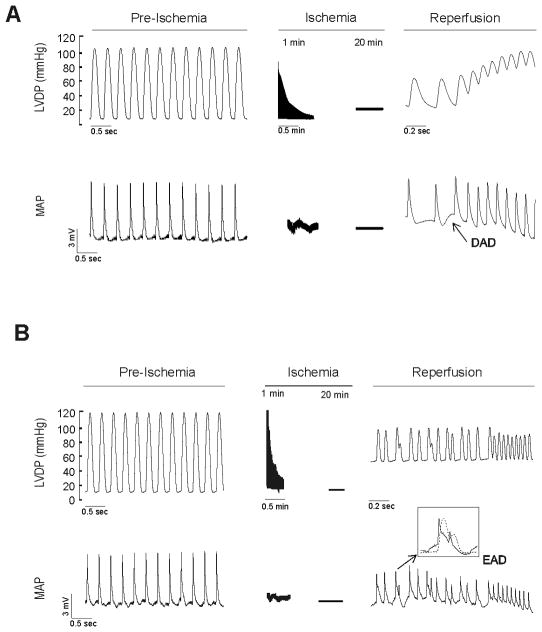
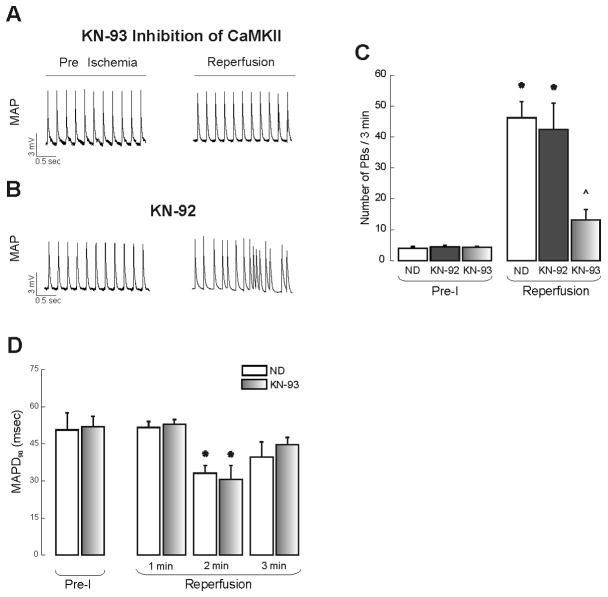
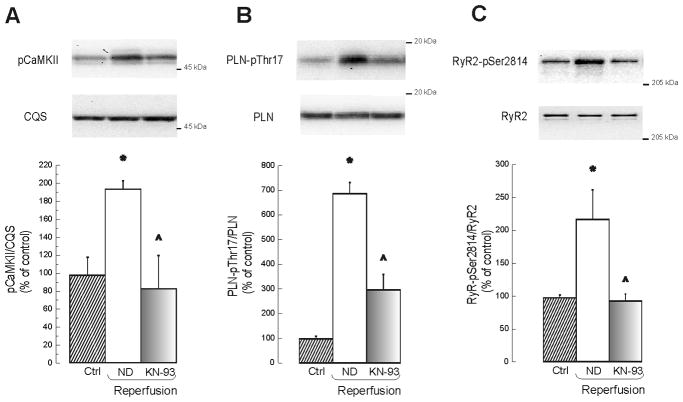
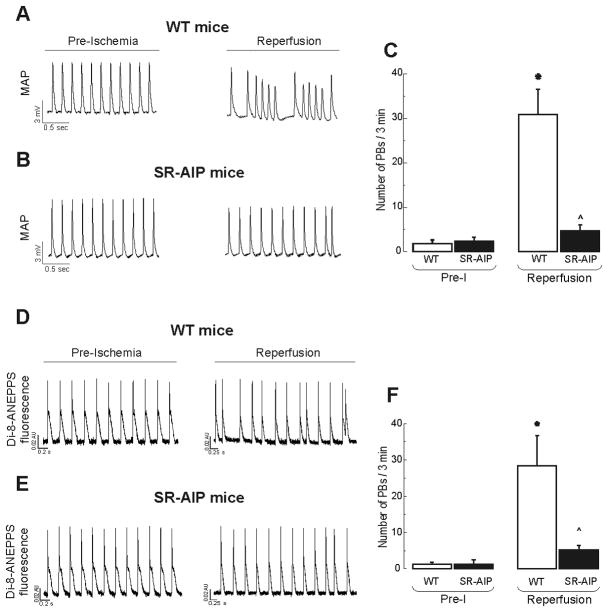
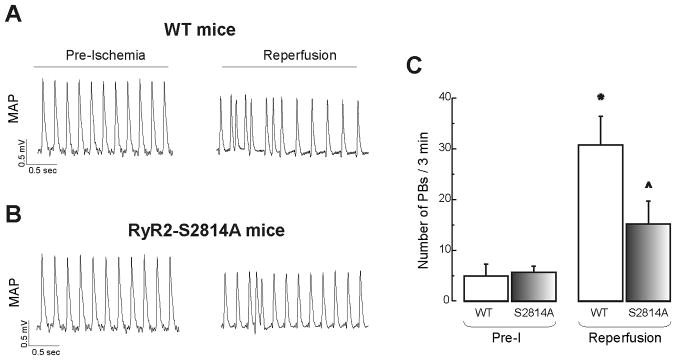
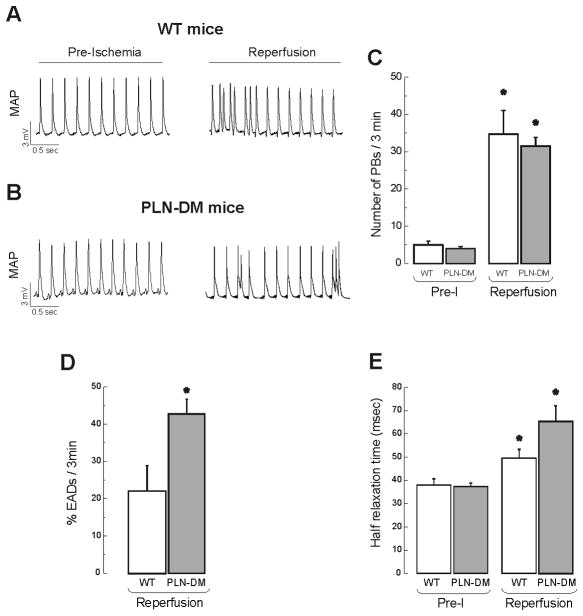
To explore whether CaMKII-dependent phosphorylation events mediate reperfusion arrhythmias, Langendorff perfused hearts were submitted to global ischemia/reperfusion. Epicardial monophasic or transmembrane action potentials and contractility were recorded. In rat hearts, reperfusion significantly increased the number of premature beats (PBs) relative to pre-ischemic values. This arrhythmic pattern was associated with a significant increase in CaMKII-dependent phosphorylation of Ser2814 on Ca(2+)-release channels (RyR2) and Thr17 on phospholamban (PLN) at the sarcoplasmic reticulum (SR). These phenomena could be prevented by the CaMKII-inhibitor KN-93. In transgenic mice with targeted inhibition of CaMKII at the SR membranes (SR-AIP), PBs were significantly decreased from 31±6 to 5±1 beats/3min with a virtually complete disappearance of early-afterdepolarizations (EADs). In mice with genetic mutation of the CaMKII phosphorylation site on RyR2 (RyR2-S2814A), PBs decreased by 51.0±14.7%. In contrast, the number of PBs upon reperfusion did not change in transgenic mice with ablation of both PLN phosphorylation sites (PLN-DM). The experiments in SR-AIP mice, in which the CaMKII inhibitor peptide is anchored in the SR membrane but also inhibits CaMKII regulation of L-type Ca(2+) channels, indicated a critical role of CaMKII-dependent phosphorylation of SR proteins and/or L-type Ca(2+) channels in reperfusion arrhythmias. The experiments in RyR2-S2814A further indicate that up to 60% of PBs related to CaMKII are dependent on the phosphorylation of RyR2-Ser2814 site and could be ascribed to delayed-afterdepolarizations (DADs). Moreover, phosphorylation of PLN-Thr17 and L-type Ca(2+) channels might contribute to reperfusion-induced PBs, by increasing SR Ca(2+) content and Ca(2+) influx.
2011 Elsevier Ltd. All rights reserved.
Figures
References
-
- Manning AS, Coltart DJ, Hearse DJ. Ischemia and reperfusion-induced arrhythmias in the rat. Effects of xanthine oxidase inhibition with allopurinol. Circ Res. 1984;55:545–548. - PubMed
-
- Carmeliet E. Cardiac ionic currents and acute ischemia: from channels to arrhythmias. Physiol Rev. 1999;79:917–1017. - PubMed
-
- Salerno JA, Previtali M, Chimienti M, Klersy C, Bobba P. Vasospasm and ventricular arrhythmias. NY Acad Sci. 1984;427:222–233. - PubMed
-
- Terkelsen CJ, Sørensen JT, Kaltoft AK, Nielsen SS, Thuesen L, Bøtker HE, et al. Prevalence and significance of accelerated idioventricular rhythm in patients with ST-elevation myocardial infarction treated with primary percutaneous coronary intervention. Am J Cardiol. 2009;104:1641–1646. - PubMed
-
- Pride YB, Appelbaum E, Lord EE, Sloan S, Cannon CP, Sabatine MS, et al. TIMI Study Group. Relation between myocardial infarct size and ventricular tachyarrhythmia among patients with preserved left ventricular ejection fraction following fibrinolytic therapy for ST-segment elevation myocardial infarction. Am J Cardiol. 2009;104:475–479. - PubMed
Publication types
MeSH terms
Substances
Grants and funding
LinkOut - more resources
Full Text Sources
Medical
Molecular Biology Databases
Research Materials
Miscellaneous
