


Genetic and environmental influences on impulsivity: a meta-analysis of twin, family and adoption studies
- PMID: 21889436
- PMCID: PMC3176916
- DOI: 10.1016/j.cpr.2011.07.005
Genetic and environmental influences on impulsivity: a meta-analysis of twin, family and adoption studies
Abstract
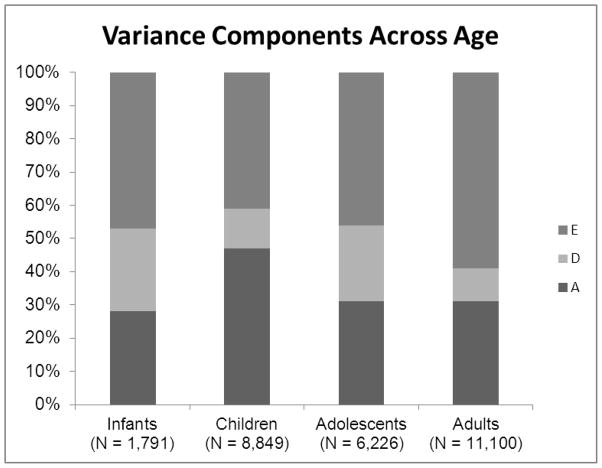
A meta-analysis of twin, family and adoption studies was conducted to estimate the magnitude of genetic and environmental influences on impulsivity. The best fitting model for 41 key studies (58 independent samples from 14 month old infants to adults; N=27,147) included equal proportions of variance due to genetic (0.50) and non-shared environmental (0.50) influences, with genetic effects being both additive (0.38) and non-additive (0.12). Shared environmental effects were unimportant in explaining individual differences in impulsivity. Age, sex, and study design (twin vs. adoption) were all significant moderators of the magnitude of genetic and environmental influences on impulsivity. The relative contribution of genetic effects (broad sense heritability) and unique environmental effects were also found to be important throughout development from childhood to adulthood. Total genetic effects were found to be important for all ages, but appeared to be strongest in children. Analyses also demonstrated that genetic effects appeared to be stronger in males than in females. Method of assessment (laboratory tasks vs. questionnaires), however, was not a significant moderator of the genetic and environmental influences on impulsivity. These results provide a structured synthesis of existing behavior genetic studies on impulsivity by providing a clearer understanding of the relative genetic and environmental contributions in impulsive traits through various stages of development.
Copyright © 2011 Elsevier Ltd. All rights reserved.
Conflict of interest statement
No Conflict of Interest to Disclose
Figures
References
-
- Akaike AC. Factor analysis and AIC. Psychometrika. 1987;52:317–32.
-
- Alberts-Corush J, Firestone P, Goodman J. Attention and impulsivity characteristics of the biological and adoptive parents of hyperactive and normal control children. American Journal of Orthopsychiatry. 1986;56:413–423. - PubMed
-
- Alderson RM, Rapport MD, Sarver DE, Kofler MJ. ADHD and behavioral disinhibition: A re-examiniation of the stop-signal paradigm. Journal of Abnormal Child Psychology. 2008;36:989–998. - PubMed
-
- Ando J, Ono Y, Yoshimura K, Onoda N, Shinohara M, Kanba S, Asai M. The genetic structure of Cloninger’s seven-factor model of temperament and character in a Japanese sample. Journal of Personality. 2002;70:583–609. - PubMed
-
- Anokhin AP, Heath AC, Meyers E. Genetics, prefrontal cortex, and cognitive control: A twin study of event-related brain potentials in a response inhibition task. Neuroscience Letters. 2004;368:314–318. - PubMed
Publication types
MeSH terms
Grants and funding
LinkOut - more resources
Full Text Sources
Medical
