. 2011 Sep 7;101(5):1221-30.
doi: 10.1016/j.bpj.2011.07.024.

Microsecond unfolding kinetics of sheep prion protein reveals an intermediate that correlates with susceptibility to classical scrapie

Affiliations

Microsecond unfolding kinetics of sheep prion protein reveals an intermediate that correlates with susceptibility to classical scrapie

Kai-Chun Chen et al. Biophys J. .

Abstract

The microsecond folding and unfolding kinetics of ovine prion proteins (ovPrP) were measured under various solution conditions. A fragment comprising residues 94-233 of the full-length ovPrP was studied for four variants with differing susceptibilities to classical scrapie in sheep. The observed biexponential unfolding kinetics of ovPrP provides evidence for an intermediate species. However, in contrast to previous results for human PrP, there is no evidence for an intermediate under refolding conditions. Global analysis of the kinetic data, based on a sequential three-state mechanism, quantitatively accounts for all folding and unfolding data as a function of denaturant concentration. The simulations predict that an intermediate accumulates under both folding and unfolding conditions, but is observable only in unfolding experiments because the intermediate is optically indistinguishable from the native state. The relative population of intermediates in two ovPrP variants, both transiently and under destabilizing equilibrium conditions, correlates with their propensities for classical scrapie. The variant susceptible to classical scrapie has a larger population of the intermediate state than the resistant variant. Thus, the susceptible variant should be favored to undergo the PrP(C) to PrP(Sc) conversion and oligomerization.


Figures

Figure 1
Figure 1
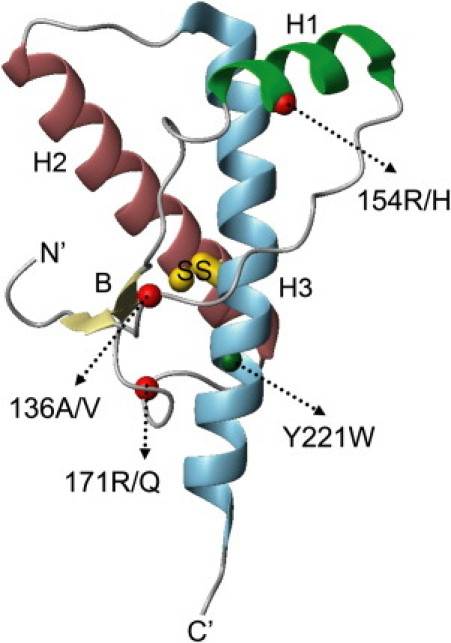
Ribbon representation of the structure of ovPrP (residue 126–233), based on a crystal structure (pdb ID 1UW3 (11)). The structure comprises three α-helices (H1–H3), a short antiparallel β-sheet (B), and a disulfide bridge (SS) linking H2 and H3. The residues involved in genetic modulation in sheep scrapie and the engineered fluorescence probe (Trp-221) are labeled.
Figure 2
Figure 2
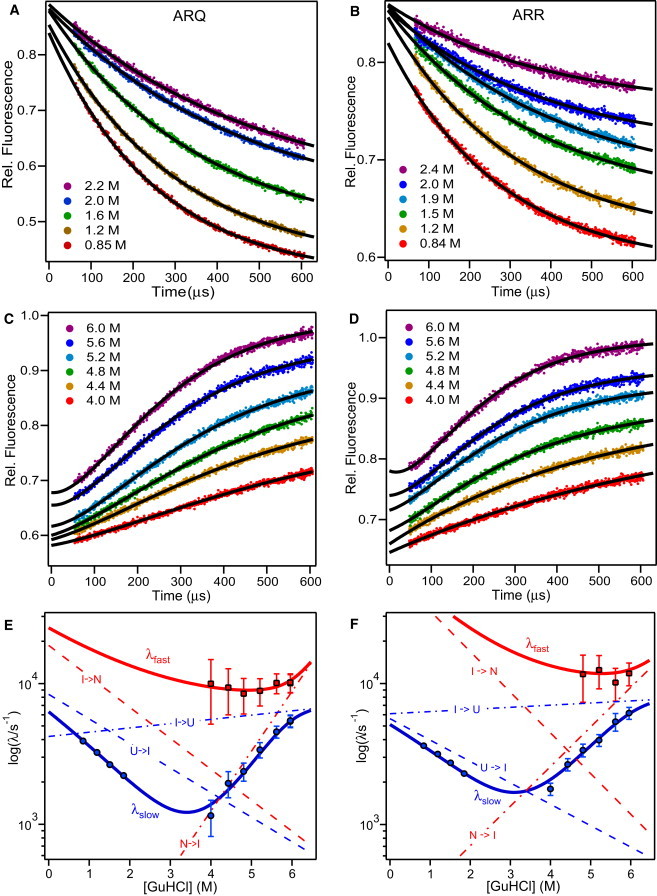
Continuous-flow fluorescence analysis of the kinetic mechanism of folding/unfolding of ovPrP variants ARQ (left panels) and ARR (right panels). The kinetics of folding (A and B) and unfolding (C and D) was measured in the presence of various concentrations of GuHCl at pH 7, 15°C. Refolding (resp. unfolding) traces were initially normalized relative to the fluorescence profiles of the unfolded protein in 5 M GuHCl (resp. native protein in 1.8 M GuHCl). Unfolding traces were then divided by the average signal of the unfolded protein in 5 M GuHCl. Solid lines were obtained by nonlinear least-squares fitting of individual traces, using a single exponential for all experiments up to 4.4 M GuHCl and a sum of two exponentials for unfolding experiments at 4.8 M GuHCl and above. In panels E and F, the logarithm of the observable rate constants are plotted versus GuHCl concentrations. Solid lines in panels E and F represent the two observable rates of folding/unfolding predicted by global analysis of the kinetic data for each variant using a sequential three-state mechanism (UIN), and dashed lines indicate the corresponding elementary rate constants.
Figure 3
Figure 3
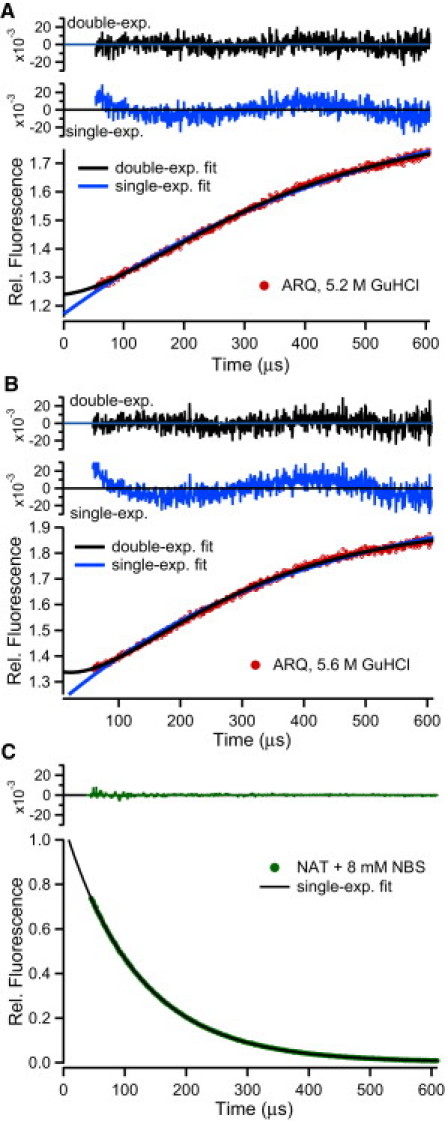
Representative continuous-flow traces illustrating the complex kinetics of unfolding. Solid circles (red) show the time course of unfolding for the ARQ variant at 5.2 M GuHCl (A) and 5.6 M GuHCl (B). Solid lines indicate single- and double-exponential fits and the corresponding residuals (upper: double-exp.; lower: single-exp.). For comparison, panel C shows a representative trace for pseudo first-order (exponential) test reaction in which NAT was mixed with 8 mM NBS under solvent conditions matching those of the protein unfolding experiment in 5.6 M GuHCl (see text and Fig. S2). All residuals are plotted on the same scale (±0.02) to allow direct comparison of the quality of single- versus double-exponential fits.
Figure 4
Figure 4
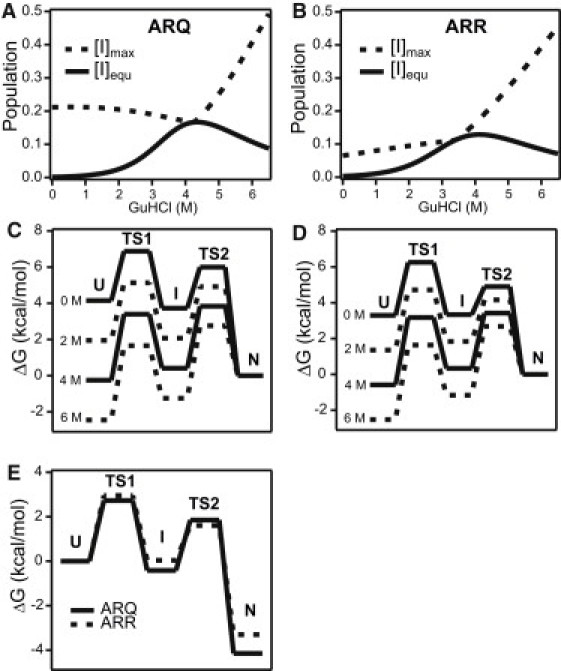
Predicted populations and free energy profiles obtained by three-state analysis of kinetic data for the ARQ (A and C) and ARR (B and D) variants of ovPrP. In panels A and B, the elementary rate constants in Table 1 were used to compute the equilibrium population (solid lines) and maximum level of transient accumulation of the I-state on a 100-μs time (dashed lines). The free energy profiles in panels C and D were calculated using the Arrhenius relationship, assuming a preexponential factor of 1 × 106 s−1. Panel E compares the free energy profiles for three-state folding of the ARQ (solid) and ARR (dashed) variants in the absence of denaturant.

References

    1. Prusiner S.B. Prions. Proc. Natl. Acad. Sci. USA. 1998;95:13363–13383. - PMC - PubMed
    1. Prusiner S.B. Novel proteinaceous infectious particles cause scrapie. Science. 1982;216:136–144. - PubMed
    1. Griffith J.S. Self-replication and scrapie. Nature. 1967;215:1043–1044. - PubMed
    1. Aguzzi A., Calella A.M. Prions: protein aggregation and infectious diseases. Physiol. Rev. 2009;89:1105–1152. - PubMed
    1. Brown D.R., Qin K., Kretzschmar H. The cellular prion protein binds copper in vivo. Nature. 1997;390:684–687. - PubMed

Publication types