


Dose escalation for prostate cancer radiotherapy: predictors of long-term biochemical tumor control and distant metastases-free survival outcomes
- PMID: 21889832
- PMCID: PMC4037155
- DOI: 10.1016/j.eururo.2011.08.029
Dose escalation for prostate cancer radiotherapy: predictors of long-term biochemical tumor control and distant metastases-free survival outcomes
Abstract
Background: Higher radiation dose levels have been shown to be associated with improved tumor-control outcomes in localized prostate cancer (PCa) patients.
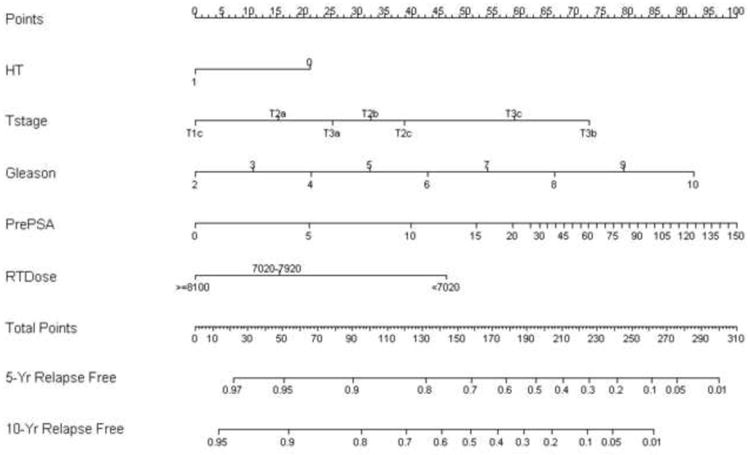
Objective: Identify predictors of biochemical tumor control and distant metastases-free survival (DMFS) outcomes for patients with clinically localized PCa treated with conformal external-beam radiotherapy (RT) as well as present an updated nomogram predicting long-term biochemical tumor control after RT.
Design, setting, and participants: This retrospective analysis comprised 2551 patients with clinical stages T1-T3 PCa. Median follow-up was 8 yr, extending >20 yr.
Intervention: Prescription doses ranged from 64.8 to 86.4 Gy. A total of 1249 patients (49%) were treated with neoadjuvant and concurrent androgen-deprivation therapy (ADT); median duration of ADT was 6 mo.
Measurements: A proportional hazards regression model predicting the probability of biochemical relapse and distant metastases after RT included pretreatment prostate-specific antigen (PSA) level, clinical stage, biopsy Gleason sum, ADT use, and radiation dose. A nomogram predicting the probability of biochemical relapse after RT was developed.
Results and limitations: Radiation dose was one of the important predictors of long-term biochemical tumor control. Dose levels < 70.2 Gy and 70.2-79.2 Gy were associated with 2.3- and 1.3-fold increased risks of PSA relapse compared with higher doses. Improved PSA relapse-free survival (PSA-RFS) outcomes with higher doses were observed for all risk groups. Use of ADT, especially for intermediate- and high-risk patients, was associated with significantly improved biochemical tumor-control outcomes. A nomogram predicting PSA-RFS was generated and was associated with a concordance index of 0.67. T stage, Gleason score, pretreatment PSA, ADT use, and higher radiation doses were also noted to be significant predictors of improved DMFS outcomes.
Conclusions: Higher radiation dose levels were consistently associated with improved biochemical control outcomes and reduction in distant metastases. The use of short-course ADT in conjunction with RT improved long-term PSA-RFS and DMFS in intermediate- and high-risk patients; however, an overall survival advantage was not observed.
Copyright © 2011 European Association of Urology. Published by Elsevier B.V. All rights reserved.
Figures



Comment in
-
Intermediate- and high-risk prostate cancer: a plea for high-dose, high-precision intensity-modulated radiotherapy with a modulated duration of androgen deprivation therapy.Eur Urol. 2011 Dec;60(6):1140-1. doi: 10.1016/j.eururo.2011.09.006. Epub 2011 Sep 15. Eur Urol. 2011. PMID: 21944436 No abstract available.
References
-
- Pollack A, Zagars GK, Starkschall G, et al. Prostate cancer radiation dose response: results of the M. D. Anderson phase III randomized trial. Int J Radiat Oncol Biol Phys. 2002;53:1097–105. - PubMed
-
- Zietman AL, Bae K, Slater JD, et al. Randomized trial comparing conventional-dose with high-dose conformal radiation therapy in early-stage adenocarcinoma of the prostate: long-term results from Proton Radiation Oncology Group/American College of Radiology 95–09. J Clin Oncol. 2010;28:1106–11. - PMC - PubMed
-
- Peeters ST, Heemsbergen WD, Koper PC, et al. Dose-response in radiotherapy for localized prostate cancer: results of the Dutch multicenter randomized phase III trial comparing 68 Gy of radiotherapy with 78 Gy. J Clin Oncol. 2006;24:1990–6. - PubMed
-
- Dearnaley DP, Sydes MR, Graham JD, et al. Escalated-dose versus standard-dose conformal radiotherapy in prostate cancer: first results from the MRC RT01 randomised controlled trial. Lancet Oncol. 2007;8:475–87. - PubMed
-
- Kuban DA, Levy LB, Cheung MR, et al. Long-term failure patterns and survival in a randomized dose-escalation trial for prostate cancer: who dies of disease? Int J Radiat Oncol Biol Phys. 2011;79:1310–7. - PubMed
MeSH terms
Substances
Grants and funding
LinkOut - more resources
Full Text Sources
Medical
Research Materials
Miscellaneous
